Question:medium
If \(X=\dfrac{a}{1+r}+\dfrac{a}{(1+r)^2}+\cdots+\dfrac{a}{(1+r)^n}\), then what is the value of \(a+a(1+r)+a(1+r)^2+\cdots+a(1+r)^{n-1}\)?
If \(X=\dfrac{a}{1+r}+\dfrac{a}{(1+r)^2}+\cdots+\dfrac{a}{(1+r)^n}\), then what is the value of \(a+a(1+r)+a(1+r)^2+\cdots+a(1+r)^{n-1}\)?
Show Hint
Multiply X by \((1+r)^n\) and notice each term's power of \((1+r)\) shifts to match the terms of the target series exactly.
Updated On: Jul 13, 2026
- \(X\left[(1+r)+(1+r)^2+\cdots+(1+r)^n\right]\)
- \(X(1+r)^n\)
- \(X\cdot\dfrac{(1+r)^n-1}{r}\)
- \(X(1+r)^{n-1}\)
Show Solution
The Correct Option is B
Solution and Explanation
Step 1: Write out X term by term.
\[ X=\frac{a}{1+r}+\frac{a}{(1+r)^2}+\cdots+\frac{a}{(1+r)^n} \]
We want $Y=a+a(1+r)+a(1+r)^2+\cdots+a(1+r)^{n-1}$, and notice both series use the same building block $a(1+r)^k$, just with different (and opposite-signed) powers of $(1+r)$.
Step 2: Multiply every term of X by $(1+r)^n$.
Multiplying each term of $X$ by $(1+r)^n$ shifts each power of $(1+r)$ up by $n$:
\[ (1+r)^n\cdot X=(1+r)^n\cdot\frac{a}{1+r}+(1+r)^n\cdot\frac{a}{(1+r)^2}+\cdots+(1+r)^n\cdot\frac{a}{(1+r)^n} \]
\[ =a(1+r)^{n-1}+a(1+r)^{n-2}+\cdots+a(1+r)^{1}+a(1+r)^{0} \]
Step 3: Recognize this as Y, just written in reverse order.
The terms $a(1+r)^{n-1}+a(1+r)^{n-2}+\cdots+a(1+r)+a$ are exactly the same terms as $Y=a+a(1+r)+\cdots+a(1+r)^{n-1}$, only listed from the highest power down to the lowest instead of the lowest up to the highest.
Addition does not care about the order of the terms, so this sum equals $Y$.
Step 4: State the result.
\[ (1+r)^n\cdot X=Y \]
So $Y=X(1+r)^n$, obtained here purely by shifting powers, without ever writing down the closed-form geometric series formula.
Step 5: Quick check.
With $a=1,r=1,n=2$: $X=0.75$, and $(1+r)^n\cdot X=4\times0.75=3$, matching $Y=1+2=3$ directly.
Final Answer:
$Y=X(1+r)^n$, option (B).
$\boxed{X(1+r)^n}$
\[ X=\frac{a}{1+r}+\frac{a}{(1+r)^2}+\cdots+\frac{a}{(1+r)^n} \]
We want $Y=a+a(1+r)+a(1+r)^2+\cdots+a(1+r)^{n-1}$, and notice both series use the same building block $a(1+r)^k$, just with different (and opposite-signed) powers of $(1+r)$.
Step 2: Multiply every term of X by $(1+r)^n$.
Multiplying each term of $X$ by $(1+r)^n$ shifts each power of $(1+r)$ up by $n$:
\[ (1+r)^n\cdot X=(1+r)^n\cdot\frac{a}{1+r}+(1+r)^n\cdot\frac{a}{(1+r)^2}+\cdots+(1+r)^n\cdot\frac{a}{(1+r)^n} \]
\[ =a(1+r)^{n-1}+a(1+r)^{n-2}+\cdots+a(1+r)^{1}+a(1+r)^{0} \]
Step 3: Recognize this as Y, just written in reverse order.
The terms $a(1+r)^{n-1}+a(1+r)^{n-2}+\cdots+a(1+r)+a$ are exactly the same terms as $Y=a+a(1+r)+\cdots+a(1+r)^{n-1}$, only listed from the highest power down to the lowest instead of the lowest up to the highest.
Addition does not care about the order of the terms, so this sum equals $Y$.
Step 4: State the result.
\[ (1+r)^n\cdot X=Y \]
So $Y=X(1+r)^n$, obtained here purely by shifting powers, without ever writing down the closed-form geometric series formula.
Step 5: Quick check.
With $a=1,r=1,n=2$: $X=0.75$, and $(1+r)^n\cdot X=4\times0.75=3$, matching $Y=1+2=3$ directly.
Final Answer:
$Y=X(1+r)^n$, option (B).
$\boxed{X(1+r)^n}$
Was this answer helpful?
0
Top Questions on Geometric Progression
If \( A = \begin{bmatrix} 1 & 0 \\ 1/2 & 1 \end{bmatrix} \), then \( A^{50} \) is:
- MHT CET - 2024
- Mathematics
- Geometric Progression
The range of the function \( f(x) = \sin^{-1}(x - \sqrt{x}) \) is equal to?
- MHT CET - 2024
- Mathematics
- Geometric Progression
The function \( f(x) = \tan^{-1} (\sin x + \cos x) \) is an increasing function in:
- MHT CET - 2024
- Mathematics
- Geometric Progression
- Let \( \vec{a} = \hat{i} + 2\hat{j} + \hat{k}, \, \vec{b} = \hat{i} - \hat{j} + \hat{k}, \, \text{and} \, \vec{c} = \hat{i} + \hat{j} - \hat{k} \). A vector in the plane of \( \vec{a} \) and \( \vec{b} \) whose projection on \( \vec{c} \) is \( \frac{1}{\sqrt{3}} \), is:
- MHT CET - 2024
- Mathematics
- Geometric Progression
- Want to practice more? Try solving extra ecology questions todayView All Questions
Questions Asked in XAT exam
Applicants have been shortlisted for interviews for some data analyst positions. Some of the applicants have advanced expertise in one or more fields among the following: data analysis, database handling and coding. The numbers of applicants with different advanced expertise are given in the 2 × 8 table below.
The number of applicants with advanced expertise in all three fields is given as x in the table, where x is a non-negative integer.
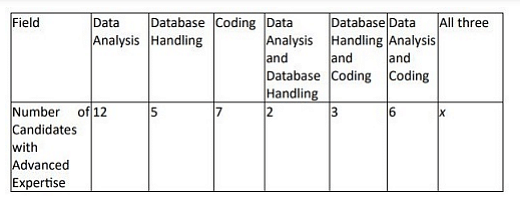
The number of applicants with advanced expertise in all three fields is given as x in the table, where x is a non-negative integer.
- XAT - 2024
- Data Interpretation