Question:medium
If \(x > 8\) and \(y > -4\), then which one of the following is always true?
If \(x > 8\) and \(y > -4\), then which one of the following is always true?
Show Hint
Turn the two given conditions into -x less than -8 and 2y more than -8, then chain them to see which option they force to be true.
Updated On: Jul 13, 2026
- \(xy < 0\)
- \(x^2 < -y\)
- \(-x < 2y\)
- \(x > y\)
Show Solution
The Correct Option is C
Solution and Explanation
Step 1: Picture the conditions on a number line.
x is any number strictly to the right of 8, so x can be 8.0001, 100, or a million. y is any number strictly to the right of -4, so y can be -3.999, 0, or a million as well. Since neither variable has an upper bound, any option involving a fixed relationship between the sizes of x and y needs to be checked at extreme values, not just typical ones.
Step 2: Break options (A) and (D) using large values.
For (A), $xy < 0$ needs one of x, y to be negative. But x is always positive here (since $x > 8 > 0$), and y is free to be positive too (say y = 1), which makes xy positive. So (A) fails for that choice.
For (D), $x > y$ needs y to stay smaller than x always. But since y has no upper limit, picking y = 1,000,000 with x = 9 breaks $x > y$ right away.
Step 3: Break option (B) using the lower bounds.
The smallest $x^2$ can get close to is $8^2 = 64$ (approached but never reached, since x is strictly greater than 8), and the largest $-y$ can get close to is $4$ (as y approaches $-4$ from above). Since $x^2$ is always above 64 and $-y$ is always below 4, the required inequality $x^2 < -y$ can never be satisfied.
Step 4: Confirm option (C) using the extreme boundary values.
Push x to its smallest allowed value, just above 8, and y to its smallest allowed value, just above -4. Even in this tightest case, $-x$ sits just below $-8$, and $2y$ sits just above $-8$, keeping $-x < 2y$ true.
Now push x and y to be very large instead: $-x$ becomes a huge negative number, while $2y$ becomes a huge positive number, so $-x < 2y$ is even more clearly true.
Since the inequality survives both the tightest boundary case and the most extreme case, it holds everywhere in between as well.
Step 5: Conclude.
Only $-x < 2y$, option (C), survives every test, so it is the one that is always true.
\[ \boxed{-x < 2y \text{ is always true}} \]
x is any number strictly to the right of 8, so x can be 8.0001, 100, or a million. y is any number strictly to the right of -4, so y can be -3.999, 0, or a million as well. Since neither variable has an upper bound, any option involving a fixed relationship between the sizes of x and y needs to be checked at extreme values, not just typical ones.
Step 2: Break options (A) and (D) using large values.
For (A), $xy < 0$ needs one of x, y to be negative. But x is always positive here (since $x > 8 > 0$), and y is free to be positive too (say y = 1), which makes xy positive. So (A) fails for that choice.
For (D), $x > y$ needs y to stay smaller than x always. But since y has no upper limit, picking y = 1,000,000 with x = 9 breaks $x > y$ right away.
Step 3: Break option (B) using the lower bounds.
The smallest $x^2$ can get close to is $8^2 = 64$ (approached but never reached, since x is strictly greater than 8), and the largest $-y$ can get close to is $4$ (as y approaches $-4$ from above). Since $x^2$ is always above 64 and $-y$ is always below 4, the required inequality $x^2 < -y$ can never be satisfied.
Step 4: Confirm option (C) using the extreme boundary values.
Push x to its smallest allowed value, just above 8, and y to its smallest allowed value, just above -4. Even in this tightest case, $-x$ sits just below $-8$, and $2y$ sits just above $-8$, keeping $-x < 2y$ true.
Now push x and y to be very large instead: $-x$ becomes a huge negative number, while $2y$ becomes a huge positive number, so $-x < 2y$ is even more clearly true.
Since the inequality survives both the tightest boundary case and the most extreme case, it holds everywhere in between as well.
Step 5: Conclude.
Only $-x < 2y$, option (C), survives every test, so it is the one that is always true.
\[ \boxed{-x < 2y \text{ is always true}} \]
Was this answer helpful?
0
Top Questions on inequalities
- Solve the inequality: \( \log_2(x^2 - 5x + 6) >1 \)
- BITSAT - 2025
- Mathematics
- inequalities
- let \(S\) be the set of positive integral values of a for which \(\frac {ax^2+2(a+1)x+9a+4}{x^2+8x+32}< 0,\) \(∀x∈R\). Then, the number of elements in \(S\) is
- JEE Main - 2024
- Mathematics
- inequalities
- IQ of a person is given by the formula \(IQ = \frac{MA}{CA}×100, \) Where MA is mental age and CA is chronological age. If 80 ≤ IQ ≤ 140 for a group of 12 years old children, find the range of their mental age.
- CBSE Class XI
- Mathematics
- inequalities
- How many litres of water will have to be added to 1125 litres of the 45% solution of acid so that the resulting mixture will contain more than 25% but less than 30% acid content?
- CBSE Class XI
- Mathematics
- inequalities
- Want to practice more? Try solving extra ecology questions todayView All Questions
Questions Asked in XAT exam
Applicants have been shortlisted for interviews for some data analyst positions. Some of the applicants have advanced expertise in one or more fields among the following: data analysis, database handling and coding. The numbers of applicants with different advanced expertise are given in the 2 × 8 table below.
The number of applicants with advanced expertise in all three fields is given as x in the table, where x is a non-negative integer.
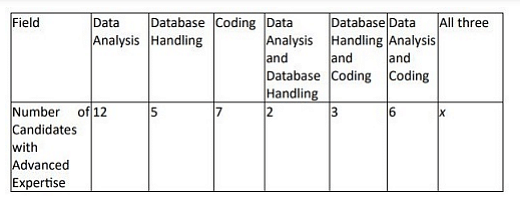
The number of applicants with advanced expertise in all three fields is given as x in the table, where x is a non-negative integer.
- XAT - 2024
- Data Interpretation