Question:medium
If the polynomial \(x^3 + px + q\) has three distinct roots, then which of the following is a possible value of \(p\)?
If the polynomial \(x^3 + px + q\) has three distinct roots, then which of the following is a possible value of \(p\)?
Show Hint
Check the derivative 3x^2+p; a non-negative p makes the cubic monotonic, so it can cross zero only once.
Updated On: Jul 13, 2026
- -1
- 0
- 1
- 2
Show Solution
The Correct Option is A
Solution and Explanation
Step 1: Use the discriminant of a depressed cubic.
For a cubic of the form \(x^3+px+q\), the discriminant is
\[ \Delta = -4p^3 - 27q^2 \]
The cubic has three distinct real roots exactly when \(\Delta > 0\).
Step 2: See what this needs from p.
Since \(q^2 \geq 0\), the term \(-27q^2 \leq 0\) always.
For \(\Delta = -4p^3-27q^2\) to be positive for some choice of \(q\), we at least need \(-4p^3>0\), that is \(p^3<0\), that is \(p<0\).
So a negative \(p\) is required before three distinct real roots are even possible; the best choice for \(q\) is \(q=0\), which removes the \(-27q^2\) term entirely.
Step 3: Test p = -1 directly in the discriminant.
With \(p=-1, q=0\):
\[ \Delta = -4(-1)^3 - 27(0)^2 = 4 - 0 = 4 > 0 \]
Since \(\Delta>0\), the cubic \(x^3-x\) has three distinct real roots, matching \(p=-1\).
Step 4: Test the other options.
For \(p=0,1,2\), all at least 0, \(-4p^3 \leq 0\), and adding \(-27q^2 \leq 0\) can only make \(\Delta\) smaller. So \(\Delta \leq 0\) for every choice of \(q\), meaning these values of \(p\) can never give three distinct real roots.
For example, with \(p=0\) the cubic is \(x^3+q\), which always has exactly one real root, since \(x=\sqrt[3]{-q}\) is the only real solution and the other two roots are complex. With \(p=1\) or \(p=2\), the discriminant \(-4p^3-27q^2\) is always negative once \(q\) is any real number, since \(-4p^3\) is already negative and \(-27q^2\) can only push it further down, so \(\Delta\) is never positive.
Step 5: Why this matches the graph picture too.
The discriminant test agrees with looking at the derivative \(3x^2+p\): whenever \(p\geq 0\) the slope of the cubic never turns negative, so the curve is always rising and can only touch the x-axis once. Only a negative \(p\) creates a hump and a dip, allowing three crossings, which is exactly the same conclusion the discriminant formula gives.
Final Answer:
Only \(p=-1\) makes \(\Delta>0\) achievable, so it is the possible value.
\[ \boxed{p=-1} \]
For a cubic of the form \(x^3+px+q\), the discriminant is
\[ \Delta = -4p^3 - 27q^2 \]
The cubic has three distinct real roots exactly when \(\Delta > 0\).
Step 2: See what this needs from p.
Since \(q^2 \geq 0\), the term \(-27q^2 \leq 0\) always.
For \(\Delta = -4p^3-27q^2\) to be positive for some choice of \(q\), we at least need \(-4p^3>0\), that is \(p^3<0\), that is \(p<0\).
So a negative \(p\) is required before three distinct real roots are even possible; the best choice for \(q\) is \(q=0\), which removes the \(-27q^2\) term entirely.
Step 3: Test p = -1 directly in the discriminant.
With \(p=-1, q=0\):
\[ \Delta = -4(-1)^3 - 27(0)^2 = 4 - 0 = 4 > 0 \]
Since \(\Delta>0\), the cubic \(x^3-x\) has three distinct real roots, matching \(p=-1\).
Step 4: Test the other options.
For \(p=0,1,2\), all at least 0, \(-4p^3 \leq 0\), and adding \(-27q^2 \leq 0\) can only make \(\Delta\) smaller. So \(\Delta \leq 0\) for every choice of \(q\), meaning these values of \(p\) can never give three distinct real roots.
For example, with \(p=0\) the cubic is \(x^3+q\), which always has exactly one real root, since \(x=\sqrt[3]{-q}\) is the only real solution and the other two roots are complex. With \(p=1\) or \(p=2\), the discriminant \(-4p^3-27q^2\) is always negative once \(q\) is any real number, since \(-4p^3\) is already negative and \(-27q^2\) can only push it further down, so \(\Delta\) is never positive.
Step 5: Why this matches the graph picture too.
The discriminant test agrees with looking at the derivative \(3x^2+p\): whenever \(p\geq 0\) the slope of the cubic never turns negative, so the curve is always rising and can only touch the x-axis once. Only a negative \(p\) creates a hump and a dip, allowing three crossings, which is exactly the same conclusion the discriminant formula gives.
Final Answer:
Only \(p=-1\) makes \(\Delta>0\) achievable, so it is the possible value.
\[ \boxed{p=-1} \]
Was this answer helpful?
0
Top Questions on Algebra
- Let \( n(A) = m \) and \( n(B) = n \), if the number of subsets of \( A \) is 56 more than that of subsets of \( B \), then \( m + n \) is equal to:
- VITEEE - 2024
- Mathematics
- Algebra
- Solve the quadratic equation: \[ x^2 - 5x + 6 = 0 \]
- VITEEE - 2025
- Mathematics
- Algebra
- Find the value of \( x \) in the following equation: \[ \frac{2}{x} + \frac{3}{x + 1} = 1 \]
- VITEEE - 2025
- Mathematics
- Algebra
- Find the value of \( x \) in the equation \( 2x + 3 = 7x - 8 \).
- VITEEE - 2025
- Mathematics
- Algebra
- Want to practice more? Try solving extra ecology questions todayView All Questions
Questions Asked in XAT exam
Applicants have been shortlisted for interviews for some data analyst positions. Some of the applicants have advanced expertise in one or more fields among the following: data analysis, database handling and coding. The numbers of applicants with different advanced expertise are given in the 2 × 8 table below.
The number of applicants with advanced expertise in all three fields is given as x in the table, where x is a non-negative integer.
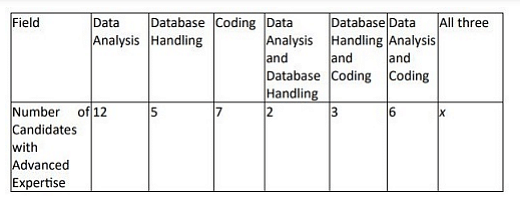
The number of applicants with advanced expertise in all three fields is given as x in the table, where x is a non-negative integer.
- XAT - 2024
- Data Interpretation