Question:medium
If \(F(x, n)\) denotes the number of ways of distributing \(x\) toys to \(n\) children so that each child gets at most 2 toys, then what is the value of \(F(4, 3)\)?
If \(F(x, n)\) denotes the number of ways of distributing \(x\) toys to \(n\) children so that each child gets at most 2 toys, then what is the value of \(F(4, 3)\)?
Show Hint
Split the 4 toys into groups no bigger than 2 per child, then count how many ways each group-shape can be handed to 3 different children.
Updated On: Jul 10, 2026
- 2
- 3
- 4
- 6
Show Solution
The Correct Option is D
Solution and Explanation
Step 1: Count all ways with no upper limit.
First ignore the "at most 2" rule. Distributing 4 identical toys among 3 children with no limit is a standard stars-and-bars count: the number of ways equals $\binom{4 + 3 - 1}{3 - 1} = \binom{6}{2} = 15$.
Step 2: Subtract the cases that break the "at most 2" rule.
A case breaks the rule if some child gets 3 or 4 toys. Let $A_i$ be the event that child $i$ gets at least 3 toys. If child $i$ gets at least 3, give that child 3 toys first, leaving only 1 toy to distribute freely among the 3 children: that is $\binom{1 + 3 - 1}{3 - 1} = \binom{3}{2} = 3$ ways. Since there are 3 children, the total count over all $A_i$ (allowing overlap) is $3 \times 3 = 9$.
Step 3: Check for double-counted cases.
Could two children each get 3 or more toys at once? That would need at least $3 + 3 = 6$ toys, but we only have 4, so no such case exists. There is nothing to add back, so the number of "bad" distributions is exactly $9$.
Step 4: Subtract to get the valid count.
Valid distributions $= 15 - 9 = 6$.
This matches the case-by-case count of the two shapes $(2,2,0)$ and $(2,1,1)$, confirming the answer through a completely different counting route.
Final Answer:
$F(4, 3) = 6$
\[ \boxed{6} \]
First ignore the "at most 2" rule. Distributing 4 identical toys among 3 children with no limit is a standard stars-and-bars count: the number of ways equals $\binom{4 + 3 - 1}{3 - 1} = \binom{6}{2} = 15$.
Step 2: Subtract the cases that break the "at most 2" rule.
A case breaks the rule if some child gets 3 or 4 toys. Let $A_i$ be the event that child $i$ gets at least 3 toys. If child $i$ gets at least 3, give that child 3 toys first, leaving only 1 toy to distribute freely among the 3 children: that is $\binom{1 + 3 - 1}{3 - 1} = \binom{3}{2} = 3$ ways. Since there are 3 children, the total count over all $A_i$ (allowing overlap) is $3 \times 3 = 9$.
Step 3: Check for double-counted cases.
Could two children each get 3 or more toys at once? That would need at least $3 + 3 = 6$ toys, but we only have 4, so no such case exists. There is nothing to add back, so the number of "bad" distributions is exactly $9$.
Step 4: Subtract to get the valid count.
Valid distributions $= 15 - 9 = 6$.
This matches the case-by-case count of the two shapes $(2,2,0)$ and $(2,1,1)$, confirming the answer through a completely different counting route.
Final Answer:
$F(4, 3) = 6$
\[ \boxed{6} \]
Was this answer helpful?
0
Top Questions on permutations and combinations
- There are 6 boys and 4 girls. Arrange their seating arrangement on a round table such that 2 boys and 1 girl can't sit together.
- MHT CET - 2025
- Mathematics
- permutations and combinations
- How many different 4-letter words can be formed from the letters of the word "BINARY" without repetition?
- BITSAT - 2025
- Mathematics
- permutations and combinations
- A local restaurant has 16 vegetarian items and 9 non-vegetarian items in their menu. Some items contain gluten, while the rest are gluten-free.
One evening, Rohit and his friends went to the restaurant. They planned to choose two different vegetarian items and three different non-vegetarian items from the entire menu. Later, Bela and her friends also went to the same restaurant: they planned to choose two different vegetarian items and one non-vegetarian item only from the gluten-free options. The number of item combinations that Rohit and his friends could choose from, given their plan, was 12 times the number of item combinations that Bela and her friends could choose from, given their plan.
How many menu items contain gluten?- XAT - 2024
- Quantitative Ability and Data Interpretation
- permutations and combinations
- Five people are distributed in four identical rooms. A room can also contain zero people. Find the number of ways to distribute them.
- JEE Main - 2024
- Mathematics
- permutations and combinations
- Want to practice more? Try solving extra ecology questions todayView All Questions
Questions Asked in XAT exam
Applicants have been shortlisted for interviews for some data analyst positions. Some of the applicants have advanced expertise in one or more fields among the following: data analysis, database handling and coding. The numbers of applicants with different advanced expertise are given in the 2 × 8 table below.
The number of applicants with advanced expertise in all three fields is given as x in the table, where x is a non-negative integer.
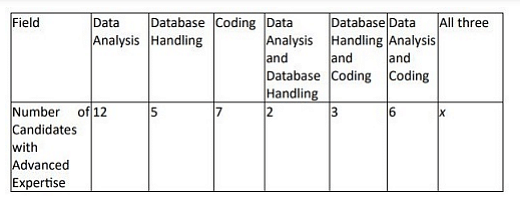
The number of applicants with advanced expertise in all three fields is given as x in the table, where x is a non-negative integer.
- XAT - 2024
- Data Interpretation