Question:hard
If \(\dfrac{a-b}{a+b} = \dfrac{(a-b)^3}{(a+b)^3}\), what set(s) of \(a\) and \(b\) is/are correct?
A. \(S_1 = \{a = \text{any real value}, b = 0\}\)
B. \(S_2 = \{a = 0, b = \text{any real value}\}\)
C. \(S_3 = \{a = 0, b = 0\}\)
If \(\dfrac{a-b}{a+b} = \dfrac{(a-b)^3}{(a+b)^3}\), what set(s) of \(a\) and \(b\) is/are correct?
A. \(S_1 = \{a = \text{any real value}, b = 0\}\)
B. \(S_2 = \{a = 0, b = \text{any real value}\}\)
C. \(S_3 = \{a = 0, b = 0\}\)
A. \(S_1 = \{a = \text{any real value}, b = 0\}\)
B. \(S_2 = \{a = 0, b = \text{any real value}\}\)
C. \(S_3 = \{a = 0, b = 0\}\)
Show Hint
Cross multiply and factor out (a-b)(a+b); the equation reduces to (a-b)(a+b)(4ab) = 0, so it holds whenever exactly one of a or b is zero, but not when both are zero at once, since that makes the original fraction 0/0.
Updated On: Jul 13, 2026
- Only A
- Only B
- Only A and B
- All A, B and C
Show Solution
The Correct Option is C
Solution and Explanation
Instead of factoring the general equation, we can test each set with real numbers and see which ones actually make \(\dfrac{a-b}{a+b}\) equal to \(\dfrac{(a-b)^3}{(a+b)^3}\).
- Set S1 (a = any real value, b = 0): try a = 5, b = 0. Left side: \(\dfrac{5-0}{5+0} = 1\). Right side: \(\dfrac{5^3}{5^3} = 1\). Both sides equal 1, so this set satisfies the equation for any nonzero a.
- Set S2 (a = 0, b = any real value): try a = 0, b = 5. Left side: \(\dfrac{0-5}{0+5} = -1\). Right side: \(\dfrac{(-5)^3}{5^3} = \dfrac{-125}{125} = -1\). Both sides equal -1, so this set also works for any nonzero b.
- Set S3 (a = 0, b = 0): here both the top and bottom of the original fraction become 0, since a - b = 0 and a + b = 0. A fraction with a zero denominator has no value, so the equation cannot hold. This set fails.
So testing confirms that S1 and S2 always give matching, well defined values on both sides, while S3 breaks the expression before we can even compare the two sides.
Let's summarize:
- Whenever exactly one of a, b is zero and the other is not, both sides of the equation reduce to the same value, either 1 or -1.
- When both a and b are zero together, the expression is undefined, so that case cannot be called a solution.
The correct choice is Only A and B.
Was this answer helpful?
0
Top Questions on Algebra
- Let \( n(A) = m \) and \( n(B) = n \), if the number of subsets of \( A \) is 56 more than that of subsets of \( B \), then \( m + n \) is equal to:
- VITEEE - 2024
- Mathematics
- Algebra
- Solve the quadratic equation: \[ x^2 - 5x + 6 = 0 \]
- VITEEE - 2025
- Mathematics
- Algebra
- Find the value of \( x \) in the following equation: \[ \frac{2}{x} + \frac{3}{x + 1} = 1 \]
- VITEEE - 2025
- Mathematics
- Algebra
- Find the value of \( x \) in the equation \( 2x + 3 = 7x - 8 \).
- VITEEE - 2025
- Mathematics
- Algebra
- Want to practice more? Try solving extra ecology questions todayView All Questions
Questions Asked in XAT exam
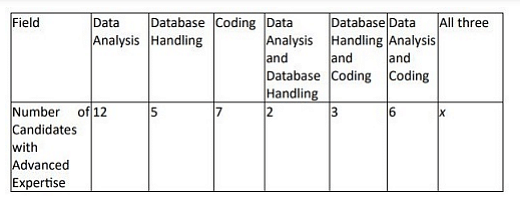
Applicants have been shortlisted for interviews for some data analyst positions. Some of the applicants have advanced expertise in one or more fields among the following: data analysis, database handling and coding. The numbers of applicants with different advanced expertise are given in the 2 × 8 table below.
The number of applicants with advanced expertise in all three fields is given as x in the table, where x is a non-negative integer.
The number of applicants with advanced expertise in all three fields is given as x in the table, where x is a non-negative integer.
- XAT - 2024
- Data Interpretation