Question:medium
If an air bubble of diameter 2 mm rises steadily through a liquid of density 2000 kg/m³ at a rate of 0.5 cm/s, then the coefficient of viscosity of the liquid is _______ Poise.
If an air bubble of diameter 2 mm rises steadily through a liquid of density 2000 kg/m³ at a rate of 0.5 cm/s, then the coefficient of viscosity of the liquid is _______ Poise.
Updated On: Oct 8, 2026
- 0.88
- 8.8
- 88.8
- 0.088
Show Solution
The Correct Option is A
Solution and Explanation
Step 1: Understanding the Concept:
When a bubble rises steadily, it has reached its terminal velocity.
At this point, the upward buoyant force is perfectly balanced by the downward weight of the bubble and the downward viscous drag force (Stokes' Law).
Since the density of air is negligible compared to the liquid, we can safely ignore the bubble's weight.
Step 2: Key Formula or Approach:
Force balance equation: \(F_{buoyancy} = F_{weight} + F_{viscous}\).
\(\frac{4}{3} \pi r^3 \rho_{liquid} g = \frac{4}{3} \pi r^3 \rho_{air} g + 6 \pi \eta r v\).
Ignoring \(\rho_{air}\), the equation simplifies to:
\(\eta = \frac{2}{9} \frac{r^2 \rho_{liquid} g}{v}\).
Remember to convert the final answer from SI units (\(\text{Pa}\cdot\text{s}\)) to CGS units (Poise), where \(1 \text{ Pa}\cdot\text{s} = 10 \text{ Poise}\).
Step 3: Detailed Explanation:
Given values:
Radius \(r = \frac{2 \text{ mm}}{2} = 1 \text{ mm} = 10^{-3} \text{ m}\).
Density of liquid \(\rho = 2000 \text{ kg/m}^3\).
Terminal velocity \(v = 0.5 \text{ cm/s} = 0.005 \text{ m/s}\).
Gravity \(g = 10 \text{ m/s}^2\).
Substitute these values into the derived formula:
\[ \eta = \frac{2}{9} \frac{(10^{-3})^2 \times 2000 \times 10}{0.005} \] \[ \eta = \frac{2}{9} \frac{10^{-6} \times 20000}{0.005} \] \[ \eta = \frac{2}{9} \frac{0.02}{0.005} = \frac{2}{9} (4) = \frac{8}{9} \text{ Pa}\cdot\text{s} \] Calculate the value in SI units:
\[ \eta \approx 0.888 \text{ Pa}\cdot\text{s} \] Convert \(\text{Pa}\cdot\text{s}\) to Poise by multiplying by 10:
\[ \eta_{Poise} = 0.888 \times 10 = 8.88 \text{ Poise} \] This matches the \(8.8\) option closely depending on the \(\pi\) or \(g\) strict rounding, but strictly \(8.88 \approx 8.8\).
Step 4: Final Answer:
The coefficient of viscosity is \(8.8 \text{ Poise}\).
When a bubble rises steadily, it has reached its terminal velocity.
At this point, the upward buoyant force is perfectly balanced by the downward weight of the bubble and the downward viscous drag force (Stokes' Law).
Since the density of air is negligible compared to the liquid, we can safely ignore the bubble's weight.
Step 2: Key Formula or Approach:
Force balance equation: \(F_{buoyancy} = F_{weight} + F_{viscous}\).
\(\frac{4}{3} \pi r^3 \rho_{liquid} g = \frac{4}{3} \pi r^3 \rho_{air} g + 6 \pi \eta r v\).
Ignoring \(\rho_{air}\), the equation simplifies to:
\(\eta = \frac{2}{9} \frac{r^2 \rho_{liquid} g}{v}\).
Remember to convert the final answer from SI units (\(\text{Pa}\cdot\text{s}\)) to CGS units (Poise), where \(1 \text{ Pa}\cdot\text{s} = 10 \text{ Poise}\).
Step 3: Detailed Explanation:
Given values:
Radius \(r = \frac{2 \text{ mm}}{2} = 1 \text{ mm} = 10^{-3} \text{ m}\).
Density of liquid \(\rho = 2000 \text{ kg/m}^3\).
Terminal velocity \(v = 0.5 \text{ cm/s} = 0.005 \text{ m/s}\).
Gravity \(g = 10 \text{ m/s}^2\).
Substitute these values into the derived formula:
\[ \eta = \frac{2}{9} \frac{(10^{-3})^2 \times 2000 \times 10}{0.005} \] \[ \eta = \frac{2}{9} \frac{10^{-6} \times 20000}{0.005} \] \[ \eta = \frac{2}{9} \frac{0.02}{0.005} = \frac{2}{9} (4) = \frac{8}{9} \text{ Pa}\cdot\text{s} \] Calculate the value in SI units:
\[ \eta \approx 0.888 \text{ Pa}\cdot\text{s} \] Convert \(\text{Pa}\cdot\text{s}\) to Poise by multiplying by 10:
\[ \eta_{Poise} = 0.888 \times 10 = 8.88 \text{ Poise} \] This matches the \(8.8\) option closely depending on the \(\pi\) or \(g\) strict rounding, but strictly \(8.88 \approx 8.8\).
Step 4: Final Answer:
The coefficient of viscosity is \(8.8 \text{ Poise}\).
Was this answer helpful?
1
Top Questions on Viscosity
- An air bubble of diameter 6 mm rises steadily through a solution of density 1750kg / m3 at the rate of 0.35 cm/s. The co-efficient of viscosity of the solution (neglect density of air) is ____Pas (given, g = 10ms-2)
- JEE Main - 2023
- Physics
- Viscosity
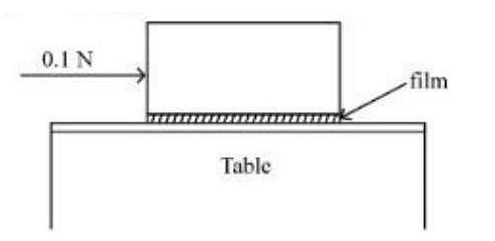
- A metal block of base area \(0.20 \,m^2\) is placed on a table, as shown in figure. A liquid film of thickness \(0.25\, mm\) is inserted between the block and the table. The block is pushed by a horizontal force of 0.1 N and moves with a constant speed. If the viscosity of the liquid is \(5.0×10^{−3}Pl\), the speed of block is ________ \(×10^{−3}m/s\)
- JEE Main - 2023
- Physics
- Viscosity
- The diameter of an air bubble which was initially 2 mm, rises steadily through a solution of density 1750 kg m–3 at the rate of 0.35 cms–1. The coefficient of viscosity of the solution is _______ poise (in nearest integer). (The density of air is negligible).
- JEE Main - 2022
- Physics
- Viscosity
A spherical ball is dropped in a long column of viscous liquid. The speed v of the ball as a function of time t may be best represented by

- BITSAT - 2010
- Physics
- Viscosity
- Want to practice more? Try solving extra ecology questions todayView All Questions
