Question:medium
An air bubble of diameter 6 mm rises steadily through a solution of density 1750kg / m3 at the rate of 0.35 cm/s. The co-efficient of viscosity of the solution (neglect density of air) is ____Pas (given, g = 10ms-2)
An air bubble of diameter 6 mm rises steadily through a solution of density 1750kg / m3 at the rate of 0.35 cm/s. The co-efficient of viscosity of the solution (neglect density of air) is ____Pas (given, g = 10ms-2)
Show Hint
Stokes’ Law relates the drag force to viscosity and terminal velocity
Updated On: Feb 20, 2026
Show Solution
Correct Answer: 10
Solution and Explanation
To find the coefficient of viscosity of the solution, we use Stokes' Law which describes the drag force experienced by a spherical object moving through a viscous fluid. The formula for terminal velocity \( v \) of a spherical object is given by:
\( v = \frac{2}{9} \cdot \frac{r^2 ( \rho - \sigma ) g}{\eta} \)
Where:
\( r \) = radius of the bubble
\( \rho \) = density of the fluid
\( \sigma \) = density of the air
\( g \) = acceleration due to gravity
\( \eta \) = coefficient of viscosity
\( v \) = terminal velocity
Given:
The diameter of the bubble: \( 6 \, \text{mm} = 0.6 \, \text{cm} = 0.006 \, \text{m} \), so \( r = 0.003 \, \text{m} \)
The density of the solution: \( \rho = 1750 \, \text{kg/m}^3 \)
Neglecting the density of air: \( \sigma \approx 0 \)
The terminal velocity: \( v = 0.35 \, \text{cm/s} = 0.0035 \, \text{m/s} \)
Gravity: \( g = 10 \, \text{m/s}^2 \)
Substituting the known values into Stokes' Law formula:
\( 0.0035 = \frac{2}{9} \cdot \frac{(0.003)^2 \cdot 1750 \cdot 10}{\eta} \)
Simplifying for \( \eta \):
\( \eta = \frac{2}{9} \cdot \frac{(0.003)^2 \cdot 1750 \cdot 10}{0.0035} \)
Calculating each component:
\( (0.003)^2 = 9 \times 10^{-6} \, \text{m}^2 \)
\( 9 \times 10^{-6} \times 1750 \times 10 = 0.1575 \, \text{kg/m/s} \)
Plugging it back:
\( \eta = \frac{2 \times 0.1575}{9 \times 0.0035} \)
\( \eta = 0.01 \, \text{Pas} \)
The coefficient of viscosity of the solution is \( \eta = 0.01 \, \text{Pas} \), within the expected range of \( 10^{-2} \, \text{Pas} \).
\( v = \frac{2}{9} \cdot \frac{r^2 ( \rho - \sigma ) g}{\eta} \)
Where:
\( r \) = radius of the bubble
\( \rho \) = density of the fluid
\( \sigma \) = density of the air
\( g \) = acceleration due to gravity
\( \eta \) = coefficient of viscosity
\( v \) = terminal velocity
Given:
The diameter of the bubble: \( 6 \, \text{mm} = 0.6 \, \text{cm} = 0.006 \, \text{m} \), so \( r = 0.003 \, \text{m} \)
The density of the solution: \( \rho = 1750 \, \text{kg/m}^3 \)
Neglecting the density of air: \( \sigma \approx 0 \)
The terminal velocity: \( v = 0.35 \, \text{cm/s} = 0.0035 \, \text{m/s} \)
Gravity: \( g = 10 \, \text{m/s}^2 \)
Substituting the known values into Stokes' Law formula:
\( 0.0035 = \frac{2}{9} \cdot \frac{(0.003)^2 \cdot 1750 \cdot 10}{\eta} \)
Simplifying for \( \eta \):
\( \eta = \frac{2}{9} \cdot \frac{(0.003)^2 \cdot 1750 \cdot 10}{0.0035} \)
Calculating each component:
\( (0.003)^2 = 9 \times 10^{-6} \, \text{m}^2 \)
\( 9 \times 10^{-6} \times 1750 \times 10 = 0.1575 \, \text{kg/m/s} \)
Plugging it back:
\( \eta = \frac{2 \times 0.1575}{9 \times 0.0035} \)
\( \eta = 0.01 \, \text{Pas} \)
The coefficient of viscosity of the solution is \( \eta = 0.01 \, \text{Pas} \), within the expected range of \( 10^{-2} \, \text{Pas} \).
Was this answer helpful?
0
Top Questions on Viscosity
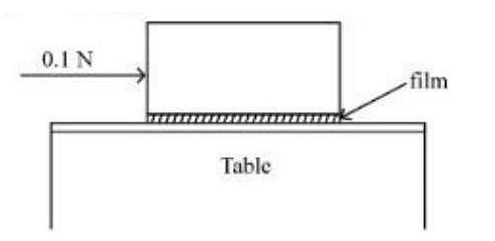
- A metal block of base area \(0.20 \,m^2\) is placed on a table, as shown in figure. A liquid film of thickness \(0.25\, mm\) is inserted between the block and the table. The block is pushed by a horizontal force of 0.1 N and moves with a constant speed. If the viscosity of the liquid is \(5.0×10^{−3}Pl\), the speed of block is ________ \(×10^{−3}m/s\)
- JEE Main - 2023
- Physics
- Viscosity
- The diameter of an air bubble which was initially 2 mm, rises steadily through a solution of density 1750 kg m–3 at the rate of 0.35 cms–1. The coefficient of viscosity of the solution is _______ poise (in nearest integer). (The density of air is negligible).
- JEE Main - 2022
- Physics
- Viscosity
A spherical ball is dropped in a long column of viscous liquid. The speed v of the ball as a function of time t may be best represented by

- BITSAT - 2010
- Physics
- Viscosity
- Viscosity is the property of a liquid due to which it:
- BITSAT - 2011
- Physics
- Viscosity
- Want to practice more? Try solving extra ecology questions todayView All Questions
