Question:medium
The diameter of an air bubble which was initially 2 mm, rises steadily through a solution of density 1750 kg m–3 at the rate of 0.35 cms–1. The coefficient of viscosity of the solution is _______ poise (in nearest integer). (The density of air is negligible).
The diameter of an air bubble which was initially 2 mm, rises steadily through a solution of density 1750 kg m–3 at the rate of 0.35 cms–1. The coefficient of viscosity of the solution is _______ poise (in nearest integer). (The density of air is negligible).
Updated On: Mar 13, 2026
Show Solution
Correct Answer: 11
Solution and Explanation
To find the coefficient of viscosity (η), we use Stokes' Law for a sphere moving through a viscous fluid: Fd = 6πηrv, where Fd is the drag force, r is the radius, and v is the velocity. For a sphere moving at terminal velocity, this force equals the buoyant force minus the gravitational force acting on the sphere. Since the density of air is negligible, the buoyant force dominates.
1. Calculate the radius of the bubble: r = diameter/2 = 2 mm / 2 = 1 mm = 0.001 m.
2. Convert the velocity to m/s: v = 0.35 cm/s = 0.0035 m/s.
3. Calculate the buoyant force using the fluid density (ρ) and the volume of the sphere (V):
V = (4/3)πr³ = (4/3)π(0.001)³ m³.
Fb = ρVg = 1750 kg/m³ × (4/3)π(0.001)³ m³ × 9.8 m/s².
Simplifying, Fb ≈ 7.229 × 10⁻⁵ N.
4. Using Stokes' Law, equate the buoyant force to the viscous drag force to find η:
Fd = Fb = 6πηrv.
7.229 × 10⁻⁵ N = 6π(η)(0.001 m)(0.0035 m/s).
Solve for η: η ≈ (7.229 × 10⁻⁵ N) / (6π × 0.001 m × 0.0035 m/s).
η ≈ 11 Poise (1 Poise = 0.1 Pa.s).
The calculated viscosity is approximately 11 Poise, which fits within the specified range of 11,11. Hence, the coefficient of viscosity is conclusively 11 Poise.
Was this answer helpful?
1
Top Questions on Viscosity
- An air bubble of diameter 6 mm rises steadily through a solution of density 1750kg / m3 at the rate of 0.35 cm/s. The co-efficient of viscosity of the solution (neglect density of air) is ____Pas (given, g = 10ms-2)
- JEE Main - 2023
- Physics
- Viscosity
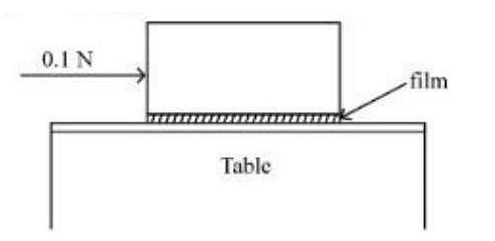
- A metal block of base area \(0.20 \,m^2\) is placed on a table, as shown in figure. A liquid film of thickness \(0.25\, mm\) is inserted between the block and the table. The block is pushed by a horizontal force of 0.1 N and moves with a constant speed. If the viscosity of the liquid is \(5.0×10^{−3}Pl\), the speed of block is ________ \(×10^{−3}m/s\)
- JEE Main - 2023
- Physics
- Viscosity
A spherical ball is dropped in a long column of viscous liquid. The speed v of the ball as a function of time t may be best represented by

- BITSAT - 2010
- Physics
- Viscosity
- Viscosity is the property of a liquid due to which it:
- BITSAT - 2011
- Physics
- Viscosity
- Want to practice more? Try solving extra ecology questions todayView All Questions
