Question:medium
If \(0 < p < 1\), then the roots of the equation \((1-p)x^2 + 4x + p = 0\) are:
If \(0 < p < 1\), then the roots of the equation \((1-p)x^2 + 4x + p = 0\) are:
Show Hint
Look at the sign of the product and the sum of the roots using \(0<p<1\), rather than trying to solve for x directly.
Updated On: Jul 10, 2026
- Both 0
- Imaginary
- Real and both positive
- Real and both negative
Show Solution
The Correct Option is D
Solution and Explanation
A different way to pin down the sign of the roots is to think of the left side as a graph rather than push through the discriminant-of-a-discriminant trick used elsewhere. Let $f(xx) = (1-p)x^2+4x+p$ for a fixed $p$ with $0<p<1$.
- Direction the parabola opens: the coefficient of $x^2$ is $1-p$, which is positive since $p<1$. So the graph of $f(xx)$ is a parabola opening upward.
- Value at $x=0$: $f(00) = p$, which is positive since $0<p<1$. So the graph sits above the x-axis at $x=0$.
- Where the vertex sits: the vertex of $f(xx)$ is at $x = -\dfrac{b}{2a} = -\dfrac{4}{2(1-p)} = -\dfrac{2}{1-p}$, a negative number because $1-p>0$. So the lowest point of the upward parabola lies to the left of $0$.
- What this forces about the roots: an upward parabola with its lowest point at a negative x-value, that is still positive at $x=0$, can only cross the x-axis at two points that both lie to the left of $0$. It cannot cross once on each side of $0$, since that would need $f(00)$ to be negative, and it is not.
- Realness of the roots: separately, $\Delta = 16-4p+4p^2 = 4(p^2-p+4)$, and $p^2-p+4 = \left(p-\frac{1}{2}\right)^2+\frac{15}{4}$ is a square plus a positive number, so it is always positive; hence $\Delta>0$ and the two roots are always real, never imaginary.
Putting the two findings together, the equation always has two real roots, and both sit to the left of $0$, so both are negative.
Let's summarize:
- The parabola opens upward and sits above the axis at $x=0$, with its vertex at a negative x-value.
- That combination is only possible if both roots, when real, are negative, and the discriminant check confirms they are always real.
So for every $p$ with $0<p<1$, the roots are real and both negative.
Was this answer helpful?
0
Top Questions on Quadratic Equations
- The equation \( (\cos p - 1)x^2 + (\cos p)x + \sin p = 0 \), where \( x \) is a variable with real roots. Then the interval of \( p \) may be any one of the following:
- MHT CET - 2024
- Mathematics
- Quadratic Equations
- If the roots of the quadratic equation \( x^2 - 7x + 12 = 0 \) are \( \alpha \) and \( \beta \), then the value of \( \alpha + \beta \) is:
- MHT CET - 2025
- Mathematics
- Quadratic Equations
- Find the roots of the quadratic equation $ x^2 - 5x + 6 = 0 $.
- MHT CET - 2025
- Mathematics
- Quadratic Equations
- Find the sum of the roots of the quadratic equation $ 2x^2 - 5x + 3 = 0 $.
- MHT CET - 2025
- Mathematics
- Quadratic Equations
- Want to practice more? Try solving extra ecology questions todayView All Questions
Questions Asked in XAT exam
Applicants have been shortlisted for interviews for some data analyst positions. Some of the applicants have advanced expertise in one or more fields among the following: data analysis, database handling and coding. The numbers of applicants with different advanced expertise are given in the 2 × 8 table below.
The number of applicants with advanced expertise in all three fields is given as x in the table, where x is a non-negative integer.
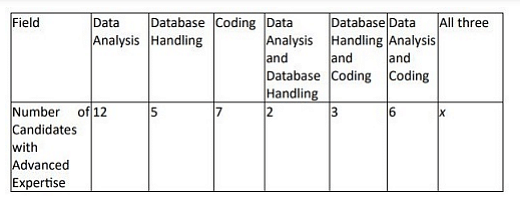
The number of applicants with advanced expertise in all three fields is given as x in the table, where x is a non-negative integer.
- XAT - 2024
- Data Interpretation