Question:hard
From questions 34 to 35, read the sentences and choose the option that best arranges them in a logical order.
Arrange the following sentences in the correct logical order:
1. The moral will arises when, for the reasons we saw earlier, this negation has to be negated; the individual moral will understands that it is the existence of the universal will, which is therefore internal to it.
2. This constitutes a negation, because the individual will is understood not to be the existence of the universal will.
3. This says that in abstract right, as we have just seen, the individual will takes its freedom (the universal will that has being in itself) to exist independent of (that is, in opposition to) itself and its particular contents.
4. Rather, the universal will is thought to exist outside any individual will, in the contracts that bind a number of property owning wills together, and in the punishments that enforce breaches of those contracts.
From questions 34 to 35, read the sentences and choose the option that best arranges them in a logical order.
Arrange the following sentences in the correct logical order:
1. The moral will arises when, for the reasons we saw earlier, this negation has to be negated; the individual moral will understands that it is the existence of the universal will, which is therefore internal to it.
2. This constitutes a negation, because the individual will is understood not to be the existence of the universal will.
3. This says that in abstract right, as we have just seen, the individual will takes its freedom (the universal will that has being in itself) to exist independent of (that is, in opposition to) itself and its particular contents.
4. Rather, the universal will is thought to exist outside any individual will, in the contracts that bind a number of property owning wills together, and in the punishments that enforce breaches of those contracts.
Arrange the following sentences in the correct logical order:
1. The moral will arises when, for the reasons we saw earlier, this negation has to be negated; the individual moral will understands that it is the existence of the universal will, which is therefore internal to it.
2. This constitutes a negation, because the individual will is understood not to be the existence of the universal will.
3. This says that in abstract right, as we have just seen, the individual will takes its freedom (the universal will that has being in itself) to exist independent of (that is, in opposition to) itself and its particular contents.
4. Rather, the universal will is thought to exist outside any individual will, in the contracts that bind a number of property owning wills together, and in the punishments that enforce breaches of those contracts.
Show Hint
Find the sentence with no backward-pointing word to open the passage, then trace "this" and "rather" to the sentence each one is reacting to.
Updated On: Jul 10, 2026
- 1, 2, 3, 4
- 3, 2, 4, 1
- 3, 1, 2, 4
- 1, 2, 3, 4
Show Solution
The Correct Option is B
Solution and Explanation
With a dense passage like this, the fastest method is to trace every pronoun and connector ("this," "rather") back to the one sentence it can attach to, rather than trying to fully unpack the philosophical content in one go.
- Sentence 3: introduces "abstract right" and explains that the individual will treats its freedom as standing apart from, and opposed to, itself and its own content. It uses no backward pointing word, so it is the only sentence that can open the passage.
- Sentence 2: opens with "This constitutes a negation." The word "this" needs an antecedent, and the only sentence that describes a state which can be called a "negation" is sentence 3, where the will is set up as being in opposition to itself. So sentence 2 must sit right after sentence 3.
- Sentence 4: opens with "Rather," a word that corrects or redirects a claim just made. It redirects the idea in sentence 2, that the individual will is not the universal will's existence, by saying where the universal will's existence is actually found instead: in contracts and punishments. So sentence 4 must follow sentence 2.
- Sentence 1: describes the "moral will" arising once "this negation" is itself negated. The negation being negated is the very state built up across sentences 3, 2, and 4, so sentence 1 must come last, as the resolution of that chain.
Chaining the connectors gives 3 (starts the idea), 2 (names it a negation), 4 (redirects to where the universal will really exists), 1 (resolves the negation into the moral will).
Let's summarize:
- Sentences with no backward pointer, like sentence 3, must open the passage.
- Words like "this" and "rather" always point to the immediately preceding idea, and tracing them gives the order 3, 2, 4, 1.
So the correct order is 3, 2, 4, 1.
Was this answer helpful?
0
Top Questions on Para Jumbles
- Five jumbled up sentences (labelled 1, 2, 3, 4 and 5), related to a topic, are given below. Four of them can be put together to form a coherent paragraph. Identify the odd sentence and key in the number of that sentence as your answer.
- Five jumbled up sentences (labelled 1, 2, 3, 4 and 5), related to a topic, are given below. Four of them can be put together to form a coherent paragraph. Identify the odd sentence and key in the number of that sentence as your answer.
- Five jumbled up sentences (labelled 1, 2, 3, 4 and 5), related to a topic, are given below. Four of them can be put together to form a coherent paragraph. Identify the odd sentence and key in the number of that sentence as your answer.
- Five jumbled up sentences (labelled 1, 2, 3, 4 and 5), related to a topic, are given below. Four of them can be put together to form a coherent paragraph. Identify the odd sentence and key in the number of that sentence as your answer.
- Want to practice more? Try solving extra ecology questions todayView All Questions
Questions Asked in XAT exam
Applicants have been shortlisted for interviews for some data analyst positions. Some of the applicants have advanced expertise in one or more fields among the following: data analysis, database handling and coding. The numbers of applicants with different advanced expertise are given in the 2 × 8 table below.
The number of applicants with advanced expertise in all three fields is given as x in the table, where x is a non-negative integer.
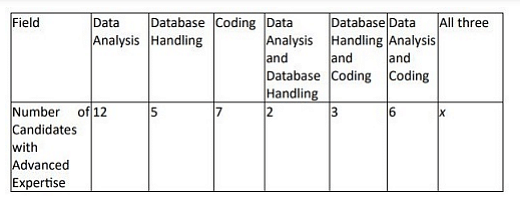
The number of applicants with advanced expertise in all three fields is given as x in the table, where x is a non-negative integer.
- XAT - 2024
- Data Interpretation