Question:hard
For each \(p > 1\), a sequence \(A_n\) is defined by \(A_0 = 1\) and \(A_n = np + (-1)^n A_{n-1}\) for \(n \geq 1\). For how many integer values of \(p\) is 1000 a term of the sequence?
For each \(p > 1\), a sequence \(A_n\) is defined by \(A_0 = 1\) and \(A_n = np + (-1)^n A_{n-1}\) for \(n \geq 1\). For how many integer values of \(p\) is 1000 a term of the sequence?
Show Hint
Group the terms by their index mod 4; only two of the four groups can ever equal a value like 1000, and both reduce to divisors of 1001.
Updated On: Jul 10, 2026
- 8
- 7
- 5
- 4
Show Solution
The Correct Option is C
Solution and Explanation
Step 1: Combine two steps of the recurrence into one relation.
Starting from $A_n = np + (-1)^n A_{n-1}$, substitute the same rule one step earlier for $A_{n-1} = (n-1)p + (-1)^{n-1}A_{n-2}$:
$A_n = np + (-1)^n\big[(n-1)p + (-1)^{n-1}A_{n-2}\big] = np + (-1)^n(n-1)p + (-1)^{2n-1}A_{n-2}$
Since $(-1)^{2n-1} = -1$ always (the exponent $2n-1$ is odd for every integer $n$), this becomes:
\[ A_n = \big[n + (-1)^n(n-1)\big]p - A_{n-2} \]
This single relation now jumps two steps at a time, skipping the awkward alternating sign entirely.
Step 2: Split this into an odd-index rule and an even-index rule.
For odd $n$: $(-1)^n = -1$, so the bracket becomes $n - (n - 1) = 1$, giving $A_n = p - A_{n-2}$.
For even $n$: $(-1)^n = 1$, so the bracket becomes $n + (n-1) = 2n - 1$, giving $A_n = (2n-1)p - A_{n-2}$.
Step 3: Unroll the odd-index rule starting from $A_1 = p - 1$.
$A_3 = p - A_1 = p - (p - 1) = 1$
$A_5 = p - A_3 = p - 1$
$A_7 = p - A_5 = 1$
The odd-indexed terms simply flip between $p - 1$ and $1$ every step: every index $\equiv 1 \bmod 4$ gives $p - 1$, and every index $\equiv 3 \bmod 4$ gives $1$.
Step 4: Unroll the even-index rule starting from $A_0 = 1$.
$A_2 = 3p - A_0 = 3p - 1$
$A_4 = 7p - A_2 = 7p - (3p-1) = 4p + 1$
$A_6 = 11p - A_4 = 11p - (4p+1) = 7p - 1$
$A_8 = 15p - A_6 = 15p - (7p-1) = 8p+1$
So the terms of the form $cp - 1$ that show up here are $A_2 = 3p-1$, $A_6 = 7p-1$, $A_{10} = 11p - 1$, and so on, with coefficients $3, 7, 11, 15, \ldots$
Step 5: Combine both families and solve $cp - 1 = 1000$.
Putting the odd-index family ($c = 1$) together with the even-index family ($c = 3, 7, 11, 15, \ldots$), we need $cp = 1001 = 7 \times 11 \times 13$. Checking every divisor of 1001 against the requirement $c = 1$ or $c \equiv 3 \pmod 4$: divisors $1, 7, 11, 91, 143$ pass; divisors $13, 77, 1001$ fail, since they leave remainder 1, not 3, when divided by 4, and none of them equal 1 either.
Step 6: Convert the 5 valid divisors into 5 values of p.
$p = 1001/1 = 1001$, $p = 1001/7 = 143$, $p = 1001/11 = 91$, $p = 1001/91 = 11$, $p = 1001/143 = 7$. All five are integers greater than 1.
Final Answer:
There are exactly 5 integer values of $p$ that make 1000 a term of the sequence.
\[ \boxed{5} \]
Starting from $A_n = np + (-1)^n A_{n-1}$, substitute the same rule one step earlier for $A_{n-1} = (n-1)p + (-1)^{n-1}A_{n-2}$:
$A_n = np + (-1)^n\big[(n-1)p + (-1)^{n-1}A_{n-2}\big] = np + (-1)^n(n-1)p + (-1)^{2n-1}A_{n-2}$
Since $(-1)^{2n-1} = -1$ always (the exponent $2n-1$ is odd for every integer $n$), this becomes:
\[ A_n = \big[n + (-1)^n(n-1)\big]p - A_{n-2} \]
This single relation now jumps two steps at a time, skipping the awkward alternating sign entirely.
Step 2: Split this into an odd-index rule and an even-index rule.
For odd $n$: $(-1)^n = -1$, so the bracket becomes $n - (n - 1) = 1$, giving $A_n = p - A_{n-2}$.
For even $n$: $(-1)^n = 1$, so the bracket becomes $n + (n-1) = 2n - 1$, giving $A_n = (2n-1)p - A_{n-2}$.
Step 3: Unroll the odd-index rule starting from $A_1 = p - 1$.
$A_3 = p - A_1 = p - (p - 1) = 1$
$A_5 = p - A_3 = p - 1$
$A_7 = p - A_5 = 1$
The odd-indexed terms simply flip between $p - 1$ and $1$ every step: every index $\equiv 1 \bmod 4$ gives $p - 1$, and every index $\equiv 3 \bmod 4$ gives $1$.
Step 4: Unroll the even-index rule starting from $A_0 = 1$.
$A_2 = 3p - A_0 = 3p - 1$
$A_4 = 7p - A_2 = 7p - (3p-1) = 4p + 1$
$A_6 = 11p - A_4 = 11p - (4p+1) = 7p - 1$
$A_8 = 15p - A_6 = 15p - (7p-1) = 8p+1$
So the terms of the form $cp - 1$ that show up here are $A_2 = 3p-1$, $A_6 = 7p-1$, $A_{10} = 11p - 1$, and so on, with coefficients $3, 7, 11, 15, \ldots$
Step 5: Combine both families and solve $cp - 1 = 1000$.
Putting the odd-index family ($c = 1$) together with the even-index family ($c = 3, 7, 11, 15, \ldots$), we need $cp = 1001 = 7 \times 11 \times 13$. Checking every divisor of 1001 against the requirement $c = 1$ or $c \equiv 3 \pmod 4$: divisors $1, 7, 11, 91, 143$ pass; divisors $13, 77, 1001$ fail, since they leave remainder 1, not 3, when divided by 4, and none of them equal 1 either.
Step 6: Convert the 5 valid divisors into 5 values of p.
$p = 1001/1 = 1001$, $p = 1001/7 = 143$, $p = 1001/11 = 91$, $p = 1001/91 = 11$, $p = 1001/143 = 7$. All five are integers greater than 1.
Final Answer:
There are exactly 5 integer values of $p$ that make 1000 a term of the sequence.
\[ \boxed{5} \]
Was this answer helpful?
0
Top Questions on Sequence and Series
- Series Expansion $ n^6 + \frac{1}{2} n^4 + \frac{1}{3} n^2 + \cdots + \frac{1}{n} C_n + 1 \quad n \to \infty $
- MHT CET - 2025
- Mathematics
- Sequence and Series
- Krishna has certain number of coins numbered with a series of consecutive natural numbers starting with 1. He found that the sum of squares of all the numbers on the coins is 1753 times the sum of numbers on coins. How many coins does he have?
- IBSAT
- Quantitative Aptitude
- Sequence and Series
- A group of 630 children is arranged in rows for a photograph session. Each row contains three children lesser than the row in front of it. Which of the below mentioned number of rows is not possible?
- IBSAT
- Quantitative Aptitude
- Sequence and Series
- In each of the following questions a number series is given with one missing (?) term. The term is given as one of the alternatives among the five numbers given in the answer choic Find the term.
1, 27, 125, ? , 729, 1331- IBSAT
- Quantitative Aptitude
- Sequence and Series
- Want to practice more? Try solving extra ecology questions todayView All Questions
Questions Asked in XAT exam
Applicants have been shortlisted for interviews for some data analyst positions. Some of the applicants have advanced expertise in one or more fields among the following: data analysis, database handling and coding. The numbers of applicants with different advanced expertise are given in the 2 × 8 table below.
The number of applicants with advanced expertise in all three fields is given as x in the table, where x is a non-negative integer.
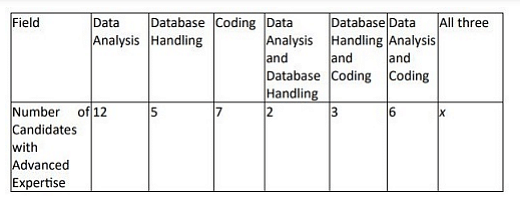
The number of applicants with advanced expertise in all three fields is given as x in the table, where x is a non-negative integer.
- XAT - 2024
- Data Interpretation