Question:medium
Each of the following questions is followed by two statements, I and II. Decide whether the data given in the statements is sufficient to answer the question.
For each rupee in monthly advertising expenditure, KUMAR & Co. experiences a Rs. 6 increase in sales. How much does KUMAR & Co. have to spend on advertising to attain Rs. 1,000,000 in sales revenue for the month?
I. Without advertising, KUMAR & Co. earns Rs. 200,000 sales revenue per month.
II. When KUMAR & Co. spends Rs. 15,000 on advertising, it earns Rs. 290,000 as sales revenue.
Each of the following questions is followed by two statements, I and II. Decide whether the data given in the statements is sufficient to answer the question.
For each rupee in monthly advertising expenditure, KUMAR & Co. experiences a Rs. 6 increase in sales. How much does KUMAR & Co. have to spend on advertising to attain Rs. 1,000,000 in sales revenue for the month?
I. Without advertising, KUMAR & Co. earns Rs. 200,000 sales revenue per month.
II. When KUMAR & Co. spends Rs. 15,000 on advertising, it earns Rs. 290,000 as sales revenue.
For each rupee in monthly advertising expenditure, KUMAR & Co. experiences a Rs. 6 increase in sales. How much does KUMAR & Co. have to spend on advertising to attain Rs. 1,000,000 in sales revenue for the month?
I. Without advertising, KUMAR & Co. earns Rs. 200,000 sales revenue per month.
II. When KUMAR & Co. spends Rs. 15,000 on advertising, it earns Rs. 290,000 as sales revenue.
Show Hint
The slope of the sales-advertising line is already given in the question; each statement supplies just enough extra data to fix the line completely.
Updated On: Jul 10, 2026
- If Statement I alone is sufficient to answer the question.
- If Statement II alone is sufficient to answer the question.
- If Statement I and Statement II together are sufficient, but neither statement alone is sufficient to answer the question.
- If either Statement I alone or Statement II alone is sufficient to answer the question.
Show Solution
The Correct Option is D
Solution and Explanation
Step 1: Recognize this as a straight line with known slope.
Treat sales $S$ as a linear function of advertising spend $A$: $S = S_0 + 6A$, where the slope 6 comes straight from the question. Only the intercept $S_0$, sales with no advertising, is missing.
Step 2: Check what Statement I hands us.
Statement I directly states $S_0 = 200{,}000$. With the slope already known, this fixes the line, so we can solve for $A$ when $S = 1{,}000{,}000$:
\[ A = \frac{1{,}000{,}000 - 200{,}000}{6} = \frac{800{,}000}{6} \approx 133{,}333 \]
Statement I alone answers the question.
Step 3: Check what Statement II hands us.
Statement II gives one point on the same line: $(A, S) = (15{,}000, 290{,}000)$. Since the slope is fixed at 6 by the question, one point is enough to find the intercept:
\[ S_0 = 290{,}000 - 6(15{,}000) = 200{,}000 \]
This is the same line as before, so Statement II alone also lets us compute $A$, giving the same value, about 133,333.
Step 4: Decide the sufficiency category.
Both statements, independently, fully determine the same equation. There is no need to combine them, and this is not a sufficient-together-only case.
Final Answer:
Either statement by itself is sufficient to answer the question, so the answer is D. \[ \boxed{D} \]
Treat sales $S$ as a linear function of advertising spend $A$: $S = S_0 + 6A$, where the slope 6 comes straight from the question. Only the intercept $S_0$, sales with no advertising, is missing.
Step 2: Check what Statement I hands us.
Statement I directly states $S_0 = 200{,}000$. With the slope already known, this fixes the line, so we can solve for $A$ when $S = 1{,}000{,}000$:
\[ A = \frac{1{,}000{,}000 - 200{,}000}{6} = \frac{800{,}000}{6} \approx 133{,}333 \]
Statement I alone answers the question.
Step 3: Check what Statement II hands us.
Statement II gives one point on the same line: $(A, S) = (15{,}000, 290{,}000)$. Since the slope is fixed at 6 by the question, one point is enough to find the intercept:
\[ S_0 = 290{,}000 - 6(15{,}000) = 200{,}000 \]
This is the same line as before, so Statement II alone also lets us compute $A$, giving the same value, about 133,333.
Step 4: Decide the sufficiency category.
Both statements, independently, fully determine the same equation. There is no need to combine them, and this is not a sufficient-together-only case.
Final Answer:
Either statement by itself is sufficient to answer the question, so the answer is D. \[ \boxed{D} \]
Was this answer helpful?
0
Top Questions on Arithmetic
- There are 25 rooms in a hotel. Each room can accommodate at most three people. For each room, the single occupancy charge is Rs. 2000 per day, the double occupancy charge is Rs. 3000 per day, and the triple occupancy charge is Rs. 3500 per day. If there are 55 people staying in the hotel today, what is the maximum possible revenue from room occupancy charges today?
- Evaluate \(\sqrt[3]{1372} \times \sqrt[3]{1458}\)
- TS EDCET - 2025
- Quantitative Aptitude
- Arithmetic
- Gopi sold a watch to Ibrahim at 12% gain and Ibrahim sold it to John at a loss of 5%. If John paid ₹ 1,330, then find how much did Gopi sell it?
- TS EDCET - 2025
- Quantitative Aptitude
- Arithmetic
- Rani read \(\frac{3}{5}\) of a book. If she finds that there are still 80 pages left to read, then the total number of pages in the book is.
- TS EDCET - 2025
- Quantitative Aptitude
- Arithmetic
- Want to practice more? Try solving extra ecology questions todayView All Questions
Questions Asked in XAT exam
Applicants have been shortlisted for interviews for some data analyst positions. Some of the applicants have advanced expertise in one or more fields among the following: data analysis, database handling and coding. The numbers of applicants with different advanced expertise are given in the 2 × 8 table below.
The number of applicants with advanced expertise in all three fields is given as x in the table, where x is a non-negative integer.
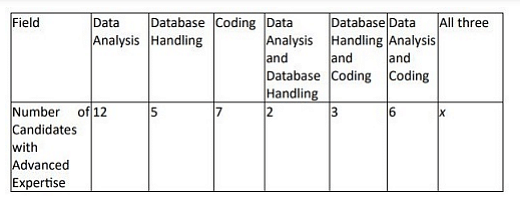
The number of applicants with advanced expertise in all three fields is given as x in the table, where x is a non-negative integer.
- XAT - 2024
- Data Interpretation