During a four-week period, each one of seven previously unadvertised products, G, H, J, K, L, M and O, will be advertised. A different pair of these products will be advertised during each of the four weeks. Exactly one of these seven products will be advertised during two of the four weeks; none of the other six products is repeated in any pair. The following conditions must hold.
1. J is not advertised during a given week unless H is advertised during the week immediately before it.
2. The product that is advertised twice is advertised during week 4 but is not advertised during week 3.
3. G is not advertised during a given week unless either J or O is also advertised during that same week.
4. K is advertised during one of the first two weeks.
5. O is one of the products advertised during week 3.
If L is the product that is advertised during two of the weeks, which one of the following is a product that MUST be advertised during one of the weeks in which L is advertised?
1. J is not advertised during a given week unless H is advertised during the week immediately before it.
2. The product that is advertised twice is advertised during week 4 but is not advertised during week 3.
3. G is not advertised during a given week unless either J or O is also advertised during that same week.
4. K is advertised during one of the first two weeks.
5. O is one of the products advertised during week 3.
If L is the product that is advertised during two of the weeks, which one of the following is a product that MUST be advertised during one of the weeks in which L is advertised?
Show Hint
- G
- H
- J
- M
The Correct Option is D
Solution and Explanation
This question asks which product is forced to share a week with L in every valid schedule, not just in one possible schedule. The fastest way to check a MUST claim is to try building a valid schedule that keeps the candidate product away from both of L's weeks. If that is possible, the candidate is not forced. If it is impossible, the candidate is the answer.
- G: Condition 3 forces G to sit in a week that also carries J or O. Since O always owns week 3, G can simply be placed there alongside O, a week with no direct link to L at all. G is not forced onto L's week.
- H: Condition 1 only asks for H in the week right before a week that carries J. If J is not made to sit right after L, H does not need to go near L either. Since J's placement is flexible, subject only to its own rule, H can be routed to sit with J's week instead of with L. H is not forced onto L's week in every case.
- J: J only needs H the week right before it; nothing ties J specifically to L. J can be placed in week 2 or week 3 alongside a product other than L, so J is not forced to share L's week either.
- K: Condition 4 only forces K into week 1 or week 2, not specifically into whichever of those weeks L occupies. Since L takes only one of week 1 or week 2 (its other slot fixed at week 4), K can be placed in the other one, away from L. K is not forced onto L's week.
- M: Once L is fixed as the repeated product, condition 2 puts one of L's slots at week 4. G is forced into week 3 alongside O, and the H-then-J chain uses up the remaining slots in week 1 and week 2. Once G, O, H and J are all placed by their own rules, the only product left over for week 4's second slot, right next to L, is M. This holds regardless of whether L's other slot is week 1 or week 2, so M always ends up sharing week 4 with L.
Running the check this way rules out G, H, J and K one at a time, since each of them can be pushed into a valid schedule that avoids both of L's weeks. M cannot be pushed away, since it is always the product left standing once every other placement rule has used up its options, and the seat left empty is always in week 4, right where L sits.
Let's summarize:
- L, as the repeated product, is fixed in week 4 plus one of week 1 or week 2.
- G, H, J and K can each be arranged in a valid schedule without sharing a week with L.
- M is always the product left over for week 4 once every other placement rule is honoured, so it always lands beside L.
So the product that must be advertised in one of L's weeks is M, which is option (EE).
Top Questions on Complex Arrangement
- Four married couples competed in a singing competition. Each couple had a unique team name. Points scored by the teams were 2, 4, 6 and 8. The 'Sweet Couple' won 2 points. The 'Bindas Singers' won two more points than Laxman's team. Mukesh's team won four points more than Lina's team, but Lina's team didn't score the least amount of points. 'Just Singing' won 6 points. Waheda wasn't on the team called 'New Singers'. Sanjeev's team won 4 points. Divya wasn't on the 'Bindas Singers' team. Tapas and Sania were on the same team, but it wasn't the 'Sweet Couple'.
Laxman's teammate and team's name were:- XAT - 2009
- Decision Making
- Complex Arrangement
- Four married couples competed in a singing competition. Each couple had a unique team name. Points scored by the teams were 2, 4, 6 and 8. The 'Sweet Couple' won 2 points. The 'Bindas Singers' won two more points than Laxman's team. Mukesh's team won four points more than Lina's team, but Lina's team didn't score the least amount of points. 'Just Singing' won 6 points. Waheda wasn't on the team called 'New Singers'. Sanjeev's team won 4 points. Divya wasn't on the 'Bindas Singers' team. Tapas and Sania were on the same team, but it wasn't the 'Sweet Couple'.
The teams arranged in the ascending order of points are:- XAT - 2009
- Decision Making
- Complex Arrangement
- Four married couples competed in a singing competition. Each couple had a unique team name. Points scored by the teams were 2, 4, 6 and 8. The 'Sweet Couple' won 2 points. The 'Bindas Singers' won two more points than Laxman's team. Mukesh's team won four points more than Lina's team, but Lina's team didn't score the least amount of points. 'Just Singing' won 6 points. Waheda wasn't on the team called 'New Singers'. Sanjeev's team won 4 points. Divya wasn't on the 'Bindas Singers' team. Tapas and Sania were on the same team, but it wasn't the 'Sweet Couple'.
The combination which has the couples rightly paired is:- XAT - 2009
- Decision Making
- Complex Arrangement
The regular mathematics faculty could not teach because of being sick. As a stop-gap arrangement, different visiting faculty taught different topics on 4 different days in a week. The scheduled time for class was 7:00 am, with a maximum permissible delay of 20 minutes. The monsoon made the city bus schedules erratic, so the classes started at different times on different days.
Mr. Singh did not teach on Thursday. Calculus was taught in the class that started at 7:20 am. Mr. Chatterjee took the class on Wednesday, but he did not teach probability. The class on Monday started at 7:00 am, but Mr. Singh did not teach it. Mr. Dutta did not teach ratio and proportion. Mr. Banerjee, who did not teach set theory, taught a class that started five minutes later than the class in which probability was taught. The teacher in Friday's class taught set theory. Wednesday's class did not start at 7:10 am. No two classes started at the same time.
77. The class on Wednesday started at:
- XAT - 2009
- Decision Making
- Complex Arrangement
- Want to practice more? Try solving extra ecology questions todayView All Questions
Questions Asked in XAT exam
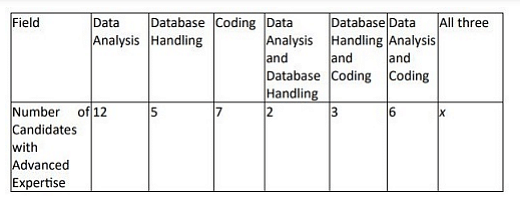
The number of applicants with advanced expertise in all three fields is given as x in the table, where x is a non-negative integer.
- XAT - 2024
- Data Interpretation