During a four-week period, each one of seven previously unadvertised products, G, H, J, K, L, M and O, will be advertised. A different pair of these products will be advertised during each of the four weeks. Exactly one of these seven products will be advertised during two of the four weeks; none of the other six products is repeated in any pair. The following conditions must hold.
1. J is not advertised during a given week unless H is advertised during the week immediately before it.
2. The product that is advertised twice is advertised during week 4 but is not advertised during week 3.
3. G is not advertised during a given week unless either J or O is also advertised during that same week.
4. K is advertised during one of the first two weeks.
5. O is one of the products advertised during week 3.
Which one of the following could be the schedule of the advertisements?
1. J is not advertised during a given week unless H is advertised during the week immediately before it.
2. The product that is advertised twice is advertised during week 4 but is not advertised during week 3.
3. G is not advertised during a given week unless either J or O is also advertised during that same week.
4. K is advertised during one of the first two weeks.
5. O is one of the products advertised during week 3.
Which one of the following could be the schedule of the advertisements?
Show Hint
- Week 1: G, J; Week 2: K, L; Week 3: O, M; Week 4: H, L
- Week 1: H, K; Week 2: J, G; Week 3: O, L; Week 4: M, K
- Week 1: H, K; Week 2: J, M; Week 3: O, L; Week 4: G, M
- Week 1: H, L; Week 2: J, M; Week 3: O, G; Week 4: K, L
The Correct Option is B
Solution and Explanation
Condition 5 places O in week 3 without exception. Condition 4 forces K into week 1 or week 2. Condition 2 forces the single repeated product into week 4, and bans it from week 3. Build the four weekly pairs around these three anchors instead of testing the four given schedules one by one.
Step 2: Place G and J using their linked rule.
Condition 3 ties G to a week that also carries J or O. Condition 1 ties J to a week that comes right after a week carrying H. A simple way to satisfy both at once is to advertise J and G together in the same week, right after a week that carries H. Try: week 1 carries H, and week 2 carries J together with G. That clears condition 1 (H precedes J) and condition 3 (J sits with G) in one move.
Step 3: Fill the remaining weeks with the leftover products.
Week 1 already carries H; condition 4 needs K somewhere in week 1 or week 2, and week 2 is full (J, G), so K must join H in week 1: week 1 becomes H, K. Two products are still unplaced, L and M, and neither carries any restriction of its own. Week 3 needs a second product alongside O, and week 4 needs the repeated product plus one more seat. Placing L with O in week 3, and letting K repeat into week 4 alongside M, uses up every product exactly as the rules require.
Step 4: Read off the built schedule and match it to the choices.
Built this way, the schedule reads: week 1, H and K; week 2, J and G; week 3, O and L; week 4, M and K (K repeating). This is exactly what option (BB) states, Week 1: H, K; Week 2: J, G; Week 3: O, L; Week 4: M, K. The other three schedules each break one of the five conditions on inspection (A puts J in week 1 with no H before it, C leaves G in week 4 with no J or O beside it, D never gives K a slot in week 1 or week 2), so none of them can be the answer.
Final Answer:
The schedule that matches every condition is option (BB): Week 1: H, K; Week 2: J, G; Week 3: O, L; Week 4: M, K.
Top Questions on Complex Arrangement
- Four married couples competed in a singing competition. Each couple had a unique team name. Points scored by the teams were 2, 4, 6 and 8. The 'Sweet Couple' won 2 points. The 'Bindas Singers' won two more points than Laxman's team. Mukesh's team won four points more than Lina's team, but Lina's team didn't score the least amount of points. 'Just Singing' won 6 points. Waheda wasn't on the team called 'New Singers'. Sanjeev's team won 4 points. Divya wasn't on the 'Bindas Singers' team. Tapas and Sania were on the same team, but it wasn't the 'Sweet Couple'.
Laxman's teammate and team's name were:- XAT - 2009
- Decision Making
- Complex Arrangement
- Four married couples competed in a singing competition. Each couple had a unique team name. Points scored by the teams were 2, 4, 6 and 8. The 'Sweet Couple' won 2 points. The 'Bindas Singers' won two more points than Laxman's team. Mukesh's team won four points more than Lina's team, but Lina's team didn't score the least amount of points. 'Just Singing' won 6 points. Waheda wasn't on the team called 'New Singers'. Sanjeev's team won 4 points. Divya wasn't on the 'Bindas Singers' team. Tapas and Sania were on the same team, but it wasn't the 'Sweet Couple'.
The teams arranged in the ascending order of points are:- XAT - 2009
- Decision Making
- Complex Arrangement
- Four married couples competed in a singing competition. Each couple had a unique team name. Points scored by the teams were 2, 4, 6 and 8. The 'Sweet Couple' won 2 points. The 'Bindas Singers' won two more points than Laxman's team. Mukesh's team won four points more than Lina's team, but Lina's team didn't score the least amount of points. 'Just Singing' won 6 points. Waheda wasn't on the team called 'New Singers'. Sanjeev's team won 4 points. Divya wasn't on the 'Bindas Singers' team. Tapas and Sania were on the same team, but it wasn't the 'Sweet Couple'.
The combination which has the couples rightly paired is:- XAT - 2009
- Decision Making
- Complex Arrangement
The regular mathematics faculty could not teach because of being sick. As a stop-gap arrangement, different visiting faculty taught different topics on 4 different days in a week. The scheduled time for class was 7:00 am, with a maximum permissible delay of 20 minutes. The monsoon made the city bus schedules erratic, so the classes started at different times on different days.
Mr. Singh did not teach on Thursday. Calculus was taught in the class that started at 7:20 am. Mr. Chatterjee took the class on Wednesday, but he did not teach probability. The class on Monday started at 7:00 am, but Mr. Singh did not teach it. Mr. Dutta did not teach ratio and proportion. Mr. Banerjee, who did not teach set theory, taught a class that started five minutes later than the class in which probability was taught. The teacher in Friday's class taught set theory. Wednesday's class did not start at 7:10 am. No two classes started at the same time.
77. The class on Wednesday started at:
- XAT - 2009
- Decision Making
- Complex Arrangement
- Want to practice more? Try solving extra ecology questions todayView All Questions
Questions Asked in XAT exam
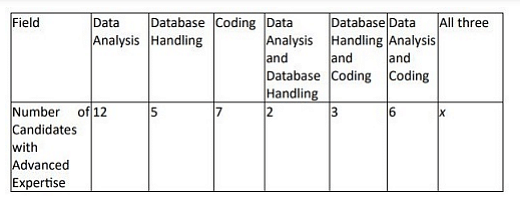
The number of applicants with advanced expertise in all three fields is given as x in the table, where x is a non-negative integer.
- XAT - 2024
- Data Interpretation