Question:hard
Directions: Read the passage carefully and answer the question that follows.
India is renowned for its diversity. Dissimilitude abounds in every sphere, from the physical elements of its land and people to the intangible workings of its beliefs and practices. Indeed, given this variety, India itself appears to be not a single entity but an amalgamation, a "construct" arising from the conjoining of innumerable, discrete parts. Modern scholarship has, quite properly, tended to explore these elements in isolation. (In part, this trend represents the conscious reversal of the stance taken by an earlier generation of scholars whose work reified India into a monolithic entity, a critical element in the much maligned "Orientalist" enterprise.) Nonetheless, the representation of India as a singular "Whole" is not an entirely capricious enterprise, for India is an identifiable entity, united by, if not born out of, certain deep and pervasive structures. Thus, for example, the Hindu tradition has long maintained a body of mythology that weaves the disparate temples, gods, even geographic landscapes that exist throughout the subcontinent into a unified, albeit syncretic, whole.
In the realm of thought, there is no more pervasive, unifying structure than karma. It is the "doctrine" or "law" that ties actions to results and creates a determinant link between an individual's status in this life and his or her fate in future lives. Following what is considered to be its appearance in the Upanishads, the doctrine reaches into nearly every corner of Hindu thought. Indeed, its dominance is such in the Hindu world view that karma encompasses, at the same time, life-affirming and life-negating functions, for just as it defines the world in terms of the "positive" function of laying out a doctrine of rewards and punishments, it also defines the world through its "negative" picture of action as an all but inescapable trap, an unremitting cycle of death and rebirth.
Despite, or perhaps because of, karma's ubiquity, the doctrine is not easily defined. Wendy Doniger O'Flaherty reports of a scholarly conference devoted to the study of karma where, although the participants admitted to a general sense of the doctrine's parameters, considerable time was spent in a "lively but ultimately vain attempt to define...karma and rebirth". The base meaning of the term "karma" (or, more precisely, in its Sanskrit stem form, karman, a neuter noun) is "action". As a doctrine, karma covers a number of quasi-independent concepts: rebirth (punarjanam), consequence (phala, literally "fruit," a word that suggests the "ripening" of actions into consequences), and the valuation or "ethic-ization" of acts, which marks them as either "good" (punya or sukarman) or "bad" (papam or duskarman).
In a general way, however, for at least the past two thousand years, the following passage (from the well known text, the Bhagavata Purana) has held true as a statement of the main elements of the karma doctrine: "The same person enjoys the fruit of the same sinful or meritorious act in the next world, in the same manner and to the same extent, according to the manner and extent to which that (sinful or meritorious) act has been done by him in this world." Even so, depending on the context in which the doctrine appears, ranging from its use across a wide range of literary sources to its use at the popular level, not all these elements may be present, though in a general way they may still be implied.
Question: Consider the following statements:
1. Meaning of karma is contextual.
2. Meaning of karma is not unanimous.
3. Meaning of karma includes many other quasi-independent concepts.
4. Karma also means actions and their rewards.
Which of the statements are true?
Directions: Read the passage carefully and answer the question that follows.
India is renowned for its diversity. Dissimilitude abounds in every sphere, from the physical elements of its land and people to the intangible workings of its beliefs and practices. Indeed, given this variety, India itself appears to be not a single entity but an amalgamation, a "construct" arising from the conjoining of innumerable, discrete parts. Modern scholarship has, quite properly, tended to explore these elements in isolation. (In part, this trend represents the conscious reversal of the stance taken by an earlier generation of scholars whose work reified India into a monolithic entity, a critical element in the much maligned "Orientalist" enterprise.) Nonetheless, the representation of India as a singular "Whole" is not an entirely capricious enterprise, for India is an identifiable entity, united by, if not born out of, certain deep and pervasive structures. Thus, for example, the Hindu tradition has long maintained a body of mythology that weaves the disparate temples, gods, even geographic landscapes that exist throughout the subcontinent into a unified, albeit syncretic, whole.
In the realm of thought, there is no more pervasive, unifying structure than karma. It is the "doctrine" or "law" that ties actions to results and creates a determinant link between an individual's status in this life and his or her fate in future lives. Following what is considered to be its appearance in the Upanishads, the doctrine reaches into nearly every corner of Hindu thought. Indeed, its dominance is such in the Hindu world view that karma encompasses, at the same time, life-affirming and life-negating functions, for just as it defines the world in terms of the "positive" function of laying out a doctrine of rewards and punishments, it also defines the world through its "negative" picture of action as an all but inescapable trap, an unremitting cycle of death and rebirth.
Despite, or perhaps because of, karma's ubiquity, the doctrine is not easily defined. Wendy Doniger O'Flaherty reports of a scholarly conference devoted to the study of karma where, although the participants admitted to a general sense of the doctrine's parameters, considerable time was spent in a "lively but ultimately vain attempt to define...karma and rebirth". The base meaning of the term "karma" (or, more precisely, in its Sanskrit stem form, karman, a neuter noun) is "action". As a doctrine, karma covers a number of quasi-independent concepts: rebirth (punarjanam), consequence (phala, literally "fruit," a word that suggests the "ripening" of actions into consequences), and the valuation or "ethic-ization" of acts, which marks them as either "good" (punya or sukarman) or "bad" (papam or duskarman).
In a general way, however, for at least the past two thousand years, the following passage (from the well known text, the Bhagavata Purana) has held true as a statement of the main elements of the karma doctrine: "The same person enjoys the fruit of the same sinful or meritorious act in the next world, in the same manner and to the same extent, according to the manner and extent to which that (sinful or meritorious) act has been done by him in this world." Even so, depending on the context in which the doctrine appears, ranging from its use across a wide range of literary sources to its use at the popular level, not all these elements may be present, though in a general way they may still be implied.
Question: Consider the following statements:
1. Meaning of karma is contextual.
2. Meaning of karma is not unanimous.
3. Meaning of karma includes many other quasi-independent concepts.
4. Karma also means actions and their rewards.
Which of the statements are true?
India is renowned for its diversity. Dissimilitude abounds in every sphere, from the physical elements of its land and people to the intangible workings of its beliefs and practices. Indeed, given this variety, India itself appears to be not a single entity but an amalgamation, a "construct" arising from the conjoining of innumerable, discrete parts. Modern scholarship has, quite properly, tended to explore these elements in isolation. (In part, this trend represents the conscious reversal of the stance taken by an earlier generation of scholars whose work reified India into a monolithic entity, a critical element in the much maligned "Orientalist" enterprise.) Nonetheless, the representation of India as a singular "Whole" is not an entirely capricious enterprise, for India is an identifiable entity, united by, if not born out of, certain deep and pervasive structures. Thus, for example, the Hindu tradition has long maintained a body of mythology that weaves the disparate temples, gods, even geographic landscapes that exist throughout the subcontinent into a unified, albeit syncretic, whole.
In the realm of thought, there is no more pervasive, unifying structure than karma. It is the "doctrine" or "law" that ties actions to results and creates a determinant link between an individual's status in this life and his or her fate in future lives. Following what is considered to be its appearance in the Upanishads, the doctrine reaches into nearly every corner of Hindu thought. Indeed, its dominance is such in the Hindu world view that karma encompasses, at the same time, life-affirming and life-negating functions, for just as it defines the world in terms of the "positive" function of laying out a doctrine of rewards and punishments, it also defines the world through its "negative" picture of action as an all but inescapable trap, an unremitting cycle of death and rebirth.
Despite, or perhaps because of, karma's ubiquity, the doctrine is not easily defined. Wendy Doniger O'Flaherty reports of a scholarly conference devoted to the study of karma where, although the participants admitted to a general sense of the doctrine's parameters, considerable time was spent in a "lively but ultimately vain attempt to define...karma and rebirth". The base meaning of the term "karma" (or, more precisely, in its Sanskrit stem form, karman, a neuter noun) is "action". As a doctrine, karma covers a number of quasi-independent concepts: rebirth (punarjanam), consequence (phala, literally "fruit," a word that suggests the "ripening" of actions into consequences), and the valuation or "ethic-ization" of acts, which marks them as either "good" (punya or sukarman) or "bad" (papam or duskarman).
In a general way, however, for at least the past two thousand years, the following passage (from the well known text, the Bhagavata Purana) has held true as a statement of the main elements of the karma doctrine: "The same person enjoys the fruit of the same sinful or meritorious act in the next world, in the same manner and to the same extent, according to the manner and extent to which that (sinful or meritorious) act has been done by him in this world." Even so, depending on the context in which the doctrine appears, ranging from its use across a wide range of literary sources to its use at the popular level, not all these elements may be present, though in a general way they may still be implied.
Question: Consider the following statements:
1. Meaning of karma is contextual.
2. Meaning of karma is not unanimous.
3. Meaning of karma includes many other quasi-independent concepts.
4. Karma also means actions and their rewards.
Which of the statements are true?
Show Hint
Check each of the four statements one at a time against a separate sentence in the passage; do not assume any one is false.
Updated On: Jul 10, 2026
- 1, 2, 3
- 2, 3, 4
- 1, 3, 4
- All the four are true
Show Solution
The Correct Option is D
Solution and Explanation
With a set of four statements to verify, the safer method is to hunt down one supporting line from the passage for each statement separately, rather than picking an answer choice first and working backward.
- Meaning of karma is contextual: the passage closes by saying that depending on "the doctrine's context", not all elements of karma may be present, which is a direct statement that meaning depends on context; true.
- Meaning of karma is not unanimous: the passage calls the scholarly attempt to define karma "vain", and says the doctrine "is not easily defined", both of which point to disagreement rather than one settled meaning; true.
- Meaning of karma includes many other quasi-independent concepts: the text lists rebirth, consequence, and ethic-ization together as "a number of quasi-independent concepts" inside the doctrine; true.
- Karma also means actions and their rewards: the passage opens by calling karma the link between "actions to results", and later explains "phala" as the fruit or consequence of an action, so actions and rewards are both part of its meaning; true.
Since every one of the four statements finds direct textual support and none is contradicted, none can be dropped from the list.
Let us summarize:
- Each statement maps to a separate, clearly stated line in the passage.
- When a passage-based question gives four claims and each is separately verifiable, check for the "all of the above" style option before assuming a partial list is correct.
So all four statements, 1, 2, 3 and 4, are true, matching the option that says all four are true.
Was this answer helpful?
0
Top Questions on Reading Comprehension
- The passage below is accompanied by four questions. Based on the passage, choose the best answer for each question.
For early postcolonial literature, the world of the novel was often the nation. Postcolonial novels were usually [concerned with] national questions. Sometimes the whole story of the novel was taken as an allegory of the nation, whether India or Tanzania. This was important for supporting anti-colonial nationalism, but could also be limiting - land-focused and inward looking.
My new book "Writing Ocean Worlds" explores another kind of world of the novel: not the village or nation, but the Indian Ocean world. The book describes a set of novels in which the Indian Ocean is at the centre of the story. It focuses on the novelists Amitav Ghosh, Abdulrazak Gurnah, Lindsey Collen and Joseph Conrad [who have] centred the Indian Ocean world in the majority of their novels. . . Their work reveals a world that is outward-looking full of movement, border-crossing and south-south interconnection. They are all very different - from colonially inclined (Conrad) to radically anti-capitalist (Collen), but together draw on and shape a wider sense of Indian Ocean space through themes, images, metaphors and language. This has the effect of remapping the world in the reader's mind, as centred in the interconnected global south. ... The Indian Ocean world is a term used to describe the very long-lasting connections among the coasts of East Africa, the Arab coasts, and South and East Asia.
These connections were made possible by the geography of the Indian Ocean. For much of history, travel by sea was much easier than by land, which meant that port cities very far apart were often more easily connected to each other than to much closer inland cities. Historical and archaeological evidence suggests that what we now call globalisation first appeared in the Indian Ocean. This is the interconnected oceanic world referenced and produced by the novels in my book. For their part Ghosh, Gurnah, Collen and even Conrad reference a different set of histories and geographies than the ones most commonly found in fiction in English. Those [commonly found ones] are mostly centred in Europe or the US, assume a background of Christianity and whiteness, and mention places like Paris and New York. The novels in [my] book highlight instead a largely Islamic space, feature characters of colour and centralise the ports of Malindi, Mombasa, Aden, Java and Bombay. . . . It is a densely imagined, richly sensory image of a southern cosmopolitan culture which provides for an enlarged sense of place in the world.
This remapping is particularly powerful for the representation of Africa. In the fiction, sailors and travellers are not all European. . . African, as well as Indian and Arab characters, are traders, nakhodas (dhow ship captains), runaways, villains, missionaries and activists. This does not mean that Indian Ocean Africa is romanticised. Migration is often a matter of force; travel is portrayed as abandonment rather than adventure, freedoms are kept from women and slavery is rife. What it does mean is that the African part of the Indian Ocean world plays an active role in its long, rich history and therefore in that of the wider world.- CAT - 2023
- Verbal Ability & Reading Comprehension (VARC)
- Reading Comprehension
- The passage below is accompanied by four questions. Based on the passage, choose the best answer for each question.
Many human phenomena and characteristics - such as behaviors, beliefs, economies, genes, incomes, life expectancies, and other things - are influenced both by geographic factors and by non-geographic factors. Geographic factors mean physical and biological factors tied to geographic location, including climate, the distributions of wild plant and animal species, soils, and topography. Non-geographic factors include those factors subsumed under the term culture, other factors subsumed under the term history, and decisions by individual people.... [T]he differences between the current economies of North and South Korea ... cannot be attributed to the modest environmental differences between [them] ... They are instead due entirely to the different [government] policies ... At the opposite extreme, the Inuit and other traditional peoples living north of the Arctic Circle developed warm fur clothes but no agriculture, while equatorial lowland peoples around the world never developed warm fur clothes but often did develop agriculture. The explanation is straightforwardly geographic, rather than a cultural or historical quirk unrelated to geography. . . Aboriginal Australia remained the sole continent occupied only by hunter/gatherers and with no indigenous farming or herding ... [Here the] explanation is biogeographic: the Australian continent has no domesticable native animal species and few domesticable native plant species. Instead, the crops and domestic animals that now make Australia a food and wool exporter are all nonnative (mainly Eurasian) species such as sheep, wheat, and grapes, brought to Australia by overseas colonists.
Today, no scholar would be silly enough to deny that culture, history, and individual choices play a big role in many human phenomena. Scholars don't react to cultural, historical, and individual-agent explanations by denouncing "cultural determinism," "historical determinism," or "individual determinism," and then thinking no further. But many scholars do react to any explanation invoking some geographic role, by denouncing "geographic determinism" ... Several reasons may underlie this widespread but nonsensical view. One reason is that some geographic explanations advanced a century ago were racist, thereby causing all geographic explanations to become tainted by racist associations in the minds of many scholars other than geographers. But many genetic, historical, psychological, and anthropological explanations advanced a century ago were also racist, yet the validity of newer non-racist genetic etc. explanations is widely accepted today. Another reason for reflex rejection of geographic explanations is that historians have a tradition, in their discipline, of stressing the role of contingency (a favorite word among historians) based on individual decisions and chance. Often that view is warranted . . . But often, too, that view is unwarranted. The development of warm fur clothes among the Inuit living north of the Arctic Circle was not because one influential Inuit leader persuaded other Inuit in 1783 to adopt warm fur clothes, for no good environmental reason. A third reason is that geographic explanations usually depend on detailed technical facts of geography and other fields of scholarship ... Most historians and economists don't acquire that detailed knowledge as part of the professional training.- CAT - 2023
- Verbal Ability & Reading Comprehension (VARC)
- Reading Comprehension
- [Fifty] years after its publication in English [in 1972], and just a year since [Marshall] Sahlins himself died—we may ask: why did [his essay] "Original Affluent Society" have such an impact, and how has it fared since? ... Sahlins's principal argument was simple but counterintuitive: before being driven into marginal environments by colonial powers, huntergatherers, or foragers, were not engaged in a desperate struggle for meager survival. Quite the contrary, they satisfied their needs with far less work than people in agricultural and industrial societies, leaving them more time to use as they wished. Hunters, he quipped, keep bankers' hours. Refusing to maximize, many were "more concerned with games of chance than with chances of game." . . . The so-called Neolithic Revolution, rather than improving life, imposed a harsher work regime and set in motion the long history of growing inequality ...
Moreover, foragers had other options. The contemporary Hadza of Tanzania, who had long been surrounded by farmers, knew they had alternatives and rejected them. To Sahlins, this showed that foragers are not simply examples of human diversity or victimhood but something more profound: they demonstrated that societies make real choices. Culture, a way of living oriented around a distinctive set of values, manifests a fundamental principle of collective self-determination. . .
But the point [of the essay] is not so much the empirical validity of the data-the real interest for most readers, after all, is not in foragers either today or in the Paleolithic-but rather its conceptual challenge to contemporary economic life and bourgeois individualism. The empirical served a philosophical and political project, a thought experiment and stimulus to the imagination of possibilities.
With its title's nod toward The Affluent Society (1958), economist John Kenneth Galbraith's famously skeptical portrait of America's postwar prosperity and inequality, and dripping with New Left contempt for consumerism, "The Original Affluent Society" brought this critical perspective to bear on the contemporary world. It did so through the classic anthropological move of showing that radical alternatives to the readers' lives really exist. If the capitalist world seeks wealth through ever greater material production to meet infinitely expansive desires, foraging societies follow "the Zen road to affluence": not by getting more, but by wanting less. If it seems that foragers have been left behind by "progress," this is due only to the ethnocentric self-congratulation of the West. Rather than accumulate material goods, these societies are guided by other values: leisure, mobility, and above all, freedom. . .
Viewed in today's context, of course, not every aspect of the essay has aged well. While acknowledging the violence of colonialism, racism, and dispossession, it does not thematize them as heavily as we might today. Rebuking evolutionary anthropologists for treating present-day foragers as "left behind" by progress, it too can succumb to the temptation to use them as proxies for the Paleolithic. Yet these characteristics should not distract us from appreciating Sahlins's effort to show that if we want to conjure new possibilities, we need to learn about actually inhabitable worlds.- CAT - 2023
- Verbal Ability & Reading Comprehension (VARC)
- Reading Comprehension
- RESIDENTS of Lozère, a hilly department in southern France, recite complaints familiar to many rural corners of Europe. In remote hamlets and villages, with names such as Le Bacon and Le Bacon Vieux, mayors grumble about a lack of local schools, jobs, or phone and internet connections. Farmers of grazing animals add another concern: the return of wolves. Eradicated from France last century, the predators are gradually creeping back to more forests and hillsides. "The wolf must be taken in hand," said an aspiring parliamentarian, Francis Palombi, when pressed by voters in an election campaign early this summer. Tourists enjoy visiting a wolf park in Lozère, but farmers fret over their livestock and their livelihoods.
As early as the ninth century, the royal office of the Luparii-wolf-catchers-was created in France to tackle the predators. Those official hunters (and others) completed their job in the 1930s, when the last wolf disappeared from the mainland. Active hunting and improved technology such as rifles in the 19th century, plus the use of poison such as strychnine later on, caused the population collapse. But in the early 1990s the animals reappeared. They crossed the Alps from Italy, upsetting sheep farmers on the French side of the border. Wolves have since spread to areas such as Lozère, delighting environmentalists, who see the predators' presence as a sign of wider ecological health. Farmers, who say the wolves cause the deaths of thousands of sheep and other grazing animals, are less cheerful. They grumble that green activists and politically correct urban types have allowed the return of an old enemy.
Various factors explain the changes of the past few decades. Rural depopulation is part of the story. In Lozère, for example, farming and a once-flourishing mining industry supported a population of over 140,000 residents in the mid- 19th century. Today the department has fewer than 80,000 people, many in its towns. As humans withdraw, forests are expanding. In France, between 1990 and 2015, forest cover increased by an average of 102,000 hectares each year, as more fields were given over to trees. Now, nearly one-third of mainland France is covered by woodland of some sort. The decline of hunting as a sport also means more forests fall quiet. In the mid-to-late 20th century over 2m hunters regularly spent winter weekends tramping in woodland, seeking boars, birds and other prey. Today the Fédération Nationale des Chasseurs, the national body, claims 1.1 m people hold hunting licences, though the number of active hunters is probably lower. The mostly protected status of the wolf in Europe-hunting them is now forbidden, other than when occasional culls are sanctioned by the state-plus the efforts of NGOs to track and count the animals, also contribute to the recovery of wolf populations.
As the lupine population of Europe spreads westwards, with occasional reports of wolves seen closer to urban areas, expect to hear of more clashes between farmers and those who celebrate the predators' return. Farmers' losses are real, but are not the only economic story. Tourist venues, such as parks where wolves are kept and the animals' spread is discussed, also generate income and jobs in rural areas.- CAT - 2023
- Verbal Ability & Reading Comprehension (VARC)
- Reading Comprehension
- Want to practice more? Try solving extra ecology questions todayView All Questions
Questions Asked in XAT exam
Applicants have been shortlisted for interviews for some data analyst positions. Some of the applicants have advanced expertise in one or more fields among the following: data analysis, database handling and coding. The numbers of applicants with different advanced expertise are given in the 2 × 8 table below.
The number of applicants with advanced expertise in all three fields is given as x in the table, where x is a non-negative integer.
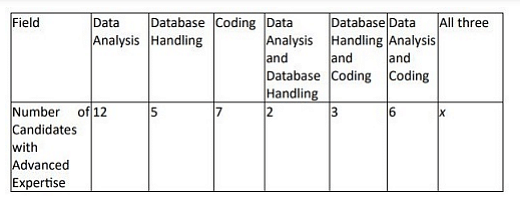
The number of applicants with advanced expertise in all three fields is given as x in the table, where x is a non-negative integer.
- XAT - 2024
- Data Interpretation