Directions for questions 49 to 52: There are exactly ten stores and no other buildings on a straight street in Bistupur Market. On the northern side of the street, from west to east, are stores 1, 3, 5, 7, and 9. On the southern side, also from west to east, are stores 2, 4, 6, 8, and 10. The stores on the northern side sit directly across the street from the stores on the southern side, facing each other in pairs: 1 and 2; 3 and 4; 5 and 6; 7 and 8; 9 and 10.
Each store is decorated with lights in exactly one colour: green, red, or yellow. The lighting follows these rules:
1. No store has the same light colour as a store next to it on the same side of the street.
2. No store has the same light colour as the store directly across the street from it.
3. Yellow lights decorate exactly one store on each side of the street.
4. Store 4 has red lights.
5. Store 5 has yellow lights.
If green lights decorate store 7, then each of the following statements could be false EXCEPT:
Each store is decorated with lights in exactly one colour: green, red, or yellow. The lighting follows these rules:
1. No store has the same light colour as a store next to it on the same side of the street.
2. No store has the same light colour as the store directly across the street from it.
3. Yellow lights decorate exactly one store on each side of the street.
4. Store 4 has red lights.
5. Store 5 has yellow lights.
If green lights decorate store 7, then each of the following statements could be false EXCEPT:
Show Hint
- Green lights decorate store 2
- Green lights decorate store 10
- Red lights decorate store 8
- Red lights decorate store 9
The Correct Option is D
Solution and Explanation
The question asks which one of four statements CANNOT be false once we are told green lights decorate store 7. A statement "cannot be false" only if every single valid way of colouring the street forces it to be true. So instead of just deriving forward, we can check each statement by trying to build a valid, complete colouring where that statement fails. If we can build even one such valid colouring, the statement is not forced, so it is wrong.
- Green lights decorate store 2: try store 2 = yellow instead. Then the south side needs its one yellow store to be somewhere among stores 2, 8, and 10, so let store 8 = red and store 10 = green. Check neighbours: store 2 (yellow) next to store 4 (red) is fine, store 4 (red) next to store 6 (green) is fine, store 6 (green) next to store 8 (red) is fine, store 8 (red) next to store 10 (green) is fine. Check facing pairs: store 1 (red) faces store 2 (yellow), store 7 (green) faces store 8 (red), store 9 (red) faces store 10 (green), none of these repeat. This is a fully valid arrangement where store 2 is yellow, not green, so "green decorates store 2" is not forced.
- Green lights decorate store 10: try store 10 = yellow instead. Then store 8 and store 2 must not be yellow, so let store 8 = red and store 2 = green. Neighbours: store 6 (green) next to store 8 (red), store 8 (red) next to store 10 (yellow), all fine. Facing pairs: store 9 (red) faces store 10 (yellow), which differs, and store 7 (green) faces store 8 (red), which also differs. This is valid, and here store 10 is yellow, not green, so that statement is not forced either.
- Red lights decorate store 8: try store 8 = yellow instead. Then the one south-side yellow slot is used up by store 8, so store 2 and store 10 must both avoid yellow: let store 2 = green and store 10 = green. Neighbours: store 6 (green) next to store 8 (yellow) is fine, store 8 (yellow) next to store 10 (green) is fine. Facing pairs: store 7 (green) faces store 8 (yellow), which differs, fine. This is a valid arrangement with store 8 yellow, not red, so that statement can be false too.
- Red lights decorate store 9: now try to make this false, meaning store 9 is not red. Store 9's only remaining options are green or yellow. Store 9 cannot be green because it neighbours store 7, which is green (given). Store 9 cannot be yellow because store 5 already holds the single yellow slot on the north side. There is no third colour to fall back on, so no valid arrangement can avoid making store 9 red. This statement cannot be broken.
Since a valid full colouring exists where each of the first three statements fails, but no valid colouring exists where the fourth one fails, "red lights decorate store 9" is the one statement that could not be false.
Let's summarize:
- Store 7 being green forces store 9 away from green (they are neighbours) and away from yellow (that slot belongs to store 5), leaving only red.
- Stores 2, 8, and 10 all still have more than one valid colour once store 7 is fixed, so no single colour is forced for any of them.
The correct statement is that red lights decorate store 9.
Top Questions on Complex Arrangement
- Four married couples competed in a singing competition. Each couple had a unique team name. Points scored by the teams were 2, 4, 6 and 8. The 'Sweet Couple' won 2 points. The 'Bindas Singers' won two more points than Laxman's team. Mukesh's team won four points more than Lina's team, but Lina's team didn't score the least amount of points. 'Just Singing' won 6 points. Waheda wasn't on the team called 'New Singers'. Sanjeev's team won 4 points. Divya wasn't on the 'Bindas Singers' team. Tapas and Sania were on the same team, but it wasn't the 'Sweet Couple'.
Laxman's teammate and team's name were:- XAT - 2009
- Decision Making
- Complex Arrangement
- Four married couples competed in a singing competition. Each couple had a unique team name. Points scored by the teams were 2, 4, 6 and 8. The 'Sweet Couple' won 2 points. The 'Bindas Singers' won two more points than Laxman's team. Mukesh's team won four points more than Lina's team, but Lina's team didn't score the least amount of points. 'Just Singing' won 6 points. Waheda wasn't on the team called 'New Singers'. Sanjeev's team won 4 points. Divya wasn't on the 'Bindas Singers' team. Tapas and Sania were on the same team, but it wasn't the 'Sweet Couple'.
The teams arranged in the ascending order of points are:- XAT - 2009
- Decision Making
- Complex Arrangement
- Four married couples competed in a singing competition. Each couple had a unique team name. Points scored by the teams were 2, 4, 6 and 8. The 'Sweet Couple' won 2 points. The 'Bindas Singers' won two more points than Laxman's team. Mukesh's team won four points more than Lina's team, but Lina's team didn't score the least amount of points. 'Just Singing' won 6 points. Waheda wasn't on the team called 'New Singers'. Sanjeev's team won 4 points. Divya wasn't on the 'Bindas Singers' team. Tapas and Sania were on the same team, but it wasn't the 'Sweet Couple'.
The combination which has the couples rightly paired is:- XAT - 2009
- Decision Making
- Complex Arrangement
The regular mathematics faculty could not teach because of being sick. As a stop-gap arrangement, different visiting faculty taught different topics on 4 different days in a week. The scheduled time for class was 7:00 am, with a maximum permissible delay of 20 minutes. The monsoon made the city bus schedules erratic, so the classes started at different times on different days.
Mr. Singh did not teach on Thursday. Calculus was taught in the class that started at 7:20 am. Mr. Chatterjee took the class on Wednesday, but he did not teach probability. The class on Monday started at 7:00 am, but Mr. Singh did not teach it. Mr. Dutta did not teach ratio and proportion. Mr. Banerjee, who did not teach set theory, taught a class that started five minutes later than the class in which probability was taught. The teacher in Friday's class taught set theory. Wednesday's class did not start at 7:10 am. No two classes started at the same time.
77. The class on Wednesday started at:
- XAT - 2009
- Decision Making
- Complex Arrangement
- Want to practice more? Try solving extra ecology questions todayView All Questions
Questions Asked in XAT exam
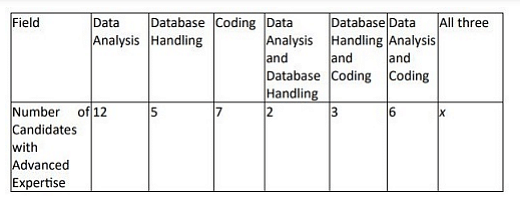
The number of applicants with advanced expertise in all three fields is given as x in the table, where x is a non-negative integer.
- XAT - 2024
- Data Interpretation