Question:hard
Directions for questions 49 and 50: Read the information given below and answer the question.
Let \(f\) be a function defined on the set of integers. Assume that \(f\) satisfies the following properties:
1. \(f(0) \neq 0\);
2. \(f(1) = 3\); and
3. \(f(x)f(y) = f(x+y) + f(x-y)\) for all integers \(x\) and \(y\).
What is \(f(3)\)?
Directions for questions 49 and 50: Read the information given below and answer the question.
Let \(f\) be a function defined on the set of integers. Assume that \(f\) satisfies the following properties:
1. \(f(0) \neq 0\);
2. \(f(1) = 3\); and
3. \(f(x)f(y) = f(x+y) + f(x-y)\) for all integers \(x\) and \(y\).
What is \(f(3)\)?
Let \(f\) be a function defined on the set of integers. Assume that \(f\) satisfies the following properties:
1. \(f(0) \neq 0\);
2. \(f(1) = 3\); and
3. \(f(x)f(y) = f(x+y) + f(x-y)\) for all integers \(x\) and \(y\).
What is \(f(3)\)?
Show Hint
Use x = y = 0 to pin down f(0), then set y = 1 to build the recurrence f(n+1) = 3f(n) - f(n-1).
Updated On: Jul 13, 2026
- 7
- 18
- 123
- 322
Show Solution
The Correct Option is B
Solution and Explanation
Step 1: Get f(0) from the given properties.
Setting \(x=y=0\) in \(f(x)f(y)=f(x+y)+f(x-y)\) gives \(f(0)^2 = 2f(0)\), so \(f(0)=0\) or \(f(0)=2\).
The condition \(f(0) \neq 0\) rules out the first case, so \(f(0)=2\).
Step 2: Find f(2) by direct substitution.
Put \(x=y=1\):
\[ f(1)f(1) = f(2) + f(0) \]
\[ 3 \times 3 = f(2) + 2 \]
\[ f(2) = 9 - 2 = 7 \]
Step 3: Find f(3) by direct substitution.
Put \(x=2, y=1\):
\[ f(2)f(1) = f(3) + f(1) \]
\[ 7 \times 3 = f(3) + 3 \]
\[ f(3) = 21 - 3 = 18 \]
Step 4: Match with the options.
This direct substitution, done without setting up any general recurrence, gives the same value $f(3)=18$, confirming option 2 is correct.
Notice that this substitution route only ever uses values we already know, $f(0)$, $f(1)$ and the newly found $f(2)$, plugged straight back into the same rule with a fresh pair of $x$ and $y$. There is no need to write down a formula like $f(n+1)=3f(n)-f(n-1)$ at all; each answer just falls out of the property directly.
Also check that the working is self-consistent: since $f(2)=7$, redo the check with $x=1,y=1$ once more as a sanity test, giving $f(1)f(1)=9=f(2)+f(0)=7+2=9$, which matches, so the value of $f(2)$ used to reach $f(3)$ is trustworthy.
So the final value is confirmed from two independent substitutions, and it agrees with the option list.
\[ \boxed{f(3) = 18} \]
Setting \(x=y=0\) in \(f(x)f(y)=f(x+y)+f(x-y)\) gives \(f(0)^2 = 2f(0)\), so \(f(0)=0\) or \(f(0)=2\).
The condition \(f(0) \neq 0\) rules out the first case, so \(f(0)=2\).
Step 2: Find f(2) by direct substitution.
Put \(x=y=1\):
\[ f(1)f(1) = f(2) + f(0) \]
\[ 3 \times 3 = f(2) + 2 \]
\[ f(2) = 9 - 2 = 7 \]
Step 3: Find f(3) by direct substitution.
Put \(x=2, y=1\):
\[ f(2)f(1) = f(3) + f(1) \]
\[ 7 \times 3 = f(3) + 3 \]
\[ f(3) = 21 - 3 = 18 \]
Step 4: Match with the options.
This direct substitution, done without setting up any general recurrence, gives the same value $f(3)=18$, confirming option 2 is correct.
Notice that this substitution route only ever uses values we already know, $f(0)$, $f(1)$ and the newly found $f(2)$, plugged straight back into the same rule with a fresh pair of $x$ and $y$. There is no need to write down a formula like $f(n+1)=3f(n)-f(n-1)$ at all; each answer just falls out of the property directly.
Also check that the working is self-consistent: since $f(2)=7$, redo the check with $x=1,y=1$ once more as a sanity test, giving $f(1)f(1)=9=f(2)+f(0)=7+2=9$, which matches, so the value of $f(2)$ used to reach $f(3)$ is trustworthy.
So the final value is confirmed from two independent substitutions, and it agrees with the option list.
\[ \boxed{f(3) = 18} \]
Was this answer helpful?
0
Top Questions on Sequence and Series
- Series Expansion $ n^6 + \frac{1}{2} n^4 + \frac{1}{3} n^2 + \cdots + \frac{1}{n} C_n + 1 \quad n \to \infty $
- MHT CET - 2025
- Mathematics
- Sequence and Series
- Krishna has certain number of coins numbered with a series of consecutive natural numbers starting with 1. He found that the sum of squares of all the numbers on the coins is 1753 times the sum of numbers on coins. How many coins does he have?
- IBSAT
- Quantitative Aptitude
- Sequence and Series
- A group of 630 children is arranged in rows for a photograph session. Each row contains three children lesser than the row in front of it. Which of the below mentioned number of rows is not possible?
- IBSAT
- Quantitative Aptitude
- Sequence and Series
- In each of the following questions a number series is given with one missing (?) term. The term is given as one of the alternatives among the five numbers given in the answer choic Find the term.
1, 27, 125, ? , 729, 1331- IBSAT
- Quantitative Aptitude
- Sequence and Series
- Want to practice more? Try solving extra ecology questions todayView All Questions
Questions Asked in XAT exam
Applicants have been shortlisted for interviews for some data analyst positions. Some of the applicants have advanced expertise in one or more fields among the following: data analysis, database handling and coding. The numbers of applicants with different advanced expertise are given in the 2 × 8 table below.
The number of applicants with advanced expertise in all three fields is given as x in the table, where x is a non-negative integer.
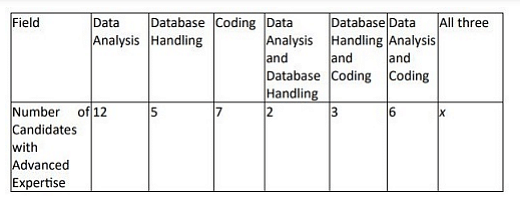
The number of applicants with advanced expertise in all three fields is given as x in the table, where x is a non-negative integer.
- XAT - 2024
- Data Interpretation