Question:medium
DIRECTIONS for questions 42 and 43: Read the information below and answer the question that follows.
A truck travelled from town A to town B over several days. During the first day, it covered \(\frac{1}{p}\) of the total distance, where p is a natural number. During the second day, it travelled \(\frac{1}{q}\) of the remaining distance, where q is a natural number. During the third day, it travelled \(\frac{1}{p}\) of the distance remaining after the second day, and during the fourth day, \(\frac{1}{q}\) of the distance remaining after the third day. By the end of the fourth day, the truck had travelled \(\frac{3}{4}\) of the distance between A and B.
42. The value of p + q is:
DIRECTIONS for questions 42 and 43: Read the information below and answer the question that follows.
A truck travelled from town A to town B over several days. During the first day, it covered \(\frac{1}{p}\) of the total distance, where p is a natural number. During the second day, it travelled \(\frac{1}{q}\) of the remaining distance, where q is a natural number. During the third day, it travelled \(\frac{1}{p}\) of the distance remaining after the second day, and during the fourth day, \(\frac{1}{q}\) of the distance remaining after the third day. By the end of the fourth day, the truck had travelled \(\frac{3}{4}\) of the distance between A and B.
42. The value of p + q is:
A truck travelled from town A to town B over several days. During the first day, it covered \(\frac{1}{p}\) of the total distance, where p is a natural number. During the second day, it travelled \(\frac{1}{q}\) of the remaining distance, where q is a natural number. During the third day, it travelled \(\frac{1}{p}\) of the distance remaining after the second day, and during the fourth day, \(\frac{1}{q}\) of the distance remaining after the third day. By the end of the fourth day, the truck had travelled \(\frac{3}{4}\) of the distance between A and B.
42. The value of p + q is:
Show Hint
Track the fraction of distance left after each day; after four days the leftover fraction is the square of \(\frac{(p-1)(q-1)}{pq}\), and it must equal \(\frac{1}{4}\).
Updated On: Jul 13, 2026
- 4
- 5
- 6
- 7
Show Solution
The Correct Option is D
Solution and Explanation
Step 1: Write the remaining fraction after 4 days.
Take the total distance as 1. After day 1, the fraction left is $\frac{p-1}{p}$. After day 2, multiply by $\frac{q-1}{q}$: what is left is $\frac{(p-1)(q-1)}{pq}$. Days 3 and 4 repeat the same two steps, so the fraction left after day 4 is the square of this value:
\[ \text{fraction left after day 4} = \left(\frac{(p-1)(q-1)}{pq}\right)^2 \]
Step 2: Match this to the given data.
The truck has covered $\frac{3}{4}$ of the distance in 4 days, so $\frac{1}{4}$ is left:
\[ \left(\frac{(p-1)(q-1)}{pq}\right)^2=\frac{1}{4} \implies \frac{(p-1)(q-1)}{pq}=\frac{1}{2} \]
(the negative square root is dropped because p and q are natural numbers, which keeps the ratio zero or positive).
Step 3: Test small natural numbers directly.
Rearranging gives $2(p-1)(q-1)=pq$. Instead of factoring, just try small values of p and see what q comes out to be:
If $p=2$: $2(1)(q-1)=2q \implies 2q-2=2q$, no solution.
If $p=3$: $2(2)(q-1)=3q \implies 4q-4=3q \implies q=4$, a natural number, so this works.
If $p=4$: $2(3)(q-1)=4q \implies 6q-6=4q \implies q=3$, also a natural number (this is just the $p=3$ case with the roles swapped).
If $p=5$: $2(4)(q-1)=5q \implies 8q-8=5q \implies 3q=8$, not a whole number, so no solution.
Trying bigger p only pushes q below 1 or gives a fraction, so $(p,q)=(3,4)$ and $(4,3)$ are the only natural number solutions that work.
Step 4: Final Answer.
Either way, $p+q=3+4=7$.
\[ \boxed{p+q=7} \]
Take the total distance as 1. After day 1, the fraction left is $\frac{p-1}{p}$. After day 2, multiply by $\frac{q-1}{q}$: what is left is $\frac{(p-1)(q-1)}{pq}$. Days 3 and 4 repeat the same two steps, so the fraction left after day 4 is the square of this value:
\[ \text{fraction left after day 4} = \left(\frac{(p-1)(q-1)}{pq}\right)^2 \]
Step 2: Match this to the given data.
The truck has covered $\frac{3}{4}$ of the distance in 4 days, so $\frac{1}{4}$ is left:
\[ \left(\frac{(p-1)(q-1)}{pq}\right)^2=\frac{1}{4} \implies \frac{(p-1)(q-1)}{pq}=\frac{1}{2} \]
(the negative square root is dropped because p and q are natural numbers, which keeps the ratio zero or positive).
Step 3: Test small natural numbers directly.
Rearranging gives $2(p-1)(q-1)=pq$. Instead of factoring, just try small values of p and see what q comes out to be:
If $p=2$: $2(1)(q-1)=2q \implies 2q-2=2q$, no solution.
If $p=3$: $2(2)(q-1)=3q \implies 4q-4=3q \implies q=4$, a natural number, so this works.
If $p=4$: $2(3)(q-1)=4q \implies 6q-6=4q \implies q=3$, also a natural number (this is just the $p=3$ case with the roles swapped).
If $p=5$: $2(4)(q-1)=5q \implies 8q-8=5q \implies 3q=8$, not a whole number, so no solution.
Trying bigger p only pushes q below 1 or gives a fraction, so $(p,q)=(3,4)$ and $(4,3)$ are the only natural number solutions that work.
Step 4: Final Answer.
Either way, $p+q=3+4=7$.
\[ \boxed{p+q=7} \]
Was this answer helpful?
0
Top Questions on Arithmetic
- There are 25 rooms in a hotel. Each room can accommodate at most three people. For each room, the single occupancy charge is Rs. 2000 per day, the double occupancy charge is Rs. 3000 per day, and the triple occupancy charge is Rs. 3500 per day. If there are 55 people staying in the hotel today, what is the maximum possible revenue from room occupancy charges today?
- Evaluate \(\sqrt[3]{1372} \times \sqrt[3]{1458}\)
- TS EDCET - 2025
- Quantitative Aptitude
- Arithmetic
- Gopi sold a watch to Ibrahim at 12% gain and Ibrahim sold it to John at a loss of 5%. If John paid ₹ 1,330, then find how much did Gopi sell it?
- TS EDCET - 2025
- Quantitative Aptitude
- Arithmetic
- Rani read \(\frac{3}{5}\) of a book. If she finds that there are still 80 pages left to read, then the total number of pages in the book is.
- TS EDCET - 2025
- Quantitative Aptitude
- Arithmetic
- Want to practice more? Try solving extra ecology questions todayView All Questions
Questions Asked in XAT exam
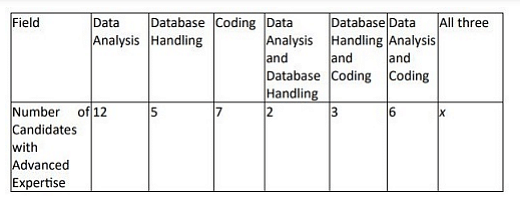
Applicants have been shortlisted for interviews for some data analyst positions. Some of the applicants have advanced expertise in one or more fields among the following: data analysis, database handling and coding. The numbers of applicants with different advanced expertise are given in the 2 × 8 table below.
The number of applicants with advanced expertise in all three fields is given as x in the table, where x is a non-negative integer.
The number of applicants with advanced expertise in all three fields is given as x in the table, where x is a non-negative integer.
- XAT - 2024
- Data Interpretation