Question:hard
Directions: Each question below is followed by two statements, I and II. Decide whether the data in the statements is sufficient to answer the question, using these options:
(AA) Statement I alone is sufficient.
(BB) Statement II alone is sufficient.
(CC) Statements I and II together are sufficient, but neither alone is sufficient.
(DD) Either statement I alone or statement II alone is sufficient.
(EE) Statements I and II together are not sufficient.
A, B, C, D, E and F are six integers such that \(E < F\), \(B > A\), and \(A < D < B\). C is the greatest of the six integers. Is A the smallest integer?
I. \(E + B < A + D\)
II. \(D < F\)
Directions: Each question below is followed by two statements, I and II. Decide whether the data in the statements is sufficient to answer the question, using these options:
(AA) Statement I alone is sufficient.
(BB) Statement II alone is sufficient.
(CC) Statements I and II together are sufficient, but neither alone is sufficient.
(DD) Either statement I alone or statement II alone is sufficient.
(EE) Statements I and II together are not sufficient.
A, B, C, D, E and F are six integers such that \(E < F\), \(B > A\), and \(A < D < B\). C is the greatest of the six integers. Is A the smallest integer?
I. \(E + B < A + D\)
II. \(D < F\)
(AA) Statement I alone is sufficient.
(BB) Statement II alone is sufficient.
(CC) Statements I and II together are sufficient, but neither alone is sufficient.
(DD) Either statement I alone or statement II alone is sufficient.
(EE) Statements I and II together are not sufficient.
A, B, C, D, E and F are six integers such that \(E < F\), \(B > A\), and \(A < D < B\). C is the greatest of the six integers. Is A the smallest integer?
I. \(E + B < A + D\)
II. \(D < F\)
Show Hint
Rearrange statement I to compare E and A directly, using the already-given fact that D is less than B.
Updated On: Jul 10, 2026
- Statement I alone is sufficient.
- Statement II alone is sufficient.
- Statements I and II together are sufficient, but neither alone is sufficient.
- Either statement I alone or statement II alone is sufficient.
Show Solution
The Correct Option is A
Solution and Explanation
Step 1: Restate the goal as a contradiction check.
Assume, for the sake of argument, that A actually is the smallest of the six integers. Under this assumption, A would have to be less than E as well, in addition to being less than D and B, which are already given. We will check whether each statement is consistent with this assumption.
Step 2: Check statement I under this assumption.
If $A < E$, and we are given $D < B$, adding these two inequalities the same way round gives $A + D < E + B$. But statement I says the opposite, $E + B < A + D$. This is a direct contradiction, so the assumption "A is the smallest" cannot be true whenever statement I holds. That means statement I, by itself, proves A is NOT the smallest, a firm and complete answer. Statement I alone is sufficient.
Step 3: Check statement II with a concrete example.
Statement II only says $D < F$. Try two different sets of numbers that both satisfy every given condition ($E < F$, $B > A$, $A < D < B$, C greatest) plus $D < F$: Example 1: $A=1, D=2, B=5, E=0, F=6, C=10$. Here $A=1 > E=0$, so A is not the smallest. Example 2: $A=1, D=2, B=5, E=3, F=6, C=10$. Here $A=1 < E=3$, so A is the smallest. Both examples satisfy statement II ($D=2<F=6$) and all the given constraints, yet they give opposite answers to "is A the smallest?". So statement II alone cannot pin down a unique answer.
Step 4: Conclude.
Statement I alone always gives a firm "No", while statement II alone can go either way depending on the numbers. So only statement I is independently sufficient, which is option (AA).
Final Answer:
Option (AA), statement I alone is sufficient.
Assume, for the sake of argument, that A actually is the smallest of the six integers. Under this assumption, A would have to be less than E as well, in addition to being less than D and B, which are already given. We will check whether each statement is consistent with this assumption.
Step 2: Check statement I under this assumption.
If $A < E$, and we are given $D < B$, adding these two inequalities the same way round gives $A + D < E + B$. But statement I says the opposite, $E + B < A + D$. This is a direct contradiction, so the assumption "A is the smallest" cannot be true whenever statement I holds. That means statement I, by itself, proves A is NOT the smallest, a firm and complete answer. Statement I alone is sufficient.
Step 3: Check statement II with a concrete example.
Statement II only says $D < F$. Try two different sets of numbers that both satisfy every given condition ($E < F$, $B > A$, $A < D < B$, C greatest) plus $D < F$: Example 1: $A=1, D=2, B=5, E=0, F=6, C=10$. Here $A=1 > E=0$, so A is not the smallest. Example 2: $A=1, D=2, B=5, E=3, F=6, C=10$. Here $A=1 < E=3$, so A is the smallest. Both examples satisfy statement II ($D=2<F=6$) and all the given constraints, yet they give opposite answers to "is A the smallest?". So statement II alone cannot pin down a unique answer.
Step 4: Conclude.
Statement I alone always gives a firm "No", while statement II alone can go either way depending on the numbers. So only statement I is independently sufficient, which is option (AA).
Final Answer:
Option (AA), statement I alone is sufficient.
Was this answer helpful?
0
Top Questions on Algebra
- Let \( n(A) = m \) and \( n(B) = n \), if the number of subsets of \( A \) is 56 more than that of subsets of \( B \), then \( m + n \) is equal to:
- VITEEE - 2024
- Mathematics
- Algebra
- Solve the quadratic equation: \[ x^2 - 5x + 6 = 0 \]
- VITEEE - 2025
- Mathematics
- Algebra
- Find the value of \( x \) in the following equation: \[ \frac{2}{x} + \frac{3}{x + 1} = 1 \]
- VITEEE - 2025
- Mathematics
- Algebra
- Find the value of \( x \) in the equation \( 2x + 3 = 7x - 8 \).
- VITEEE - 2025
- Mathematics
- Algebra
- Want to practice more? Try solving extra ecology questions todayView All Questions
Questions Asked in XAT exam
Applicants have been shortlisted for interviews for some data analyst positions. Some of the applicants have advanced expertise in one or more fields among the following: data analysis, database handling and coding. The numbers of applicants with different advanced expertise are given in the 2 × 8 table below.
The number of applicants with advanced expertise in all three fields is given as x in the table, where x is a non-negative integer.
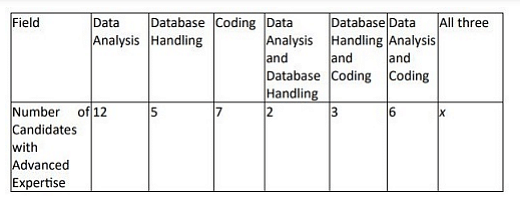
The number of applicants with advanced expertise in all three fields is given as x in the table, where x is a non-negative integer.
- XAT - 2024
- Data Interpretation