Question:hard
Directions: Each question below is followed by two statements, I and II. Decide whether the data in the statements is sufficient to answer the question, using these options:
(AA) Statement I alone is sufficient.
(BB) Statement II alone is sufficient.
(CC) Statements I and II together are sufficient, but neither alone is sufficient.
(DD) Either statement I alone or statement II alone is sufficient.
(EE) Statements I and II together are not sufficient.
The base of a triangle is 60 cm, and one of its base angles is \(60^{\circ}\). What is the length of the shortest side of the triangle?
I. The sum of the lengths of the other two sides is 80 cm.
II. The other base angle is \(45^{\circ}\).
Directions: Each question below is followed by two statements, I and II. Decide whether the data in the statements is sufficient to answer the question, using these options:
(AA) Statement I alone is sufficient.
(BB) Statement II alone is sufficient.
(CC) Statements I and II together are sufficient, but neither alone is sufficient.
(DD) Either statement I alone or statement II alone is sufficient.
(EE) Statements I and II together are not sufficient.
The base of a triangle is 60 cm, and one of its base angles is \(60^{\circ}\). What is the length of the shortest side of the triangle?
I. The sum of the lengths of the other two sides is 80 cm.
II. The other base angle is \(45^{\circ}\).
(AA) Statement I alone is sufficient.
(BB) Statement II alone is sufficient.
(CC) Statements I and II together are sufficient, but neither alone is sufficient.
(DD) Either statement I alone or statement II alone is sufficient.
(EE) Statements I and II together are not sufficient.
The base of a triangle is 60 cm, and one of its base angles is \(60^{\circ}\). What is the length of the shortest side of the triangle?
I. The sum of the lengths of the other two sides is 80 cm.
II. The other base angle is \(45^{\circ}\).
Show Hint
Try statement I with the cosine rule using the known base and base angle, then try statement II by finding the third angle and applying the sine rule, and check if each works alone.
Updated On: Jul 10, 2026
- Statement I alone is sufficient.
- Statement II alone is sufficient.
- Statements I and II together are sufficient, but neither alone is sufficient.
- Either statement I alone or statement II alone is sufficient.
Show Solution
The Correct Option is D
Solution and Explanation
Step 1: Draw the height from the apex for statement I.
Let ABC have base AB = 60, angle A = $60^{\circ}$, BC = a, AC = b. Drop a perpendicular from C to AB, meeting it at D. In right triangle ADC, angle A = $60^{\circ}$, so:
\[ AD = b\cos 60^{\circ} = \frac{b}{2}, \qquad CD = b\sin 60^{\circ} = \frac{b\sqrt{3}}{2} \]
Step 2: Use the right triangle on the other side.
Then $DB = 60 - \frac{b}{2}$, and in right triangle CDB, Pythagoras gives:
\[ a^2 = CD^2 + DB^2 = \frac{3b^2}{4} + \left(60 - \frac{b}{2}\right)^2 \]
Expanding the square, $\left(60-\frac{b}{2}\right)^2 = 3600 - 60b + \frac{b^2}{4}$, so:
\[ a^2 = \frac{3b^2}{4} + 3600 - 60b + \frac{b^2}{4} = b^2 - 60b + 3600 \]
Step 3: Bring in statement I and solve.
Statement I gives $a = 80 - b$, so $a^2 = 6400 - 160b + b^2$. Setting the two expressions for $a^2$ equal:
\[ 6400 - 160b + b^2 = b^2 - 60b + 3600 \] \[ 6400 - 160b = 3600 - 60b \] \[ 2800 = 100b \implies b = 28, \quad a = 52 \]
This matches the cosine-rule route exactly and fixes every side, so the shortest side is 28 cm, and statement I alone is sufficient.
Step 4: Reason about statement II directly.
Statement II gives a second angle, $45^{\circ}$, so the third angle is fixed at $180^{\circ} - 60^{\circ} - 45^{\circ} = 75^{\circ}$. A triangle is completely fixed, up to one unique shape and size, once one side and its two adjacent angles are known, which is the ASA rule from basic geometry. Here the base (60 cm) and both its adjacent angles ($60^{\circ}$ and $45^{\circ}$) are known, so the whole triangle, including the shortest side, is determined without doing the sine-rule arithmetic at all.
Final Answer:
Both statements are independently sufficient, each fixes a full triangle on its own, so the answer is option (DD), either statement alone works.
Let ABC have base AB = 60, angle A = $60^{\circ}$, BC = a, AC = b. Drop a perpendicular from C to AB, meeting it at D. In right triangle ADC, angle A = $60^{\circ}$, so:
\[ AD = b\cos 60^{\circ} = \frac{b}{2}, \qquad CD = b\sin 60^{\circ} = \frac{b\sqrt{3}}{2} \]
Step 2: Use the right triangle on the other side.
Then $DB = 60 - \frac{b}{2}$, and in right triangle CDB, Pythagoras gives:
\[ a^2 = CD^2 + DB^2 = \frac{3b^2}{4} + \left(60 - \frac{b}{2}\right)^2 \]
Expanding the square, $\left(60-\frac{b}{2}\right)^2 = 3600 - 60b + \frac{b^2}{4}$, so:
\[ a^2 = \frac{3b^2}{4} + 3600 - 60b + \frac{b^2}{4} = b^2 - 60b + 3600 \]
Step 3: Bring in statement I and solve.
Statement I gives $a = 80 - b$, so $a^2 = 6400 - 160b + b^2$. Setting the two expressions for $a^2$ equal:
\[ 6400 - 160b + b^2 = b^2 - 60b + 3600 \] \[ 6400 - 160b = 3600 - 60b \] \[ 2800 = 100b \implies b = 28, \quad a = 52 \]
This matches the cosine-rule route exactly and fixes every side, so the shortest side is 28 cm, and statement I alone is sufficient.
Step 4: Reason about statement II directly.
Statement II gives a second angle, $45^{\circ}$, so the third angle is fixed at $180^{\circ} - 60^{\circ} - 45^{\circ} = 75^{\circ}$. A triangle is completely fixed, up to one unique shape and size, once one side and its two adjacent angles are known, which is the ASA rule from basic geometry. Here the base (60 cm) and both its adjacent angles ($60^{\circ}$ and $45^{\circ}$) are known, so the whole triangle, including the shortest side, is determined without doing the sine-rule arithmetic at all.
Final Answer:
Both statements are independently sufficient, each fixes a full triangle on its own, so the answer is option (DD), either statement alone works.
Was this answer helpful?
0
Top Questions on Triangles
Fill in the blanks using the correct word given in the brackets :
(i) All circles are __________. (congruent, similar)
(ii) All squares are __________. (similar, congruent)
(iii) All __________ triangles are similar. (isosceles, equilateral)
(iv) Two polygons of the same number of sides are similar, if (a) their corresponding angles are __________ and (b) their corresponding sides are __________. (equal, proportional)- CBSE Class X
- Mathematics
- Triangles
- Give two different examples of a pair of
(i) Similar figures
(ii)Non-similar figures- CBSE Class X
- Mathematics
- Triangles
- State whether the following quadrilaterals are similar or not:

- CBSE Class X
- Mathematics
- Triangles
- In figure below (i) and (ii), DE || BC. Find EC in (i) and AD in (ii).
(i)
(ii)
- CBSE Class X
- Mathematics
- Triangles
- Want to practice more? Try solving extra ecology questions todayView All Questions
Questions Asked in XAT exam
Applicants have been shortlisted for interviews for some data analyst positions. Some of the applicants have advanced expertise in one or more fields among the following: data analysis, database handling and coding. The numbers of applicants with different advanced expertise are given in the 2 × 8 table below.
The number of applicants with advanced expertise in all three fields is given as x in the table, where x is a non-negative integer.
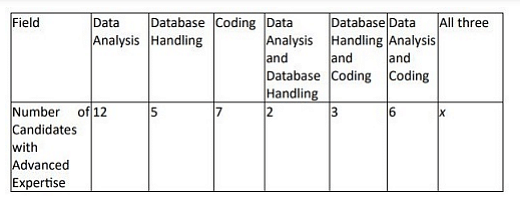
The number of applicants with advanced expertise in all three fields is given as x in the table, where x is a non-negative integer.
- XAT - 2024
- Data Interpretation