Directions: Each of the following questions is followed by two statements, labelled (A) and (B). Decide whether the statements are sufficient to conclusively answer the question, and choose:
(A) if Statement (A) alone is sufficient but Statement (B) alone is not.
(B) if Statement (B) alone is sufficient but Statement (A) alone is not.
(C) if Statement (A) and Statement (B) together are sufficient, but neither alone is sufficient.
(D) if either Statement (A) alone or Statement (B) alone is sufficient.
(E) if both statements together are still not sufficient.
ABC is a triangle with \(\angle B = 90^{\circ}\). What is the length of the side AC?
(A) D is the midpoint of BC and E is the midpoint of AB.
(B) AD = 7 and CE = 5.
(A) if Statement (A) alone is sufficient but Statement (B) alone is not.
(B) if Statement (B) alone is sufficient but Statement (A) alone is not.
(C) if Statement (A) and Statement (B) together are sufficient, but neither alone is sufficient.
(D) if either Statement (A) alone or Statement (B) alone is sufficient.
(E) if both statements together are still not sufficient.
ABC is a triangle with \(\angle B = 90^{\circ}\). What is the length of the side AC?
(A) D is the midpoint of BC and E is the midpoint of AB.
(B) AD = 7 and CE = 5.
Show Hint
- (A) Statement (A) alone is sufficient, but Statement (B) alone is not sufficient.
- (B) Statement (B) alone is sufficient, but Statement (A) alone is not sufficient.
- (C) Statement (A) and Statement (B) together are sufficient, but neither alone is sufficient.
- (D) Either Statement (A) alone or Statement (B) alone is sufficient.
The Correct Option is C
Solution and Explanation
Let's solve this by setting up coordinates instead of the median-length formula, which makes it obvious why both pieces of information are needed together.
Place the right angle at the origin: $B=(0,0)$, $A=(c,0)$ on one leg, and $C=(0,a)$ on the other leg, where $c=AB$ and $a=BC$.
Using Statement (A) alone: D being the midpoint of BC gives $D=(0, a/2)$, and E being the midpoint of AB gives $E=(c/2, 0)$. This is purely a statement about *where* D and E sit; it says nothing about the actual size of the triangle, so a, c, and hence AC, are completely unknown. Not sufficient.
Using Statement (B) alone: we are told two segment lengths, AD = 7 and CE = 5, but without knowing where D and E are located on their sides, these numbers cannot be tied to a and c in any single way. Not sufficient.
Using both together: with $D=(0,a/2)$ and $A=(c,0)$,
$$AD = \sqrt{c^2 + (a/2)^2} = 7 \implies c^2 + \frac{a^2}{4} = 49$$With $E=(c/2,0)$ and $C=(0,a)$,
$$CE = \sqrt{a^2 + (c/2)^2} = 5 \implies a^2 + \frac{c^2}{4} = 25$$Adding these two equations:
$$\left(a^2+c^2\right)\left(1+\frac14\right) = 74 \implies a^2+c^2 = \frac{296}{5}$$Since $AC=\sqrt{a^2+c^2}$ (AC is the hypotenuse, running from $A=(c,0)$ to $C=(0,a)$), we get a single fixed value:
$$AC = \sqrt{\frac{296}{5}} = \frac{2\sqrt{370}}{5} \approx 7.69$$Let's summarize:
- Statement (A) only fixes the position of D and E relative to the triangle, with no size information.
- Statement (B) only gives two lengths, but they cannot be used without knowing D and E are midpoints.
- Together, the two median-style equations combine to give a single value of $a^2+c^2$, and hence of AC.
So the two statements together are sufficient, but neither one alone is.
Top Questions on Triangles
Fill in the blanks using the correct word given in the brackets :
(i) All circles are __________. (congruent, similar)
(ii) All squares are __________. (similar, congruent)
(iii) All __________ triangles are similar. (isosceles, equilateral)
(iv) Two polygons of the same number of sides are similar, if (a) their corresponding angles are __________ and (b) their corresponding sides are __________. (equal, proportional)- CBSE Class X
- Mathematics
- Triangles
- Give two different examples of a pair of
(i) Similar figures
(ii)Non-similar figures- CBSE Class X
- Mathematics
- Triangles
- State whether the following quadrilaterals are similar or not:

- CBSE Class X
- Mathematics
- Triangles
- In figure below (i) and (ii), DE || BC. Find EC in (i) and AD in (ii).
(i)
(ii)
- CBSE Class X
- Mathematics
- Triangles
- Want to practice more? Try solving extra ecology questions todayView All Questions
Questions Asked in XAT exam
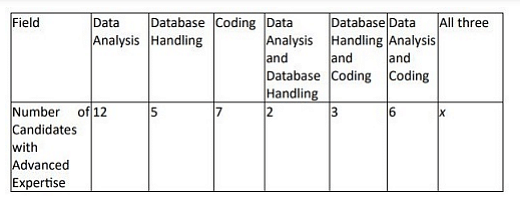
The number of applicants with advanced expertise in all three fields is given as x in the table, where x is a non-negative integer.
- XAT - 2024
- Data Interpretation