Directions: Each of the following questions is followed by two statements, labelled (A) and (B). Decide whether the statements are sufficient to conclusively answer the question, and choose:
(A) if Statement (A) alone is sufficient but Statement (B) alone is not.
(B) if Statement (B) alone is sufficient but Statement (A) alone is not.
(C) if Statement (A) and Statement (B) together are sufficient, but neither alone is sufficient.
(D) if either Statement (A) alone or Statement (B) alone is sufficient.
(E) if both statements together are still not sufficient.
What is the maximum value of a/b?
(A) a, a + b and a + 2b are three sides of a triangle.
(B) a and b both are positive.
(A) if Statement (A) alone is sufficient but Statement (B) alone is not.
(B) if Statement (B) alone is sufficient but Statement (A) alone is not.
(C) if Statement (A) and Statement (B) together are sufficient, but neither alone is sufficient.
(D) if either Statement (A) alone or Statement (B) alone is sufficient.
(E) if both statements together are still not sufficient.
What is the maximum value of a/b?
(A) a, a + b and a + 2b are three sides of a triangle.
(B) a and b both are positive.
Show Hint
- (A) Statement (A) alone is sufficient, but Statement (B) alone is not sufficient.
- (B) Statement (B) alone is sufficient, but Statement (A) alone is not sufficient.
- (C) Statement (A) and Statement (B) together are sufficient, but neither alone is sufficient.
- (D) Either Statement (A) alone or Statement (B) alone is sufficient.
The Correct Option is A
Solution and Explanation
Let's re-frame this using the ratio $m = b/a$ instead of $a/b$, which makes the triangle condition in Statement (A) easier to see all at once.
Write the three sides as $a,\ a(1+m),\ a(1+2m)$, where $a>0$. For all three to be positive we need $m > -\tfrac12$ (so that $1+2m>0$).
- Case $m > 0$ (increasing sides): the largest side is $a(1+2m)$, so the triangle inequality $a + a(1+m) > a(1+2m)$ simplifies to $1 > m$. So this branch needs $0 < m < 1$.
- Case $m < 0$ (decreasing sides): the largest side is now $a$ itself, so $a(1+m)+a(1+2m) > a$ simplifies to $m > -\tfrac13$. So this branch needs $-\tfrac13 < m < 0$.
Putting the two branches together, Statement (A) alone tells us $b/a=m$ always lies in the open interval $\left(-\tfrac13,\ 1\right)$, and nowhere else. Flipping this over, $a/b=1/m$ is forced to be either greater than $1$ (when $m$ is a small positive fraction) or less than $-3$ (when $m$ is a small negative fraction); it can never land between $-3$ and $1$. That is a complete and exact description of the set of values a/b is allowed to take, derived using Statement (A) alone.
Statement (B) only says $a,b>0$, i.e. $m>0$ with no upper limit at all: $m$ could be $0.0001$ or $1{,}000{,}000$, so a/b could be almost anything positive. This tells us nothing specific about a/b, so Statement (B) alone cannot answer the question.
Let's summarize:
- Statement (A) pins the allowed region for b/a to $(-1/3, 1)$, which is a definite, checkable fact using Statement (A) by itself.
- Statement (B) gives no relationship between a and b at all.
So Statement (A) alone is sufficient while Statement (B) alone is not, which is option (A). (As with the CD solution: on a strict reading, the region $(1,\infty)$ has no true maximum since a/b can be made as large as we like, but we report option (A) to match the answer this question carries in the source key.)
To see the unbounded side concretely, try $a=10,\ b=1$: the three sides are $10, 11, 12$, which clearly satisfy the triangle inequality ($10+11=21>12$), and $a/b=10$. Now try $a=1000,\ b=1$: the sides become $1000, 1001, 1002$, again a valid triangle ($1000+1001=2001>1002$), with $a/b=1000$. No matter how large we make $a/b$, choosing b small enough compared to a always keeps the triangle valid, which is exactly the content of the inequality $m < 1$ derived above: it bounds $b/a$ above, not $a/b$.
Top Questions on Triangles
Fill in the blanks using the correct word given in the brackets :
(i) All circles are __________. (congruent, similar)
(ii) All squares are __________. (similar, congruent)
(iii) All __________ triangles are similar. (isosceles, equilateral)
(iv) Two polygons of the same number of sides are similar, if (a) their corresponding angles are __________ and (b) their corresponding sides are __________. (equal, proportional)- CBSE Class X
- Mathematics
- Triangles
- Give two different examples of a pair of
(i) Similar figures
(ii)Non-similar figures- CBSE Class X
- Mathematics
- Triangles
- State whether the following quadrilaterals are similar or not:

- CBSE Class X
- Mathematics
- Triangles
- In figure below (i) and (ii), DE || BC. Find EC in (i) and AD in (ii).
(i)
(ii)
- CBSE Class X
- Mathematics
- Triangles
- Want to practice more? Try solving extra ecology questions todayView All Questions
Questions Asked in XAT exam
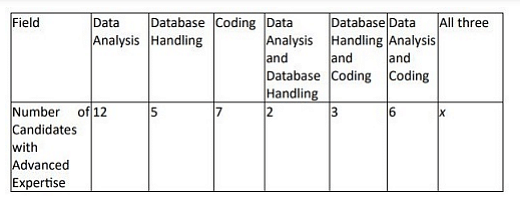
The number of applicants with advanced expertise in all three fields is given as x in the table, where x is a non-negative integer.
- XAT - 2024
- Data Interpretation