Question:medium
Directions: A statement is followed by three conclusions. Choose the answer from the options below.
(AA) Using the given statement, only conclusion I can be derived.
(BB) Using the given statement, only conclusion II can be derived.
(CC) Using the given statement, only conclusion III can be derived.
(DD) Using the given statement, all conclusions can be derived.
(EE) Using the given statement, none of the three conclusions I, II and III can be derived.
A, B, C and D are whole numbers such that:
\(A + B + C = 118\)
\(B + C + D = 156\)
\(C + D + A = 166\)
\(D + A + B = 178\)
Conclusion I: A is the smallest number and A = 21.
Conclusion II: D is the largest number and D = 88.
Conclusion III: B is the largest number and B = 56.
Directions: A statement is followed by three conclusions. Choose the answer from the options below.
(AA) Using the given statement, only conclusion I can be derived.
(BB) Using the given statement, only conclusion II can be derived.
(CC) Using the given statement, only conclusion III can be derived.
(DD) Using the given statement, all conclusions can be derived.
(EE) Using the given statement, none of the three conclusions I, II and III can be derived.
A, B, C and D are whole numbers such that:
\(A + B + C = 118\)
\(B + C + D = 156\)
\(C + D + A = 166\)
\(D + A + B = 178\)
Conclusion I: A is the smallest number and A = 21.
Conclusion II: D is the largest number and D = 88.
Conclusion III: B is the largest number and B = 56.
(AA) Using the given statement, only conclusion I can be derived.
(BB) Using the given statement, only conclusion II can be derived.
(CC) Using the given statement, only conclusion III can be derived.
(DD) Using the given statement, all conclusions can be derived.
(EE) Using the given statement, none of the three conclusions I, II and III can be derived.
A, B, C and D are whole numbers such that:
\(A + B + C = 118\)
\(B + C + D = 156\)
\(C + D + A = 166\)
\(D + A + B = 178\)
Conclusion I: A is the smallest number and A = 21.
Conclusion II: D is the largest number and D = 88.
Conclusion III: B is the largest number and B = 56.
Show Hint
Add all four given equations together first; that sum equals 3 times (A+B+C+D), which lets you find each variable one at a time.
Updated On: Jul 10, 2026
- Using the given statement, only conclusion I can be derived.
- Using the given statement, only conclusion II can be derived.
- Using the given statement, only conclusion III can be derived.
- Using the given statement, all conclusions can be derived.
Show Solution
The Correct Option is B
Solution and Explanation
Instead of adding all four equations at once, this approach finds the differences between pairs of equations directly, which pins down two variables early and lets the rest follow by simple substitution.
- Subtract equation (ii) from equation (iii): $(C + D + A) - (A + B + C) = 166 - 118$, which simplifies to $D - B = 48$.
- Subtract equation (ii) from equation (iv): $(D + A + B) - (B + C + D) = 178 - 156$, which simplifies to $A - C = 22$.
- Use equation (ii) with the first difference: $B + C + D = 156$. Substitute $D = B + 48$: $B + C + B + 48 = 156$, so $2B + C = 108$.
- Use equation (ii) with the second difference: $A + B + C = 118$ and $A = C + 22$, so $(C + 22) + B + C = 118$, giving $2C + B = 96$.
- Solve the two-variable system: from $2B + C = 108$ and $B + 2C = 96$, multiply the first by 2: $4B + 2C = 216$. Subtract the second equation from this: $4B + 2C - (B + 2C) = 216 - 96$, giving $3B = 120$, so $B = 40$.
- Back-substitute for the rest: from $2B + C = 108$: $C = 108 - 80 = 28$. From $A = C + 22$: $A = 50$. From $D = B + 48$: $D = 88$.
These values match a direct sum-of-all-equations approach: $A = 50$, $B = 40$, $C = 28$, $D = 88$, and together they add to $206$, which checks out against every one of the four original equations.
Let's summarize:
- Comparing the four values, $D = 88$ is the biggest and $C = 28$ is the smallest, so D is the largest number, not A or B.
- Conclusion I is wrong on both counts, Conclusion III is wrong on both counts, while Conclusion II is exactly right.
So only Conclusion II can be derived from the statement.
Was this answer helpful?
0
Top Questions on Algebra
- Let \( n(A) = m \) and \( n(B) = n \), if the number of subsets of \( A \) is 56 more than that of subsets of \( B \), then \( m + n \) is equal to:
- VITEEE - 2024
- Mathematics
- Algebra
- Solve the quadratic equation: \[ x^2 - 5x + 6 = 0 \]
- VITEEE - 2025
- Mathematics
- Algebra
- Find the value of \( x \) in the following equation: \[ \frac{2}{x} + \frac{3}{x + 1} = 1 \]
- VITEEE - 2025
- Mathematics
- Algebra
- Find the value of \( x \) in the equation \( 2x + 3 = 7x - 8 \).
- VITEEE - 2025
- Mathematics
- Algebra
- Want to practice more? Try solving extra ecology questions todayView All Questions
Questions Asked in XAT exam
Applicants have been shortlisted for interviews for some data analyst positions. Some of the applicants have advanced expertise in one or more fields among the following: data analysis, database handling and coding. The numbers of applicants with different advanced expertise are given in the 2 × 8 table below.
The number of applicants with advanced expertise in all three fields is given as x in the table, where x is a non-negative integer.
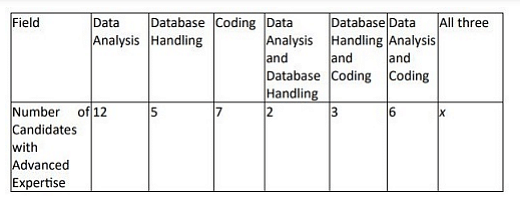
The number of applicants with advanced expertise in all three fields is given as x in the table, where x is a non-negative integer.
- XAT - 2024
- Data Interpretation