Question:hard
Directions: A statement is followed by three conclusions. Choose the answer from the options below.
(AA) Using the given statement, only conclusion I can be derived.
(BB) Using the given statement, only conclusion II can be derived.
(CC) Using the given statement, only conclusion III can be derived.
(DD) Using the given statement, all conclusions can be derived.
(EE) Using the given statement, none of the three conclusions I, II and III can be derived.
An operation # is defined by \(a \# b = 1 - \dfrac{b}{a}\).
Conclusion I: \((2 \# 1) \# (4 \# 3) = -1\)
Conclusion II: \((3 \# 1) \# (4 \# 2) = -2\)
Conclusion III: \((2 \# 3) \# (1 \# 3) = 0\)
Directions: A statement is followed by three conclusions. Choose the answer from the options below.
(AA) Using the given statement, only conclusion I can be derived.
(BB) Using the given statement, only conclusion II can be derived.
(CC) Using the given statement, only conclusion III can be derived.
(DD) Using the given statement, all conclusions can be derived.
(EE) Using the given statement, none of the three conclusions I, II and III can be derived.
An operation # is defined by \(a \# b = 1 - \dfrac{b}{a}\).
Conclusion I: \((2 \# 1) \# (4 \# 3) = -1\)
Conclusion II: \((3 \# 1) \# (4 \# 2) = -2\)
Conclusion III: \((2 \# 3) \# (1 \# 3) = 0\)
(AA) Using the given statement, only conclusion I can be derived.
(BB) Using the given statement, only conclusion II can be derived.
(CC) Using the given statement, only conclusion III can be derived.
(DD) Using the given statement, all conclusions can be derived.
(EE) Using the given statement, none of the three conclusions I, II and III can be derived.
An operation # is defined by \(a \# b = 1 - \dfrac{b}{a}\).
Conclusion I: \((2 \# 1) \# (4 \# 3) = -1\)
Conclusion II: \((3 \# 1) \# (4 \# 2) = -2\)
Conclusion III: \((2 \# 3) \# (1 \# 3) = 0\)
Show Hint
Work out the value of each conclusion's expression using the given rule for #, then compare it with the number the conclusion claims.
Updated On: Jul 10, 2026
- Using the given statement, only conclusion I can be derived.
- Using the given statement, only conclusion II can be derived.
- Using the given statement, only conclusion III can be derived.
- Using the given statement, none of the three conclusions I, II and III can be derived.
Show Solution
The Correct Option is D
Solution and Explanation
The custom operator here is $a \# b = 1 - \dfrac{b}{a}$, read as take 1 and subtract the second number divided by the first. Since each conclusion nests this operator twice, first inside the brackets and then between the two bracket results, work from the inside out for each one and check if the final number matches what the conclusion states.
- Conclusion I: $(2 \# 1) \# (4 \# 3) = -1$? Inner values: $2 \# 1 = 1 - 1/2 = 1/2$ and $4 \# 3 = 1 - 3/4 = 1/4$. Outer step, with $a = 1/2$ and $b = 1/4$: $1 - \dfrac{1/4}{1/2} = 1 - 1/2 = 1/2$. Since $1/2 \neq -1$, this conclusion is false.
- Conclusion II: $(3 \# 1) \# (4 \# 2) = -2$? Inner values: $3 \# 1 = 1 - 1/3 = 2/3$ and $4 \# 2 = 1 - 2/4 = 1/2$. Outer step, with $a = 2/3$ and $b = 1/2$: $1 - \dfrac{1/2}{2/3} = 1 - 3/4 = 1/4$. Since $1/4 \neq -2$, this conclusion is also false.
- Conclusion III: $(2 \# 3) \# (1 \# 3) = 0$? Inner values: $2 \# 3 = 1 - 3/2 = -1/2$ and $1 \# 3 = 1 - 3/1 = -2$. Outer step, with $a = -1/2$ and $b = -2$: $1 - \dfrac{-2}{-1/2} = 1 - 4 = -3$. Since $-3 \neq 0$, this conclusion fails as well.
Every one of the three conclusions produces a number that does not match the claim in the conclusion, so nothing in the statement supports Conclusion I, II or III.
Let's summarize:
- Always compute the inner two brackets first, then apply the operator once more between those two results, keeping careful track of the order of $a$ and $b$ since the operator is not symmetric.
- Conclusion I gives $1/2$ (not $-1$), Conclusion II gives $1/4$ (not $-2$), and Conclusion III gives $-3$ (not $0$), so all three are wrong.
Since none of the three conclusions can actually be derived, the correct option is the one stating that none of them holds.
Was this answer helpful?
0
Top Questions on Algebra
- Let \( n(A) = m \) and \( n(B) = n \), if the number of subsets of \( A \) is 56 more than that of subsets of \( B \), then \( m + n \) is equal to:
- VITEEE - 2024
- Mathematics
- Algebra
- Solve the quadratic equation: \[ x^2 - 5x + 6 = 0 \]
- VITEEE - 2025
- Mathematics
- Algebra
- Find the value of \( x \) in the following equation: \[ \frac{2}{x} + \frac{3}{x + 1} = 1 \]
- VITEEE - 2025
- Mathematics
- Algebra
- Find the value of \( x \) in the equation \( 2x + 3 = 7x - 8 \).
- VITEEE - 2025
- Mathematics
- Algebra
- Want to practice more? Try solving extra ecology questions todayView All Questions
Questions Asked in XAT exam
Applicants have been shortlisted for interviews for some data analyst positions. Some of the applicants have advanced expertise in one or more fields among the following: data analysis, database handling and coding. The numbers of applicants with different advanced expertise are given in the 2 × 8 table below.
The number of applicants with advanced expertise in all three fields is given as x in the table, where x is a non-negative integer.
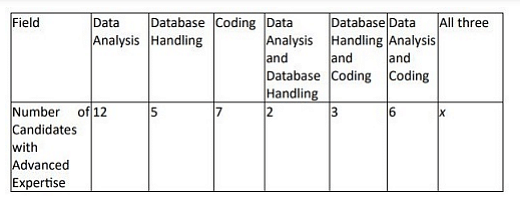
The number of applicants with advanced expertise in all three fields is given as x in the table, where x is a non-negative integer.
- XAT - 2024
- Data Interpretation