Directions: A circular field, with inner radius of 10 meters and outer radius of 20 meters, was divided into five successive stages for ploughing. The ploughing of each stage was handed over to a different farmer.
1. Farmers are referred to by the symbols F1, F2, F3, F4, F5.
2. The points between different stages are referred to by the symbols P1, P2, P3, P4, P5, not necessarily in that order.
3. Farmer F5 was given the work of ploughing the stage starting at point P4.
4. The stage from point P5 to point P3 was not the first stage.
5. Farmer F4 was given the work of the fourth stage.
6. Stage 3 finished at point P1, and the work of which was not given to farmer F1.
7. Farmer F3 was given the work of the stage ending at point P5.
Which was the starting point for farmer F3?
Directions: A circular field, with inner radius of 10 meters and outer radius of 20 meters, was divided into five successive stages for ploughing. The ploughing of each stage was handed over to a different farmer.
1. Farmers are referred to by the symbols F1, F2, F3, F4, F5.
2. The points between different stages are referred to by the symbols P1, P2, P3, P4, P5, not necessarily in that order.
3. Farmer F5 was given the work of ploughing the stage starting at point P4.
4. The stage from point P5 to point P3 was not the first stage.
5. Farmer F4 was given the work of the fourth stage.
6. Stage 3 finished at point P1, and the work of which was not given to farmer F1.
7. Farmer F3 was given the work of the stage ending at point P5.
Which was the starting point for farmer F3?
Show Hint
- P2
- P3
- P4
- P1
The Correct Option is A
Solution and Explanation
We can check each option directly against the fixed arrangement of points and clue 7, instead of re-deriving the whole loop step by step.
- P2: Once the loop is fixed as stage 1 = P2 to P5, stage 2 = P5 to P3, stage 3 = P3 to P1, stage 4 = P1 to P4, stage 5 = P4 to P2, the stage ending at P5 (clue 7, F3's stage) is stage 1, which starts at P2. This matches.
- P3: The stage starting at P3 is stage 3, which ends at P1, not P5, so this cannot be F3's stage.
- P4: The stage starting at P4 is stage 5, which by clue 3 belongs to F5, not F3, so this is wrong.
- P1: The stage starting at P1 is stage 4, which by clue 5 belongs to F4, not F3, so this is wrong.
Only P2 lines up with clue 7's requirement that F3's stage ends at P5.
Let's summarize:
- Clue 7 is the fastest way to pin F3's stage once the loop of points is known.
- Checking each option's stage against clue 7 avoids reworking the whole puzzle from scratch.
The correct answer is P2.
Top Questions on Complex Arrangement
- Four married couples competed in a singing competition. Each couple had a unique team name. Points scored by the teams were 2, 4, 6 and 8. The 'Sweet Couple' won 2 points. The 'Bindas Singers' won two more points than Laxman's team. Mukesh's team won four points more than Lina's team, but Lina's team didn't score the least amount of points. 'Just Singing' won 6 points. Waheda wasn't on the team called 'New Singers'. Sanjeev's team won 4 points. Divya wasn't on the 'Bindas Singers' team. Tapas and Sania were on the same team, but it wasn't the 'Sweet Couple'.
Laxman's teammate and team's name were:- XAT - 2009
- Decision Making
- Complex Arrangement
- Four married couples competed in a singing competition. Each couple had a unique team name. Points scored by the teams were 2, 4, 6 and 8. The 'Sweet Couple' won 2 points. The 'Bindas Singers' won two more points than Laxman's team. Mukesh's team won four points more than Lina's team, but Lina's team didn't score the least amount of points. 'Just Singing' won 6 points. Waheda wasn't on the team called 'New Singers'. Sanjeev's team won 4 points. Divya wasn't on the 'Bindas Singers' team. Tapas and Sania were on the same team, but it wasn't the 'Sweet Couple'.
The teams arranged in the ascending order of points are:- XAT - 2009
- Decision Making
- Complex Arrangement
- Four married couples competed in a singing competition. Each couple had a unique team name. Points scored by the teams were 2, 4, 6 and 8. The 'Sweet Couple' won 2 points. The 'Bindas Singers' won two more points than Laxman's team. Mukesh's team won four points more than Lina's team, but Lina's team didn't score the least amount of points. 'Just Singing' won 6 points. Waheda wasn't on the team called 'New Singers'. Sanjeev's team won 4 points. Divya wasn't on the 'Bindas Singers' team. Tapas and Sania were on the same team, but it wasn't the 'Sweet Couple'.
The combination which has the couples rightly paired is:- XAT - 2009
- Decision Making
- Complex Arrangement
The regular mathematics faculty could not teach because of being sick. As a stop-gap arrangement, different visiting faculty taught different topics on 4 different days in a week. The scheduled time for class was 7:00 am, with a maximum permissible delay of 20 minutes. The monsoon made the city bus schedules erratic, so the classes started at different times on different days.
Mr. Singh did not teach on Thursday. Calculus was taught in the class that started at 7:20 am. Mr. Chatterjee took the class on Wednesday, but he did not teach probability. The class on Monday started at 7:00 am, but Mr. Singh did not teach it. Mr. Dutta did not teach ratio and proportion. Mr. Banerjee, who did not teach set theory, taught a class that started five minutes later than the class in which probability was taught. The teacher in Friday's class taught set theory. Wednesday's class did not start at 7:10 am. No two classes started at the same time.
77. The class on Wednesday started at:
- XAT - 2009
- Decision Making
- Complex Arrangement
- Want to practice more? Try solving extra ecology questions todayView All Questions
Questions Asked in XAT exam
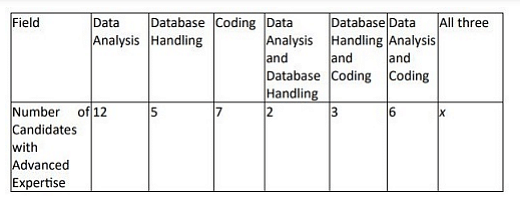
The number of applicants with advanced expertise in all three fields is given as x in the table, where x is a non-negative integer.
- XAT - 2024
- Data Interpretation