Question:medium
Consider the matrix \[ M= \begin{bmatrix} 2 & -1 \\ 1 & 0 \end{bmatrix} \] Let \(p,q,r,s,a,b,c,d\) be integers such that \[ M^{26}= \begin{bmatrix} p & q \\ r & s \end{bmatrix} \] and \[ \sum_{k=1}^{26} M^k= \begin{bmatrix} a & b \\ c & d \end{bmatrix}. \] Then which of the following statements is (are) TRUE?
Consider the matrix \[ M= \begin{bmatrix} 2 & -1 \\ 1 & 0 \end{bmatrix} \] Let \(p,q,r,s,a,b,c,d\) be integers such that \[ M^{26}= \begin{bmatrix} p & q \\ r & s \end{bmatrix} \] and \[ \sum_{k=1}^{26} M^k= \begin{bmatrix} a & b \\ c & d \end{bmatrix}. \] Then which of the following statements is (are) TRUE?
Show Hint
M = I + E with E squared equal to zero, so M^n = I + nE. Use this to get M^26 and the sum, then test each statement.
Updated On: Nov 19, 2026
- There exists a \(2\times2\) invertible matrix \(N\) with real entries such that \[ MN= N \begin{bmatrix} 1 & 1 \\ 0 & 1 \end{bmatrix} \]
- The value of \(a\) is \(378\)
- For any two given integers \(m\) and \(n\), there exist unique integers \(x\) and \(y\) such that \[ px+qy=m \] and \[ rx+sy=n \]
- For each positive real number \(t\), the system of linear equations \[ (a+t)x+by=1 \] \[ cx+(d+t)y=-1 \] has a unique solution
Show Solution
The Correct Option is A, C, D
Solution and Explanation
Step 1: Find M^26 using the Cayley-Hamilton idea:
The characteristic polynomial of $M$ is $\lambda^2-2\lambda+1=(\lambda-1)^2$. So $(M-I)^2=0$.
Expand $M^n=(I+(M-I))^n=I+n(M-I)$, since higher powers of $(M-I)$ vanish.
With $M-I=\begin{bmatrix}1&-1\\1&-1\end{bmatrix}$: $M^{26}=\begin{bmatrix}27&-26\\26&-25\end{bmatrix}$.
The sum is $26I+(1+2+\dots+26)(M-I)=26I+351(M-I)$. This gives $a=377$, $b=-351$, $c=351$, $d=-325$.
Step 2: Statement (A) by Jordan form:
$M$ has the single eigenvalue $1$, repeated twice. But $M\ne I$, so $M$ has only one independent eigenvector.
Such a matrix is similar to the Jordan block $\begin{bmatrix}1&1\\0&1\end{bmatrix}$. So an invertible $N$ with $MN=NJ$ exists.
An explicit one is $N=\begin{bmatrix}1&1\\1&0\end{bmatrix}$. (A) is TRUE.
Step 3: Statement (B) by direct value:
$a=26+351=377$. The option says $378$. So (B) is FALSE.
Step 4: Statement (C) by integer inverse:
For a $2\times2$ matrix the inverse is $\dfrac1{\det}\begin{bmatrix}s&-q\\-r&p\end{bmatrix}$.
Here $\det M^{26}=ps-qr=27(-25)+26\cdot26=-675+676=1$.
So the inverse is $\begin{bmatrix}-25&26\\-26&27\end{bmatrix}$, with integer entries. For every integer pair $(m,n)$ the solution is unique and integral. (C) is TRUE.
Step 5: Statement (D) by eigenvalues:
The matrix $S=26I+351(M-I)$ has the eigenvalue $26$ (twice), because $(M-I)$ is nilpotent.
Then $S+tI$ has the eigenvalue $26+t$ (twice). Its determinant is $(26+t)^2$.
For $t>0$ this is non-zero, so the system has exactly one solution. (D) is TRUE.
Final Answer:
Statements A, C and D hold; statement B is false because a equals 377. \[ \boxed{\text{A, C, D}} \]
Was this answer helpful?
0
Top Questions on Algebra
- Let \( n(A) = m \) and \( n(B) = n \), if the number of subsets of \( A \) is 56 more than that of subsets of \( B \), then \( m + n \) is equal to:
- VITEEE - 2024
- Mathematics
- Algebra
- Solve the quadratic equation: \[ x^2 - 5x + 6 = 0 \]
- VITEEE - 2025
- Mathematics
- Algebra
- Find the value of \( x \) in the following equation: \[ \frac{2}{x} + \frac{3}{x + 1} = 1 \]
- VITEEE - 2025
- Mathematics
- Algebra
- Find the value of \( x \) in the equation \( 2x + 3 = 7x - 8 \).
- VITEEE - 2025
- Mathematics
- Algebra
- Want to practice more? Try solving extra ecology questions todayView All Questions
Questions Asked in JEE Advanced exam
A thin uniform rod of length L and certain mass is kept on a frictionless horizontal table with a massless string of length L fixed to one end (top view is shown in the figure). The other end of the string is pivoted to a point O. If a horizontal impulse P is imparted to the rod at a distance x = L/n from the mid-point of the rod (see figure), then the rod and string revolve together around the point O, with the rod remaining aligned with the string. In such a case, the value of n is _____.
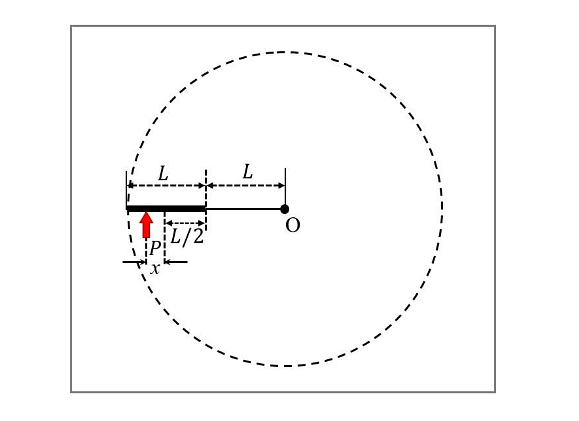
- JEE Advanced - 2024
- Friction