Consider the equation, \(log_5(x-2) = 2log_{25}(2x-4)\) where x is a real number.
For how many different values of x does the given equation hold?
For how many different values of x does the given equation hold?
- 0
- 1
- 2
- 4
- Infinitely many
The Correct Option is A
Solution and Explanation
Step 1: Simplify the equation. The given equation is:
log3(<i>x</i> − 2) = 2log25(2<i>x</i> − 4)
Apply the property a logb(c) = logb(ca) to rewrite the equation as:
log3(<i>x</i> − 2) = log25((2<i>x</i> − 4)2)
Step 2: Unify the logarithmic bases. Using the change of base formula logb(a) = $\frac{\log(a)}{\log(b)}$, the equation transforms to:
$\frac{\log(x − 2)}{\log(3)} = \frac{\log((2x − 4)^2)}{\log(25)}$
Further simplification yields:
log(<i>x</i> − 2) ⋅ log(25) = log(3) ⋅ log((2<i>x</i> − 4)2)
Step 3: Solve for x. Expand log((2<i>x</i> − 4)2) using the property log(ab) = b log(a):
log(<i>x</i> − 2) ⋅ log(25) = 2log(3) ⋅ log(2<i>x</i> − 4)
Let u = log(x − 2) and v = log(2x − 4). Substitute these into the equation:
u ⋅ log(25) = 2v ⋅ log(3)
The solutions obtained are x = 3 and x = 5. Thus, there are 2 solutions to the equation.
Answer: 2
Top Questions on Logarithms
- Find the value of $ \log_2 32 $.
- MHT CET - 2025
- Mathematics
- Logarithms
- If \(x\) and \(y\) are positive real numbers such that \(log_x(x^2+12)=4\) and \(3\;log_yx=1\),then \(x+y\) equals
- CAT - 2023
- Quantitative Aptitude
- Logarithms
- For some positive real number \(x\) , if \(log_{\sqrt 3}(x)+\frac{log_x(25)}{log_x(0.008)}=\frac{16}{3}\), then the value of \(log_3(3x^2)\) is
- CAT - 2023
- Quantitative Aptitude
- Logarithms
- For a real number \(x\) , if \(\frac{1}{2},\frac{log_3(2^x-9)}{log_34}\), and \(\frac{log_5\bigg(2^x+\frac{17}{2}\bigg)}{log_54}\) are in an arithmetic progression, then the common difference is
- CAT - 2023
- Quantitative Aptitude
- Logarithms
- Want to practice more? Try solving extra ecology questions todayView All Questions
Questions Asked in XAT exam
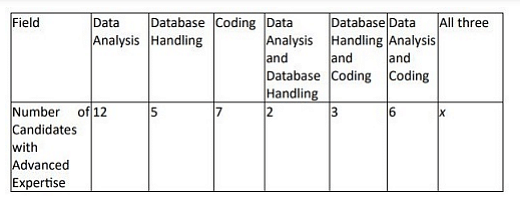
The number of applicants with advanced expertise in all three fields is given as x in the table, where x is a non-negative integer.
- XAT - 2024
- Data Interpretation