Question:medium
Consider a hydrogen atom with \(v_k,\ r_k,\) and \(K_k\) denoting the velocity, orbital radius and kinetic energy of the electron in \(k^{\text{th}}\) orbit, respectively. The electron undergoes a transition from the \(n^{\text{th}}\) orbit, emitting radiation corresponding to the Lyman series. Considering \(h\) to be the Planck's constant and \(\epsilon_0\) the permittivity of free space, the correct statement(s) is/are:
Consider a hydrogen atom with \(v_k,\ r_k,\) and \(K_k\) denoting the velocity, orbital radius and kinetic energy of the electron in \(k^{\text{th}}\) orbit, respectively. The electron undergoes a transition from the \(n^{\text{th}}\) orbit, emitting radiation corresponding to the Lyman series. Considering \(h\) to be the Planck's constant and \(\epsilon_0\) the permittivity of free space, the correct statement(s) is/are:
Show Hint
Use K = (h/4 pi)(k v_k/r_k) from the angular momentum rule, E = -K, and r_k = e^2/(8 pi eps0 K_k). Check each option against these.
Updated On: Nov 19, 2026
- Magnitude of change in kinetic energy can be expressed as \[ \frac{h}{4\pi} \left| \frac{nv_n}{r_n}-\frac{v_1}{r_1} \right| \]
- Magnitude of change in de Broglie wavelength can be expressed as \[ \frac{e^2}{4\epsilon_0} \left| \frac1{K_n}-\frac1{K_1} \right| \]
- Frequency of radiation emitted can be expressed as \[ \frac{e^2}{8\pi\epsilon_0 h} \left( \frac1{r_1}-\frac1{r_n} \right) \]
- Magnitude of change in total energy can be expressed as \[ \frac{h}{2\pi} \left| \frac{v_1}{r_1}-\frac{nv_n}{r_n} \right| \]
Show Solution
The Correct Option is A, C
Solution and Explanation
Step 1: Write everything in terms of the first orbit:
In Bohr's model $r_n = n^2 a_0$, $v_n = \dfrac{v_1}{n}$, $K_n = \dfrac{K_1}{n^2}$, and $m v_1 a_0 = \dfrac{h}{2\pi}$.
Also $K_1 = \tfrac12 m v_1^2 = \dfrac{h v_1}{4\pi a_0}$.
Step 2: Test (A):
$\dfrac{n v_n}{r_n} = \dfrac{v_1}{n^2 a_0}$ and $\dfrac{v_1}{r_1} = \dfrac{v_1}{a_0}$.
\[ \frac{h}{4\pi}\left|\frac{n v_n}{r_n} - \frac{v_1}{r_1}\right| = \frac{h v_1}{4\pi a_0}\left|\frac{1}{n^2} - 1\right| = K_1\left(1 - \frac{1}{n^2}\right) = K_1 - K_n \]
This is the change in kinetic energy. So (A) is TRUE.
Step 3: Test (B):
Since $K_k = \dfrac{e^2}{8\pi\epsilon_0 r_k}$, we have $\dfrac{e^2}{4\epsilon_0 K_1} = 2\pi a_0$.
\[ \frac{e^2}{4\epsilon_0}\left|\frac{1}{K_n} - \frac{1}{K_1}\right| = 2\pi a_0\,(n^2 - 1) \]
But $\lambda_k = \dfrac{h}{m v_k} = k\,\lambda_1$ with $\lambda_1 = 2\pi a_0$. So $|\lambda_n - \lambda_1| = 2\pi a_0 (n - 1)$.
The two are different for $n \ge 2$ (for example $n = 2$ gives $3$ and $1$). So (B) is FALSE.
Step 4: Test (C):
$\nu = \dfrac{E_n - E_1}{h} = \dfrac{K_1 - K_n}{h}$, and $K_k = \dfrac{e^2}{8\pi\epsilon_0 r_k}$.
This gives $\nu = \dfrac{e^2}{8\pi\epsilon_0 h}\left(\dfrac{1}{r_1} - \dfrac{1}{r_n}\right)$. So (C) is TRUE.
Step 5: Test (D):
$|\Delta E| = |E_n - E_1| = K_1 - K_n$. We showed in (A) that $K_1 - K_n = \dfrac{h}{4\pi}\left|\dfrac{v_1}{r_1} - \dfrac{n v_n}{r_n}\right|$.
The option has $\dfrac{h}{2\pi}$, twice this value. So (D) is FALSE.
Final Answer:
Only (A) and (C) are correct. \[ \boxed{\text{A, C}} \]
Was this answer helpful?
0
Top Questions on Bohr's model of hydrogen atom
- What is the ratio of the wavelength of the Lyman series limit to the Paschen series limit?
- MHT CET - 2025
- Physics
- Bohr's model of hydrogen atom
- What is the ratio of the wavelength of a photon?
- MHT CET - 2025
- Physics
- Bohr's model of hydrogen atom
- A stationary hydrogen atom deexcites from first excited state to ground state. Find recoil speed of hydrogen atom up to nearest integer value.
(mass of hydrogen atom = \(1.8 \times 10^{-27}\) \(kg\))- JEE Main - 2024
- Physics
- Bohr's model of hydrogen atom
Theratio of the magnitude of the kinetic energy to the potential energy of an electron in the 5th excited state of a hydrogen atom is:
- JEE Main - 2024
- Physics
- Bohr's model of hydrogen atom
- Want to practice more? Try solving extra ecology questions todayView All Questions
Questions Asked in JEE Advanced exam
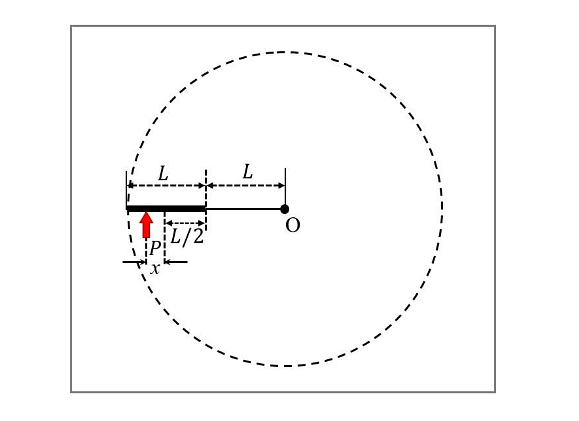
A thin uniform rod of length L and certain mass is kept on a frictionless horizontal table with a massless string of length L fixed to one end (top view is shown in the figure). The other end of the string is pivoted to a point O. If a horizontal impulse P is imparted to the rod at a distance x = L/n from the mid-point of the rod (see figure), then the rod and string revolve together around the point O, with the rod remaining aligned with the string. In such a case, the value of n is _____.
- JEE Advanced - 2024
- Friction