Question:hard
Company BELIANCE hosted a party for 8 members of Company AXIAL. In the party no member of AXIAL had interacted with more than three members of BELIANCE. Out of all the members of BELIANCE, three members each interacted with four members of AXIAL and the remaining members each interacted with two members of AXIAL. The greatest possible number of company BELIANCE members in the party is:
Company BELIANCE hosted a party for 8 members of Company AXIAL. In the party no member of AXIAL had interacted with more than three members of BELIANCE. Out of all the members of BELIANCE, three members each interacted with four members of AXIAL and the remaining members each interacted with two members of AXIAL. The greatest possible number of company BELIANCE members in the party is:
Show Hint
Count total interactions from both sides of the party; the AXIAL side gives a hard ceiling of 24, and you need the largest n for which the BELIANCE side stays within that ceiling.
Updated On: Jul 10, 2026
- 9
- 10
- 11
- 12
Show Solution
The Correct Option is A
Solution and Explanation
This problem is about counting the same set of interactions in two different ways, once from the BELIANCE side and once from the AXIAL side, and using the fact that they must agree.
- Count from BELIANCE's side: if there are n BELIANCE members in total, 3 of them each spoke to 4 AXIAL members (12 interactions), and the rest, $(n-3)$ of them, each spoke to 2 AXIAL members ($2(n-3)$ interactions). Adding these gives a BELIANCE-side total of $12 + 2(n-3) = 2n + 6$ interactions.
- Count from AXIAL's side: there are only 8 AXIAL members, and each spoke to at most 3 BELIANCE members. So the AXIAL-side total can never exceed $8 \times 3 = 24$ interactions.
- Set up the inequality: since the two counts describe the same interactions, the BELIANCE-side total cannot exceed the AXIAL-side ceiling: $2n + 6 \leq 24$, which gives $n \leq 9$.
- Check that this bound can be reached: at n = 9, the total is exactly 24, meaning every one of the 8 AXIAL members interacted with exactly 3 BELIANCE members. Nothing in the problem forbids this, so it is achievable, and n = 9 is a real maximum, not just a loose upper bound.
So the greatest possible number of BELIANCE members in the party is 9, which is option A. A value like 10, 11, or 12 would push the BELIANCE-side total above 24, which the AXIAL-side restriction rules out.
Let's summarize:
- Every interaction gets counted once from each side, so the two totals must be consistent with the stricter constraint.
- The AXIAL side, with only 8 members capped at 3 interactions each, sets the hard ceiling of 24.
Thus the answer is 9.
Was this answer helpful?
0
Top Questions on permutations and combinations
- There are 6 boys and 4 girls. Arrange their seating arrangement on a round table such that 2 boys and 1 girl can't sit together.
- MHT CET - 2025
- Mathematics
- permutations and combinations
- How many different 4-letter words can be formed from the letters of the word "BINARY" without repetition?
- BITSAT - 2025
- Mathematics
- permutations and combinations
- A local restaurant has 16 vegetarian items and 9 non-vegetarian items in their menu. Some items contain gluten, while the rest are gluten-free.
One evening, Rohit and his friends went to the restaurant. They planned to choose two different vegetarian items and three different non-vegetarian items from the entire menu. Later, Bela and her friends also went to the same restaurant: they planned to choose two different vegetarian items and one non-vegetarian item only from the gluten-free options. The number of item combinations that Rohit and his friends could choose from, given their plan, was 12 times the number of item combinations that Bela and her friends could choose from, given their plan.
How many menu items contain gluten?- XAT - 2024
- Quantitative Ability and Data Interpretation
- permutations and combinations
- Five people are distributed in four identical rooms. A room can also contain zero people. Find the number of ways to distribute them.
- JEE Main - 2024
- Mathematics
- permutations and combinations
- Want to practice more? Try solving extra ecology questions todayView All Questions
Questions Asked in XAT exam
Applicants have been shortlisted for interviews for some data analyst positions. Some of the applicants have advanced expertise in one or more fields among the following: data analysis, database handling and coding. The numbers of applicants with different advanced expertise are given in the 2 × 8 table below.
The number of applicants with advanced expertise in all three fields is given as x in the table, where x is a non-negative integer.
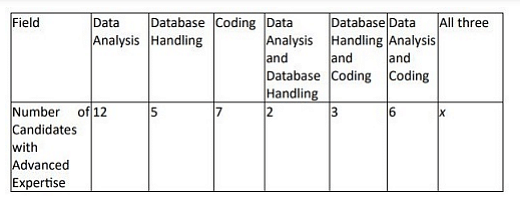
The number of applicants with advanced expertise in all three fields is given as x in the table, where x is a non-negative integer.
- XAT - 2024
- Data Interpretation