Question:medium
Choose the option that points out sentence(s) with grammatical error(s).
(i) I love the man dancing on the table.
(ii) I love the man's dancing on the table.
(iii) In 1986 Elie Wiesel was named the Nobel Peace Prize recipient, an honour established by Alfred Nobel.
(iv) Neither of the recommendations works as well as we thought they would.
(v) Either the Minister or the Minister's wife will have to excuse themselves from the reception to speak to the caterer.
Choose the option that points out sentence(s) with grammatical error(s).
(i) I love the man dancing on the table.
(ii) I love the man's dancing on the table.
(iii) In 1986 Elie Wiesel was named the Nobel Peace Prize recipient, an honour established by Alfred Nobel.
(iv) Neither of the recommendations works as well as we thought they would.
(v) Either the Minister or the Minister's wife will have to excuse themselves from the reception to speak to the caterer.
(i) I love the man dancing on the table.
(ii) I love the man's dancing on the table.
(iii) In 1986 Elie Wiesel was named the Nobel Peace Prize recipient, an honour established by Alfred Nobel.
(iv) Neither of the recommendations works as well as we thought they would.
(v) Either the Minister or the Minister's wife will have to excuse themselves from the reception to speak to the caterer.
Show Hint
Check what each appositive actually renames, and for "either...or"/"neither...nor" match the verb and pronoun to the nearer subject, not to the whole pair.
Updated On: Jul 13, 2026
- (iii) and (v)
- (i) and (iv)
- (ii) and (v)
- (iii) and (iv)
Show Solution
The Correct Option is A
Solution and Explanation
Step 1: Understanding the Question.
We have five short sentences, marked (i) to (v), and we must find exactly which ones are grammatically wrong. The answer choices pair up two sentences at a time, so we only need to sort each sentence into "correct" or "wrong" and then match the pair that both fail. Getting even one sentence wrong flips the whole answer, so it helps to test each one on its own before comparing them.
Step 2: Key Rules to Apply.
Two grammar rules decide this question. First, an appositive, a phrase set off by a comma that renames a noun, must rename the noun sitting directly before it, not some other noun nearby in the sentence. Second, when a subject is built with "either...or" or "neither...nor", any verb or pronoun linked to that subject must agree in number and gender with the closer of the two parts, not with the pair taken together. Keep both rules in mind while reading sentences (i) through (v).
Step 3: Detailed Explanation.
Sentences (i) and (ii) both use the word "dancing", but in different roles. In (i), "dancing on the table" is a participle phrase describing "the man", telling us which man is meant. In (ii), "the man's dancing" turns "dancing" into a gerund, a noun, owned by "the man's", exactly like saying "I love his dancing". Both patterns are standard English, so neither sentence has an error.
Sentence (iv) uses "works", a singular verb that correctly matches the singular subject "Neither". The pronoun "they" that comes later does not refer to "Neither"; it refers to "the recommendations", the plural noun sitting inside the sentence. Since "they" correctly matches an actual plural noun, the grammar holds up here too, even though it might look suspicious at first glance.
Sentence (iii) is where the appositive rule breaks down. The phrase "an honour established by Alfred Nobel" sits directly after the word "recipient", so by the rules of English grammar it renames "recipient", not "the Nobel Peace Prize". But logically the honour is the Prize itself, established by Nobel, not the person who received it. This mismatch between what the grammar says and what the sentence means to say is a genuine error.
Sentence (v) breaks the agreement rule. In "either the Minister or the Minister's wife", the closer of the two subjects is "the Minister's wife", a single woman. The correct reflexive pronoun should therefore be "herself". Using the plural "themselves" does not match this singular, feminine antecedent, which makes this sentence grammatically wrong as well.
Step 4: Final Answer.
Testing all five sentences this way leaves only (iii) and (v) with real grammar errors, one from a misplaced appositive and one from a pronoun that does not agree with its nearer antecedent. That combination is option 1.
We have five short sentences, marked (i) to (v), and we must find exactly which ones are grammatically wrong. The answer choices pair up two sentences at a time, so we only need to sort each sentence into "correct" or "wrong" and then match the pair that both fail. Getting even one sentence wrong flips the whole answer, so it helps to test each one on its own before comparing them.
Step 2: Key Rules to Apply.
Two grammar rules decide this question. First, an appositive, a phrase set off by a comma that renames a noun, must rename the noun sitting directly before it, not some other noun nearby in the sentence. Second, when a subject is built with "either...or" or "neither...nor", any verb or pronoun linked to that subject must agree in number and gender with the closer of the two parts, not with the pair taken together. Keep both rules in mind while reading sentences (i) through (v).
Step 3: Detailed Explanation.
Sentences (i) and (ii) both use the word "dancing", but in different roles. In (i), "dancing on the table" is a participle phrase describing "the man", telling us which man is meant. In (ii), "the man's dancing" turns "dancing" into a gerund, a noun, owned by "the man's", exactly like saying "I love his dancing". Both patterns are standard English, so neither sentence has an error.
Sentence (iv) uses "works", a singular verb that correctly matches the singular subject "Neither". The pronoun "they" that comes later does not refer to "Neither"; it refers to "the recommendations", the plural noun sitting inside the sentence. Since "they" correctly matches an actual plural noun, the grammar holds up here too, even though it might look suspicious at first glance.
Sentence (iii) is where the appositive rule breaks down. The phrase "an honour established by Alfred Nobel" sits directly after the word "recipient", so by the rules of English grammar it renames "recipient", not "the Nobel Peace Prize". But logically the honour is the Prize itself, established by Nobel, not the person who received it. This mismatch between what the grammar says and what the sentence means to say is a genuine error.
Sentence (v) breaks the agreement rule. In "either the Minister or the Minister's wife", the closer of the two subjects is "the Minister's wife", a single woman. The correct reflexive pronoun should therefore be "herself". Using the plural "themselves" does not match this singular, feminine antecedent, which makes this sentence grammatically wrong as well.
Step 4: Final Answer.
Testing all five sentences this way leaves only (iii) and (v) with real grammar errors, one from a misplaced appositive and one from a pronoun that does not agree with its nearer antecedent. That combination is option 1.
Was this answer helpful?
0
Top Questions on Error Detection and Correction
- What should be the minimum Hamming distance \( d_{\text{min}} \) to guarantee correction of up to p errors in a given block code?
- CUET (PG) - 2025
- Computer Science
- Error Detection and Correction
Unless you do not listen to his advice, (a) I am not going (b) to help you. (c) No error (d)
- MET - 2013
- English
- Error Detection and Correction
The teacher called Ravi (a)and asked him (b) to describe about the incident. (c) No error (d)
- MET - 2013
- English
- Error Detection and Correction
- Be smart (a)/not only in dress (b)/and also in action. (c)/No error (d)
- MET - 2013
- English
- Error Detection and Correction
- Want to practice more? Try solving extra ecology questions todayView All Questions
Questions Asked in XAT exam
Applicants have been shortlisted for interviews for some data analyst positions. Some of the applicants have advanced expertise in one or more fields among the following: data analysis, database handling and coding. The numbers of applicants with different advanced expertise are given in the 2 × 8 table below.
The number of applicants with advanced expertise in all three fields is given as x in the table, where x is a non-negative integer.
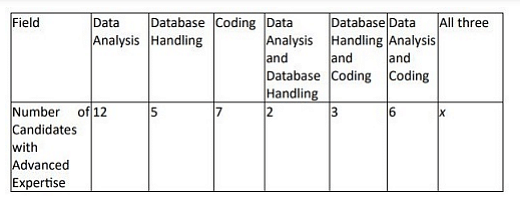
The number of applicants with advanced expertise in all three fields is given as x in the table, where x is a non-negative integer.
- XAT - 2024
- Data Interpretation