Question:hard
Choose the appropriate words to fill in the blanks.
If a person makes the statement: "I never speak the truth." The person can be said to be ______.
Choose the appropriate words to fill in the blanks.
If a person makes the statement: "I never speak the truth." The person can be said to be ______.
If a person makes the statement: "I never speak the truth." The person can be said to be ______.
Show Hint
Test both possibilities, the statement being true and the statement being false, and see which one holds up without contradiction.
Updated On: Jul 10, 2026
- speaking the truth.
- lying.
- lying as well as speaking the truth.
- making a logically contradictory statement.
Show Solution
The Correct Option is D
Solution and Explanation
This question is a version of the classic liar paradox, dressed up as a sentence-completion item. The statement "I never speak the truth" talks about itself, and that self-reference is what breaks the usual true or false test.
- Option 1, speaking the truth: If we say the person is speaking the truth here, then it must be really true that they never speak the truth. But they just spoke truthfully in saying so, which cancels out the claim itself. So this option cannot hold up.
- Option 2, lying: If we say the person is lying, then the opposite of "I never speak the truth" should hold, meaning they do sometimes speak the truth. That seems fine on the surface, but it does not pin down anything definite about this particular statement, and does not resolve the loop the sentence creates about itself.
- Option 3, lying as well as speaking the truth: A single statement cannot be true and false at the same time, so calling it both is not a valid logical position; this option just avoids the problem instead of solving it.
- Option 4, originally D, making a logically contradictory statement: Testing both cases, true and false, each leads back to a contradiction, which is exactly the sign of a self-referential paradox. The honest description of the statement is that it contradicts itself, regardless of which value we try to assign it.
So neither "truth" nor "lie" can be pinned on the statement without a contradiction showing up, and the only description that survives both tests is that the statement is logically contradictory.
Let's summarize:
- A statement that refers to its own truth or falsehood can create a paradox, as with the liar paradox.
- If assuming a statement is true creates a contradiction, and assuming it is false also creates a contradiction, the statement itself is logically contradictory.
So the person can be said to be making a logically contradictory statement, which is option 4 (originally D).
Was this answer helpful?
0
Top Questions on Fill in the Blanks
- Complete the given narrative, by filling in the blank with the correct option.
The opportunity to volunteer at the local food bank made me ______ the challenges faced by underprivileged communities.- CBSE Class X - 2024
- English Language and Literature
- Fill in the Blanks
- Fill in the blank by choosing the correct option to complete the update on the school’s chess team.
It’s a victorious day!
Our school’s chess team ______ the interschool chess championship.- CBSE Class X - 2024
- English Language and Literature
- Fill in the Blanks
- Complete the line from a song by filling in the blank with the correct option.
The whispering leaves tell your tale,
The silent stones ______ your journey,
The sun casts light on your path,
Leading you towards tomorrow’s glory.- CBSE Class X - 2024
- English Language and Literature
- Fill in the Blanks
- Fill in the blanks (i) – (iii) with the appropriate option from those given in the brackets.
A house on my way to work (i) ________ (had acquired/has acquired/acquired) an American pit bull terrier. On the surface, it (ii) ________ (seems/seemed/has seemed) to be a friendly dog. All it does (iii) ________ (was/are/is) stand and grin through the fence.- CBSE Class X - 2024
- English
- Fill in the Blanks
- Want to practice more? Try solving extra ecology questions todayView All Questions
Questions Asked in XAT exam
Applicants have been shortlisted for interviews for some data analyst positions. Some of the applicants have advanced expertise in one or more fields among the following: data analysis, database handling and coding. The numbers of applicants with different advanced expertise are given in the 2 × 8 table below.
The number of applicants with advanced expertise in all three fields is given as x in the table, where x is a non-negative integer.
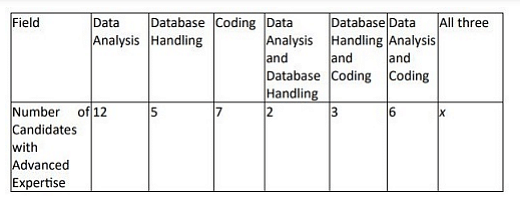
The number of applicants with advanced expertise in all three fields is given as x in the table, where x is a non-negative integer.
- XAT - 2024
- Data Interpretation