Question:medium
Choose the appropriate words to fill in the blanks.
Mark Twain was responsible for many striking, mostly cynical ______, such as "Always do right. That will gratify some of the people, and astonish the rest." ______ can sometimes end up as ______, but rarely would someone use them as an ______.
Choose the appropriate words to fill in the blanks.
Mark Twain was responsible for many striking, mostly cynical ______, such as "Always do right. That will gratify some of the people, and astonish the rest." ______ can sometimes end up as ______, but rarely would someone use them as an ______.
Mark Twain was responsible for many striking, mostly cynical ______, such as "Always do right. That will gratify some of the people, and astonish the rest." ______ can sometimes end up as ______, but rarely would someone use them as an ______.
Show Hint
Work out which of the three related words, epigram, epitaph or epigraph, fits each blank by meaning before looking at the options.
Updated On: Jul 10, 2026
- epitaphs, Epitaphs, epigrams, epigraph
- epigraphs, Epigraphs, epitaphs, epigraph
- epigrams, Epitaphs, epigrams, epigraph
- epigrams, Epigrams, epigraphs, epitaph
Show Solution
The Correct Option is D
Solution and Explanation
This question tests three closely related words built from the same root "epi-": epigram, epitaph and epigraph. Each has a distinct, specific use, and the sentence is built so that only one arrangement of the three makes sense across all four blanks.
- Option 1 (epitaphs, Epitaphs, epigrams, epigraph): This puts "epitaphs" (tomb inscriptions) in the first blank, but Mark Twain's quoted line is a witty remark, not something written on a grave, so this is wrong from the very first blank.
- Option 2 (epigraphs, Epigraphs, epitaphs, epigraph): This calls Twain's cynical sayings "epigraphs", but an epigraph is a quotation borrowed by someone else to open a book, not something a person is "responsible for" producing themselves. Wrong.
- Option 3 (epigrams, Epitaphs, epigrams, epigraph): The first blank is right, since Twain's lines are epigrams. But the second blank repeats the same word and should stay "epigrams", not switch to "Epitaphs", so this option breaks the sentence's own logic.
- Option 4, originally E (epigrams, Epigrams, epigraphs, epitaph): Twain wrote epigrams (blank 1), and epigrams (blank 2) can later be quoted as epigraphs at the start of a book or chapter (blank 3), but they are rarely solemn enough to serve as an epitaph on a tombstone (blank 4). Every blank fits.
Reading the finished sentence confirms it: "Mark Twain was responsible for many striking, mostly cynical epigrams... Epigrams can sometimes end up as epigraphs, but rarely would someone use them as an epitaph." That flows correctly and uses each word for its real meaning.
Let's summarize:
- Epigram: a short, witty saying.
- Epigraph: a quotation placed at the start of a book, chapter or building.
- Epitaph: words inscribed on a tomb.
So the sentence is completed by epigrams, Epigrams, epigraphs, epitaph, which is option 4 (originally E).
Was this answer helpful?
0
Top Questions on Fill in the Blanks
- Complete the given narrative, by filling in the blank with the correct option.
The opportunity to volunteer at the local food bank made me ______ the challenges faced by underprivileged communities.- CBSE Class X - 2024
- English Language and Literature
- Fill in the Blanks
- Fill in the blank by choosing the correct option to complete the update on the school’s chess team.
It’s a victorious day!
Our school’s chess team ______ the interschool chess championship.- CBSE Class X - 2024
- English Language and Literature
- Fill in the Blanks
- Complete the line from a song by filling in the blank with the correct option.
The whispering leaves tell your tale,
The silent stones ______ your journey,
The sun casts light on your path,
Leading you towards tomorrow’s glory.- CBSE Class X - 2024
- English Language and Literature
- Fill in the Blanks
- Fill in the blanks (i) – (iii) with the appropriate option from those given in the brackets.
A house on my way to work (i) ________ (had acquired/has acquired/acquired) an American pit bull terrier. On the surface, it (ii) ________ (seems/seemed/has seemed) to be a friendly dog. All it does (iii) ________ (was/are/is) stand and grin through the fence.- CBSE Class X - 2024
- English
- Fill in the Blanks
- Want to practice more? Try solving extra ecology questions todayView All Questions
Questions Asked in XAT exam
Applicants have been shortlisted for interviews for some data analyst positions. Some of the applicants have advanced expertise in one or more fields among the following: data analysis, database handling and coding. The numbers of applicants with different advanced expertise are given in the 2 × 8 table below.
The number of applicants with advanced expertise in all three fields is given as x in the table, where x is a non-negative integer.
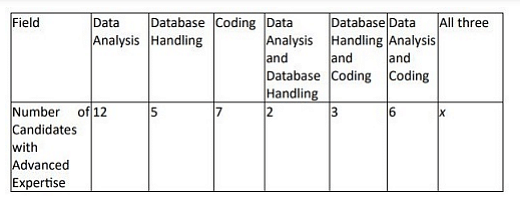
The number of applicants with advanced expertise in all three fields is given as x in the table, where x is a non-negative integer.
- XAT - 2024
- Data Interpretation