Between two numbers whose sum is \(2\frac{1}{6}\), an even number of arithmetic means is inserted between them. The sum of these means exceeds their number by unity. How many means are there?
Show Hint
- 12
- 6
- 24
- None
The Correct Option is A
Solution and Explanation
Take the two given numbers as \(a\) and \(b\), with \(a + b = 2\frac{1}{6} = \frac{13}{6}\). Suppose \(n\) equal arithmetic means \(m_1, m_2, \ldots, m_n\) sit between them, so that \(a, m_1, m_2, \ldots, m_n, b\) is one arithmetic progression with common difference \(d\).
Since there are \(n+2\) terms in total, \(b\) is the \((n+2)\)th term, so
\[ b = a + (n+1)d \]Now write each mean in terms of \(a\) and \(d\): \(m_k = a + kd\) for \(k = 1, 2, \ldots, n\). Add all n means:
\[ \sum_{k=1}^{n} m_k = na + d\cdot\frac{n(n+1)}{2} \]From \(b = a+(n+1)d\), we get \(d = \dfrac{b-a}{n+1}\). Put this in:
\[ \sum m_k = na + \frac{n(n+1)}{2}\cdot\frac{b-a}{n+1} = na + \frac{n(b-a)}{2} = \frac{n(a+b)}{2} \]This confirms the sum of the n means is \(\dfrac{n}{2}(a+b)\). With \(a+b=\frac{13}{6}\), the sum becomes \(\dfrac{13n}{12}\).
The question says this sum is 1 more than n, the count of means:
\[ \frac{13n}{12} = n + 1 \implies 13n = 12n + 12 \implies n = 12 \]Twelve is indeed even, so it fits the condition "an even number of means" given in the question. Checking the other choices, n=6 gives a sum of 6.5 (should be 7) and n=24 gives a sum of 26 (should be 25), so neither works. Only n=12 satisfies the equation exactly.
\[ \boxed{n = 12} \]Questions Asked in XAT exam
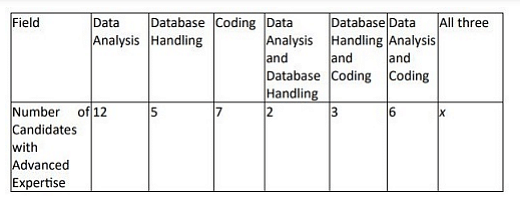
The number of applicants with advanced expertise in all three fields is given as x in the table, where x is a non-negative integer.
- XAT - 2024
- Data Interpretation