Question:medium
An operation \( \$ \) is defined as follows. For any two positive integers \(x\) and \(y\),
\[ x \$ y = \sqrt{ \sqrt{\dfrac{x}{y}} + \sqrt{\dfrac{y}{x}} } \]
Which of the following is an integer?
An operation \( \$ \) is defined as follows. For any two positive integers \(x\) and \(y\),
\[ x \$ y = \sqrt{ \sqrt{\dfrac{x}{y}} + \sqrt{\dfrac{y}{x}} } \]
Which of the following is an integer?
\[ x \$ y = \sqrt{ \sqrt{\dfrac{x}{y}} + \sqrt{\dfrac{y}{x}} } \]
Which of the following is an integer?
Show Hint
Plug the given pairs into the formula one at a time and simplify the nested square roots fully before deciding if the result is a whole number.
Updated On: Jul 13, 2026
- \(4 \$ 9\)
- \(4 \$ 16\)
- \(4 \$ 4\)
- None of the above
Show Solution
The Correct Option is D
Solution and Explanation
Step 1: Rewrite the rule in one variable.
Let $r = x/y$. Then $y/x = 1/r$, so the operation becomes a function of just $r$:
\[ x \$ y = \sqrt{ \sqrt{r} + \dfrac{1}{\sqrt{r}} } \]
This is a cleaner way to test all three cases, since we only need the ratio $x/y$ for each pair, not the two numbers separately.
Step 2: Find $r$ for each option.
For $4 \$ 9$, $r = 4/9$.
For $4 \$ 16$, $r = 4/16 = 1/4$.
For $4 \$ 4$, $r = 4/4 = 1$.
Step 3: Evaluate the function at $r = 4/9$.
$\sqrt{r} = 2/3$ and $1/\sqrt{r} = 3/2$.
Sum $= 2/3 + 3/2 = 13/6$, which is not a perfect square of a rational number, since 13 is prime and does not divide 6. So $\sqrt{13/6}$ is irrational, and $4 \$ 9$ fails.
Step 4: Evaluate the function at $r = 1/4$.
$\sqrt{r} = 1/2$ and $1/\sqrt{r} = 2$.
Sum $= 1/2 + 2 = 5/2$. Again 5 and 2 share no square factor, so $\sqrt{5/2}$ is irrational. $4 \$ 16$ fails too.
Step 5: Evaluate the function at $r = 1$.
$\sqrt{r} = 1$ and $1/\sqrt{r} = 1$.
Sum $= 1 + 1 = 2$, and $\sqrt{2}$ is a classic irrational number. $4 \$ 4$ fails as well.
Step 6: Conclude.
All three specific cases give an irrational square root, never a whole number. So none of the given options works, and the answer has to be none of the above.
\[ \boxed{\text{None of the above}} \]
Let $r = x/y$. Then $y/x = 1/r$, so the operation becomes a function of just $r$:
\[ x \$ y = \sqrt{ \sqrt{r} + \dfrac{1}{\sqrt{r}} } \]
This is a cleaner way to test all three cases, since we only need the ratio $x/y$ for each pair, not the two numbers separately.
Step 2: Find $r$ for each option.
For $4 \$ 9$, $r = 4/9$.
For $4 \$ 16$, $r = 4/16 = 1/4$.
For $4 \$ 4$, $r = 4/4 = 1$.
Step 3: Evaluate the function at $r = 4/9$.
$\sqrt{r} = 2/3$ and $1/\sqrt{r} = 3/2$.
Sum $= 2/3 + 3/2 = 13/6$, which is not a perfect square of a rational number, since 13 is prime and does not divide 6. So $\sqrt{13/6}$ is irrational, and $4 \$ 9$ fails.
Step 4: Evaluate the function at $r = 1/4$.
$\sqrt{r} = 1/2$ and $1/\sqrt{r} = 2$.
Sum $= 1/2 + 2 = 5/2$. Again 5 and 2 share no square factor, so $\sqrt{5/2}$ is irrational. $4 \$ 16$ fails too.
Step 5: Evaluate the function at $r = 1$.
$\sqrt{r} = 1$ and $1/\sqrt{r} = 1$.
Sum $= 1 + 1 = 2$, and $\sqrt{2}$ is a classic irrational number. $4 \$ 4$ fails as well.
Step 6: Conclude.
All three specific cases give an irrational square root, never a whole number. So none of the given options works, and the answer has to be none of the above.
\[ \boxed{\text{None of the above}} \]
Was this answer helpful?
0
Top Questions on Functions
- If \( \mathbf{a} = \mathbf{i} + 2\mathbf{j} - 3\mathbf{k} \) and \( \mathbf{b} = 2\mathbf{i} - 3\mathbf{j} - 5\mathbf{k} \), then:
- MHT CET - 2024
- Mathematics
- Functions
- If \( f(x) = |x| - |1| \), then points where \( f(x) \) is not differentiable, is/are:
- MHT CET - 2024
- Mathematics
- Functions
- The point on the line \( 4x - y - 2 = 0 \) which is equidistant from the points \( (-5, 6) \) and \( (3, 2) \) is
- MHT CET - 2024
- Mathematics
- Functions
- If \( f(x) = 3x + 6 \), \( g(x) = 4x + k \), and \( f \circ g(x) = g \circ f(x) \), then find \( k \):
- MHT CET - 2024
- Mathematics
- Functions
- Want to practice more? Try solving extra ecology questions todayView All Questions
Questions Asked in XAT exam
Applicants have been shortlisted for interviews for some data analyst positions. Some of the applicants have advanced expertise in one or more fields among the following: data analysis, database handling and coding. The numbers of applicants with different advanced expertise are given in the 2 × 8 table below.
The number of applicants with advanced expertise in all three fields is given as x in the table, where x is a non-negative integer.
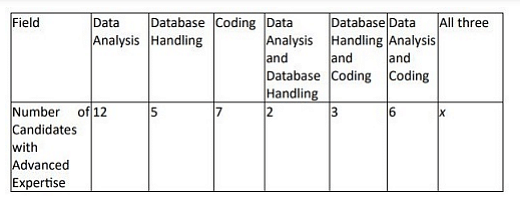
The number of applicants with advanced expertise in all three fields is given as x in the table, where x is a non-negative integer.
- XAT - 2024
- Data Interpretation