Question:medium
ABCD is a quadrilateral whose diagonals intersect at point P. The area of triangle APD is 27 and the area of triangle BPC is 12. If the areas of triangles APB and CPD are equal, then the area of triangle APB is
ABCD is a quadrilateral whose diagonals intersect at point P. The area of triangle APD is 27 and the area of triangle BPC is 12. If the areas of triangles APB and CPD are equal, then the area of triangle APB is
Show Hint
Recall that for any quadrilateral with diagonals meeting at P, area(APB) times area(CPD) always equals area(BPC) times area(APD).
Updated On: Jul 10, 2026
- 21
- 18
- 16
- 15
Show Solution
The Correct Option is B
Solution and Explanation
Step 1: Use a general property of diagonal-split quadrilaterals.
For any quadrilateral ABCD whose diagonals meet at P, the following identity always holds:
\[ \text{Area}(APB) \times \text{Area}(CPD) = \text{Area}(BPC) \times \text{Area}(APD) \]
This is true because angle APB and angle CPD are vertically opposite, so equal, and angle BPC and angle APD are also vertically opposite, so equal too. Writing each triangle's area as half the product of its two sides from P times the sine of the included angle, the sine terms cancel out between the two sides of the identity, leaving exactly this relationship between the segment lengths from P.
Step 2: Plug in the known areas.
We are given Area(BPC) = 12 and Area(APD) = 27, so their product is:
\[ \text{Area}(BPC) \times \text{Area}(APD) = 12 \times 27 = 324 \]
Step 3: Use the equal-area condition.
We are told Area(APB) = Area(CPD). Call this common area $x$. Then from Step 1's identity:
\[ x \times x = 324 \implies x^2 = 324 \implies x = \sqrt{324} = 18 \]
(taking the positive root, since an area cannot be negative).
Step 4: Sanity check against the given numbers.
An area of 18 sits between 12 and 27, which is exactly what we would expect: since Area(APB) = Area(CPD) = 18, the ratio 18/12 = 1.5 should match 27/18 = 1.5 as well, both being equal to $DP/BP$ found by the base-height method, and indeed both ratios come out to 1.5, confirming the answer.
Final Answer:
The area of triangle APB is 18.\[ \boxed{18} \]
For any quadrilateral ABCD whose diagonals meet at P, the following identity always holds:
\[ \text{Area}(APB) \times \text{Area}(CPD) = \text{Area}(BPC) \times \text{Area}(APD) \]
This is true because angle APB and angle CPD are vertically opposite, so equal, and angle BPC and angle APD are also vertically opposite, so equal too. Writing each triangle's area as half the product of its two sides from P times the sine of the included angle, the sine terms cancel out between the two sides of the identity, leaving exactly this relationship between the segment lengths from P.
Step 2: Plug in the known areas.
We are given Area(BPC) = 12 and Area(APD) = 27, so their product is:
\[ \text{Area}(BPC) \times \text{Area}(APD) = 12 \times 27 = 324 \]
Step 3: Use the equal-area condition.
We are told Area(APB) = Area(CPD). Call this common area $x$. Then from Step 1's identity:
\[ x \times x = 324 \implies x^2 = 324 \implies x = \sqrt{324} = 18 \]
(taking the positive root, since an area cannot be negative).
Step 4: Sanity check against the given numbers.
An area of 18 sits between 12 and 27, which is exactly what we would expect: since Area(APB) = Area(CPD) = 18, the ratio 18/12 = 1.5 should match 27/18 = 1.5 as well, both being equal to $DP/BP$ found by the base-height method, and indeed both ratios come out to 1.5, confirming the answer.
Final Answer:
The area of triangle APB is 18.\[ \boxed{18} \]
Was this answer helpful?
0
Top Questions on Triangles
Fill in the blanks using the correct word given in the brackets :
(i) All circles are __________. (congruent, similar)
(ii) All squares are __________. (similar, congruent)
(iii) All __________ triangles are similar. (isosceles, equilateral)
(iv) Two polygons of the same number of sides are similar, if (a) their corresponding angles are __________ and (b) their corresponding sides are __________. (equal, proportional)- CBSE Class X
- Mathematics
- Triangles
- Give two different examples of a pair of
(i) Similar figures
(ii)Non-similar figures- CBSE Class X
- Mathematics
- Triangles
- State whether the following quadrilaterals are similar or not:

- CBSE Class X
- Mathematics
- Triangles
- In figure below (i) and (ii), DE || BC. Find EC in (i) and AD in (ii).
(i)
(ii)
- CBSE Class X
- Mathematics
- Triangles
- Want to practice more? Try solving extra ecology questions todayView All Questions
Questions Asked in XAT exam
Applicants have been shortlisted for interviews for some data analyst positions. Some of the applicants have advanced expertise in one or more fields among the following: data analysis, database handling and coding. The numbers of applicants with different advanced expertise are given in the 2 × 8 table below.
The number of applicants with advanced expertise in all three fields is given as x in the table, where x is a non-negative integer.
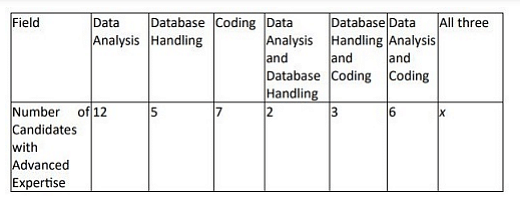
The number of applicants with advanced expertise in all three fields is given as x in the table, where x is a non-negative integer.
- XAT - 2024
- Data Interpretation