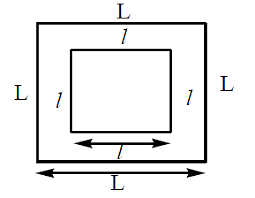
A small square loop of wire of side l is placed inside a large square loop of wire L(L>>l). As shown in figure, both loops are coplanar and their centers coincide at point O. The mutual inductance of the system is:
\(\frac{2\sqrt2 \mu_0L^2}{\pi l}\)
\(\frac{\mu_0L^2}{2\sqrt2 \pi L}\)
\(\frac{2\sqrt 2 \mu_0 l^2}{\pi L}\)
\(\frac{\mu_0L^2}{2\sqrt2\pi l}\)
The Correct Option is C
Solution and Explanation
To find the mutual inductance between the two coplanar square loops, we need to understand the concept of magnetic flux linkage and how it applies to this configuration.
Mutual inductance M is defined between two coils as:
M = \frac{\Phi}{I}
where \Phi is the magnetic flux through one coil due to the current I in the other coil.
Step 1: Magnetic Field Due to the Larger Loop
The magnetic field B at the center of a square loop of side L carrying a current I is given by:
B = \frac{2\sqrt{2}\mu_0 I}{\pi L}
where \mu_0 is the permeability of free space.
Step 2: Flux Through the Smaller Loop
The flux \Phi through the smaller loop of side l is:
\Phi = B \times \text{Area of smaller loop} = \left(\frac{2\sqrt{2}\mu_0 I}{\pi L}\right) \times (l^2)
Step 3: Mutual Inductance Calculation
Substitute \Phi in the formula for mutual inductance:
M = \frac{\Phi}{I} = \frac{2\sqrt{2}\mu_0 l^2}{\pi L}
Therefore, the mutual inductance of the system is:
\frac{2\sqrt 2 \mu_0 l^2}{\pi L}
This matches the correct answer: \(\frac{2\sqrt 2 \mu_0 l^2}{\pi L}\) .
Top Questions on Inductance
- Two coils are placed close to each other. The mutual inductance of the pair of coils depends upon:
- MHT CET - 2024
- Physics
- Inductance
- In a coil, the current changes from \( -2 \, \text{A} \) to \( +2 \, \text{A} \) in \( 0.2 \, \text{s} \) and induces an emf of \( 0.1 \, \text{V} \). The self-inductance of the coil is:
- MHT CET - 2024
- Physics
- Inductance
- If \( L \) is the inductance and \( R \) is the resistance, then the unit of \( \frac{L}{R} \) is:
- MHT CET - 2024
- Physics
- Inductance
- An e.m.f of 5 volts is produced by a self-inductance when the current changes at a steady rate from 3A to 2A in 1 millisecond. The value of self-inductance is:
- MHT CET - 2024
- Physics
- Inductance
- Want to practice more? Try solving extra ecology questions todayView All Questions
