A flight, traveling to a destination 11,200 kms away, was supposed to take off at 6:30 AM. Due to bad weather, the departure of the flight got delayed by three hours. The pilot increased the average speed of the airplane by 100 km/hr from the initially planned average speed, to reduce the overall delay to one hour.
Had the pilot increased the average speed by 350 km/hr from the initially planned average speed, when would have the flight reached its destination?
A flight, traveling to a destination 11,200 kms away, was supposed to take off at 6:30 AM. Due to bad weather, the departure of the flight got delayed by three hours. The pilot increased the average speed of the airplane by 100 km/hr from the initially planned average speed, to reduce the overall delay to one hour.
Had the pilot increased the average speed by 350 km/hr from the initially planned average speed, when would have the flight reached its destination?
- 0.979166666666667
- 0.826388888888889
- 0.715277777777778
- 0.840277777777778
- 0.941666666666667
The Correct Option is D
Solution and Explanation
Let the initially planned speed of the flight be v km/hr. The original time to travel 11200 km would have been:
$t = \frac{11200}{v}$
Step 1: Given an increase in speed of 100 km/hr, the new speed is v + 100 km/hr. The time taken becomes:
$t' = \frac{11200}{v + 100}$
The flight delay was reduced by 1 hour, meaning the time difference between the original and new flight times is 2 hours:
t − t' = 2
Substituting the expressions for t and t':
$\frac{11200}{v} - \frac{11200}{v + 100} = 2$
Simplifying the equation:
$11200 \left( \frac{1}{v} - \frac{1}{v + 100} \right) = 2$
$\frac{11200}{v(v + 100)} = 2$
$v(v + 100) = 560000$
Solving for v:
v2 + 100v − 560000 = 0
Using the quadratic formula:
$v = \frac{-100 \pm \sqrt{100^2 + 4 \times 560000}}{2}$
$v = \frac{-100 \pm \sqrt{2250000}}{2}$
v = −100 ± 750
Since speed must be positive, v = 700 km/hr.
Step 2: Calculate the time if the speed increased by 350 km/hr. The new speed would be:
v + 350 = 1050 km/hr.
The time taken to travel 11,200 km at this speed is:
$t'' = \frac{11200}{1050} = 10.66 \text{ hours (10 hours and 40 minutes).}$
Step 3: Determine the arrival time. The flight took off at 9:30 AM. Adding the flight duration of 10 hours and 40 minutes:
9:30 AM + 10:40 = 8:10 PM.
Answer: 8:10 PM
Top Questions on Speed, Time and Distance
- In a kilometer race, A gives B a head start of 50 m and still beats B by 8 m. By what distance A will beat B, if B gives a start of 50 m to A.
- IBSAT
- Quantitative Aptitude
- Speed, Time and Distance
- A train passes a telegraph post in 40 seconds moving at a rate of 36 km/h. Then the length of the train is:
- JEECUP - 2024
- Mathematics
- Speed, Time and Distance
- The earth makes a complete rotation about its axis in 24 hours. What angle will it turn in 3 hours 20 minutes?
- JEECUP - 2024
- Mathematics
- Speed, Time and Distance
- Ajay walks at a speed of 4 km/hr. He doubles his speed after reaching exactly halfway. He walks for 12 hours in all. What is the total distance travelled by him?
- CUET (UG) - 2024
- General Aptitude
- Speed, Time and Distance
- Want to practice more? Try solving extra ecology questions todayView All Questions
Questions Asked in XAT exam
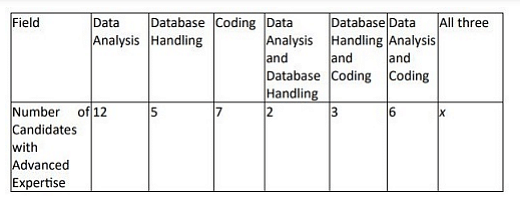
The number of applicants with advanced expertise in all three fields is given as x in the table, where x is a non-negative integer.
- XAT - 2024
- Data Interpretation