A brokerage house offers 3 stock portfolios. Portfolio I consists of 2 blocks of common stock and 1 municipal bond. Portfolio II consists of 4 blocks of common stock, 2 municipal bonds and 3 blocks of preferred stock. Portfolio III consists of 2 blocks of common stock, 2 municipal bonds and 3 blocks of preferred stock. A customer wants 12 blocks of common stock, 6 municipal bonds and 6 preferred stocks. How many portfolio III should be offered?
Show Hint
- 1
- 2
- 3
- None of the above
The Correct Option is D
Solution and Explanation
Instead of solving the full system in one go, plug candidate values of Portfolio III (z) into the three requirement equations and see which one actually works. The three needs are 12 common stocks, 6 municipal bonds and 6 preferred stocks, coming from Portfolio I (2 common, 1 bond, 0 preferred), Portfolio II (4 common, 2 bonds, 3 preferred) and Portfolio III (2 common, 2 bonds, 3 preferred).
The preferred stock only comes from Portfolios II and III: $3y + 3z = 6$, so $y = 2 - z$. This already tells us z can only be 0, 1 or 2 for y to stay non-negative, which rules out 3 and 4 right away as candidate values for z.
- z = 1: then $y = 1$. Bonds needed: $x + 2(1) + 2(1) = 6 \Rightarrow x = 2$. Check common stock: $2(2) + 4(1) + 2(1) = 4+4+2 = 10 \neq 12$. Fails.
- z = 2: then $y = 0$. Bonds: $x + 0 + 4 = 6 \Rightarrow x = 2$. Common stock: $2(2)+0+4 = 8 \neq 12$. Fails.
- z = 3: already ruled out, since $y = 2-3 = -1$ would be negative, which is not allowed for a count of portfolios.
Since z = 1 and z = 2 both fail, and z = 3 (or higher) is impossible, try $z=0$ directly: $y = 2$, bonds give $x + 4 + 0 = 6 \Rightarrow x = 2$, and common stock checks as $2(2)+4(2)+2(0) = 4+8+0=12$, which matches exactly.
Let's summarize:
- The preferred stock equation pins $y = 2-z$ immediately, cutting the search down to $z=0,1,2$.
- Testing $z=1$ and $z=2$ against the common stock requirement breaks the equation, so the true value is $z=0$.
So Portfolio III is not offered at all, meaning the correct choice is "None of the above".
Top Questions on Algebra
- Let \( n(A) = m \) and \( n(B) = n \), if the number of subsets of \( A \) is 56 more than that of subsets of \( B \), then \( m + n \) is equal to:
- VITEEE - 2024
- Mathematics
- Algebra
- Solve the quadratic equation: \[ x^2 - 5x + 6 = 0 \]
- VITEEE - 2025
- Mathematics
- Algebra
- Find the value of \( x \) in the following equation: \[ \frac{2}{x} + \frac{3}{x + 1} = 1 \]
- VITEEE - 2025
- Mathematics
- Algebra
- Find the value of \( x \) in the equation \( 2x + 3 = 7x - 8 \).
- VITEEE - 2025
- Mathematics
- Algebra
- Want to practice more? Try solving extra ecology questions todayView All Questions
Questions Asked in XAT exam
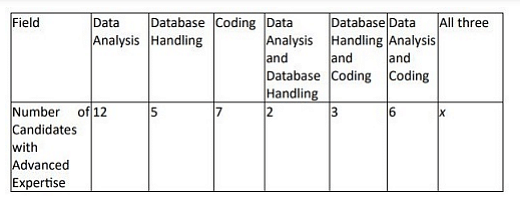
The number of applicants with advanced expertise in all three fields is given as x in the table, where x is a non-negative integer.
- XAT - 2024
- Data Interpretation