Question:hard
\(a\), \(b\) and \(c\) are the sides of a triangle. The equations \(ax^2 + bx + c = 0\) and \(3x^2 + 4x + 5 = 0\) have a common root. Then angle C is equal to
\(a\), \(b\) and \(c\) are the sides of a triangle. The equations \(ax^2 + bx + c = 0\) and \(3x^2 + 4x + 5 = 0\) have a common root. Then angle C is equal to
Show Hint
The equation 3x^2+4x+5=0 has no real roots, so any real-coefficient quadratic sharing one of its roots must share both, making a, b, c proportional to 3, 4, 5, a Pythagorean triple.
Updated On: Jul 13, 2026
- \(60^{\circ}\)
- \(90^{\circ}\)
- \(120^{\circ}\)
- None of these
Show Solution
The Correct Option is B
Solution and Explanation
Step 1: Establish that a, b, c are proportional to 3, 4, 5.
The equation \(3x^2+4x+5=0\) has discriminant \(16 - 60 = -44 < 0\), so its two roots are complex conjugates of each other, not real numbers. A real-coefficient quadratic like \(ax^2+bx+c=0\) can only pick up one of these as a root if it also picks up the other, since its own roots must either both be real or form a conjugate pair. Sharing exactly one complex root is not possible for a real quadratic on its own, so both roots match, forcing \(ax^2+bx+c=0\) and \(3x^2+4x+5=0\) to be scalar multiples of each other:
\[ a = 3k, \quad b = 4k, \quad c = 5k \]
Step 2: Apply the Law of Cosines directly.
The Law of Cosines states:
\[ \cos C = \frac{a^2+b^2-c^2}{2ab} \]
Step 3: Substitute a = 3k, b = 4k, c = 5k.
\[ \cos C = \frac{(3k)^2+(4k)^2-(5k)^2}{2(3k)(4k)} = \frac{9k^2+16k^2-25k^2}{24k^2} \]
Step 4: Simplify the numerator.
\[ 9k^2+16k^2-25k^2 = 0 \]
So:
\[ \cos C = \frac{0}{24k^2} = 0 \]
Step 5: Solve for angle C.
\(\cos C = 0\) means \(C = 90^{\circ}\), the only angle between 0 degrees and 180 degrees whose cosine is zero.
\[ \boxed{90^{\circ}} \]
The equation \(3x^2+4x+5=0\) has discriminant \(16 - 60 = -44 < 0\), so its two roots are complex conjugates of each other, not real numbers. A real-coefficient quadratic like \(ax^2+bx+c=0\) can only pick up one of these as a root if it also picks up the other, since its own roots must either both be real or form a conjugate pair. Sharing exactly one complex root is not possible for a real quadratic on its own, so both roots match, forcing \(ax^2+bx+c=0\) and \(3x^2+4x+5=0\) to be scalar multiples of each other:
\[ a = 3k, \quad b = 4k, \quad c = 5k \]
Step 2: Apply the Law of Cosines directly.
The Law of Cosines states:
\[ \cos C = \frac{a^2+b^2-c^2}{2ab} \]
Step 3: Substitute a = 3k, b = 4k, c = 5k.
\[ \cos C = \frac{(3k)^2+(4k)^2-(5k)^2}{2(3k)(4k)} = \frac{9k^2+16k^2-25k^2}{24k^2} \]
Step 4: Simplify the numerator.
\[ 9k^2+16k^2-25k^2 = 0 \]
So:
\[ \cos C = \frac{0}{24k^2} = 0 \]
Step 5: Solve for angle C.
\(\cos C = 0\) means \(C = 90^{\circ}\), the only angle between 0 degrees and 180 degrees whose cosine is zero.
\[ \boxed{90^{\circ}} \]
Was this answer helpful?
0
Top Questions on Quadratic Equations
- The equation \( (\cos p - 1)x^2 + (\cos p)x + \sin p = 0 \), where \( x \) is a variable with real roots. Then the interval of \( p \) may be any one of the following:
- MHT CET - 2024
- Mathematics
- Quadratic Equations
- If the roots of the quadratic equation \( x^2 - 7x + 12 = 0 \) are \( \alpha \) and \( \beta \), then the value of \( \alpha + \beta \) is:
- MHT CET - 2025
- Mathematics
- Quadratic Equations
- Find the roots of the quadratic equation $ x^2 - 5x + 6 = 0 $.
- MHT CET - 2025
- Mathematics
- Quadratic Equations
- Find the sum of the roots of the quadratic equation $ 2x^2 - 5x + 3 = 0 $.
- MHT CET - 2025
- Mathematics
- Quadratic Equations
- Want to practice more? Try solving extra ecology questions todayView All Questions
Questions Asked in XAT exam
Applicants have been shortlisted for interviews for some data analyst positions. Some of the applicants have advanced expertise in one or more fields among the following: data analysis, database handling and coding. The numbers of applicants with different advanced expertise are given in the 2 × 8 table below.
The number of applicants with advanced expertise in all three fields is given as x in the table, where x is a non-negative integer.
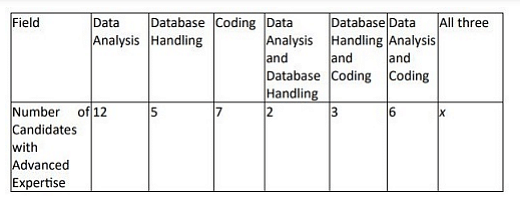
The number of applicants with advanced expertise in all three fields is given as x in the table, where x is a non-negative integer.
- XAT - 2024
- Data Interpretation