Question:medium
65. Consider the system of linear equations:
\[ 2x + 3y + 4z = 16 \]
\[ 4x + 4y + 5z = 26 \]
\[ ax + by + cz = r \]
For \(r = 5\) and \(a = 1\), the system of linear equations will have an infinite number of solutions if \(c = ?\)
65. Consider the system of linear equations:
\[ 2x + 3y + 4z = 16 \]
\[ 4x + 4y + 5z = 26 \]
\[ ax + by + cz = r \]
For \(r = 5\) and \(a = 1\), the system of linear equations will have an infinite number of solutions if \(c = ?\)
\[ 2x + 3y + 4z = 16 \]
\[ 4x + 4y + 5z = 26 \]
\[ ax + by + cz = r \]
For \(r = 5\) and \(a = 1\), the system of linear equations will have an infinite number of solutions if \(c = ?\)
Show Hint
Solve the first two equations for x and y in terms of z, then require the third equation to hold for every value of z.
Updated On: Jul 13, 2026
- \(\dfrac{3}{2}\)
- 1
- \(\dfrac{1}{2}\)
- 0
Show Solution
The Correct Option is C
Solution and Explanation
Step 1: Find the line where the first two planes meet.
Solve the first two equations for x and y in terms of z. From $2x+3y+4z=16$: $2x+3y=16-4z$. From $4x+4y+5z=26$: $4x+4y=26-5z$.
Step 2: Eliminate x.
Multiply the first reduced equation by 2: $4x+6y=32-8z$. Subtract the second reduced equation from this:
\[ (4x+6y)-(4x+4y) = (32-8z)-(26-5z) \]
\[ 2y = 6-3z \ \Rightarrow\ y = 3-1.5z \]
Step 3: Solve for x.
Put $y=3-1.5z$ back into $2x+3y=16-4z$:
\[ 2x + 3(3-1.5z) = 16-4z \]
\[ 2x + 9 - 4.5z = 16-4z \]
\[ 2x = 7+0.5z \ \Rightarrow\ x = 3.5+0.25z \]
So every point where the first two planes meet has this form, whatever value z takes.
Step 4: Force the third plane to contain this whole line.
For infinitely many solutions, the third equation $x+by+cz=5$ (using $a=1$, $r=5$) must hold for every z on that line, not just for one point. Substitute:
\[ (3.5+0.25z) + b(3-1.5z) + cz = 5 \]
\[ (3.5+3b) + z(0.25-1.5b+c) = 5 \]
This can only be true for every z if the constant part equals 5 and the part multiplying z equals 0.
Step 5: Solve the two conditions.
\[ 3.5+3b=5 \ \Rightarrow\ b=\frac{1}{2} \]
\[ 0.25-1.5b+c=0 \ \Rightarrow\ 0.25-0.75+c=0 \ \Rightarrow\ c=\frac{1}{2} \]
This matches the linear-combination method exactly: c = 1/2.
Step 6: Check the answer against the original equations.
With $b=\frac{1}{2}$ and $c=\frac{1}{2}$, the third equation is $x+\frac{1}{2}y+\frac{1}{2}z=5$, which is the same as $2x+y+z=10$. Multiplying this by 2 gives $4x+2y+2z=20$, and it is worth checking that this line of reasoning is consistent with both original equations along the shared solution line found in Step 3: taking, say, $z=0$ gives $x=3.5$, $y=3$ from Steps 2 and 3, and indeed $2(3.5)+3(3)+4(0)=7+9=16$ (matches equation 1) and $4(3.5)+4(3)+5(0)=14+12=26$ (matches equation 2) and $1(3.5)+\frac{1}{2}(3)+\frac{1}{2}(0)=3.5+1.5=5$ (matches the third equation with $r=5$). All three equations agree at this point, and since the same holds for every value of z, the three planes share the entire line, confirming infinitely many solutions.
Step 7: Why the other choices fail.
If $c=\frac{3}{2}$, $c=1$ or $c=0$ instead, the coefficient of z in Step 4 would not cancel out, so the third equation would only match the shared line at one particular value of z rather than for every z; that gives a single unique solution (or no solution at all), not infinitely many. Only $c=\frac{1}{2}$ makes the z-coefficient vanish completely. \[ \boxed{c=\frac{1}{2}} \]
Solve the first two equations for x and y in terms of z. From $2x+3y+4z=16$: $2x+3y=16-4z$. From $4x+4y+5z=26$: $4x+4y=26-5z$.
Step 2: Eliminate x.
Multiply the first reduced equation by 2: $4x+6y=32-8z$. Subtract the second reduced equation from this:
\[ (4x+6y)-(4x+4y) = (32-8z)-(26-5z) \]
\[ 2y = 6-3z \ \Rightarrow\ y = 3-1.5z \]
Step 3: Solve for x.
Put $y=3-1.5z$ back into $2x+3y=16-4z$:
\[ 2x + 3(3-1.5z) = 16-4z \]
\[ 2x + 9 - 4.5z = 16-4z \]
\[ 2x = 7+0.5z \ \Rightarrow\ x = 3.5+0.25z \]
So every point where the first two planes meet has this form, whatever value z takes.
Step 4: Force the third plane to contain this whole line.
For infinitely many solutions, the third equation $x+by+cz=5$ (using $a=1$, $r=5$) must hold for every z on that line, not just for one point. Substitute:
\[ (3.5+0.25z) + b(3-1.5z) + cz = 5 \]
\[ (3.5+3b) + z(0.25-1.5b+c) = 5 \]
This can only be true for every z if the constant part equals 5 and the part multiplying z equals 0.
Step 5: Solve the two conditions.
\[ 3.5+3b=5 \ \Rightarrow\ b=\frac{1}{2} \]
\[ 0.25-1.5b+c=0 \ \Rightarrow\ 0.25-0.75+c=0 \ \Rightarrow\ c=\frac{1}{2} \]
This matches the linear-combination method exactly: c = 1/2.
Step 6: Check the answer against the original equations.
With $b=\frac{1}{2}$ and $c=\frac{1}{2}$, the third equation is $x+\frac{1}{2}y+\frac{1}{2}z=5$, which is the same as $2x+y+z=10$. Multiplying this by 2 gives $4x+2y+2z=20$, and it is worth checking that this line of reasoning is consistent with both original equations along the shared solution line found in Step 3: taking, say, $z=0$ gives $x=3.5$, $y=3$ from Steps 2 and 3, and indeed $2(3.5)+3(3)+4(0)=7+9=16$ (matches equation 1) and $4(3.5)+4(3)+5(0)=14+12=26$ (matches equation 2) and $1(3.5)+\frac{1}{2}(3)+\frac{1}{2}(0)=3.5+1.5=5$ (matches the third equation with $r=5$). All three equations agree at this point, and since the same holds for every value of z, the three planes share the entire line, confirming infinitely many solutions.
Step 7: Why the other choices fail.
If $c=\frac{3}{2}$, $c=1$ or $c=0$ instead, the coefficient of z in Step 4 would not cancel out, so the third equation would only match the shared line at one particular value of z rather than for every z; that gives a single unique solution (or no solution at all), not infinitely many. Only $c=\frac{1}{2}$ makes the z-coefficient vanish completely. \[ \boxed{c=\frac{1}{2}} \]
Was this answer helpful?
0
Top Questions on Algebra
- Let \( n(A) = m \) and \( n(B) = n \), if the number of subsets of \( A \) is 56 more than that of subsets of \( B \), then \( m + n \) is equal to:
- VITEEE - 2024
- Mathematics
- Algebra
- Solve the quadratic equation: \[ x^2 - 5x + 6 = 0 \]
- VITEEE - 2025
- Mathematics
- Algebra
- Find the value of \( x \) in the following equation: \[ \frac{2}{x} + \frac{3}{x + 1} = 1 \]
- VITEEE - 2025
- Mathematics
- Algebra
- Find the value of \( x \) in the equation \( 2x + 3 = 7x - 8 \).
- VITEEE - 2025
- Mathematics
- Algebra
- Want to practice more? Try solving extra ecology questions todayView All Questions
Questions Asked in XAT exam
Applicants have been shortlisted for interviews for some data analyst positions. Some of the applicants have advanced expertise in one or more fields among the following: data analysis, database handling and coding. The numbers of applicants with different advanced expertise are given in the 2 × 8 table below.
The number of applicants with advanced expertise in all three fields is given as x in the table, where x is a non-negative integer.
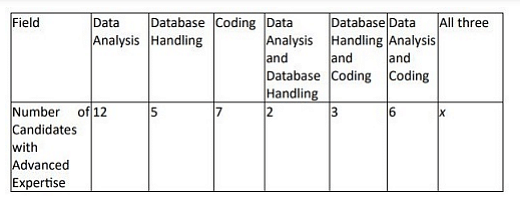
The number of applicants with advanced expertise in all three fields is given as x in the table, where x is a non-negative integer.
- XAT - 2024
- Data Interpretation