Question:medium
114. Five persons, A, B, C, D and E, are either guards or thieves. The guards always tell the truth, whereas thieves always lie. A claims that B is a guard. B claims that C is a thief. C claims that D is a thief. E claims that A is a guard. D claims that B and E are different kinds. The number of thieves is:
114. Five persons, A, B, C, D and E, are either guards or thieves. The guards always tell the truth, whereas thieves always lie. A claims that B is a guard. B claims that C is a thief. C claims that D is a thief. E claims that A is a guard. D claims that B and E are different kinds. The number of thieves is:
Show Hint
Start by assuming A is a guard, follow the chain of claims through B, C, D and E, and see if it loops back consistently; if it contradicts, flip A to a thief and try again.
Updated On: Jul 13, 2026
- 1
- 2
- 3
- 4
Show Solution
The Correct Option is D
Solution and Explanation
A neat way to crack this without guessing randomly is to notice the claims form a chain: A talks about B, B talks about C, C talks about D, D talks about B and E, and E talks about A. Following the chain from A in both of its possible states settles everyone at once.
- If A is a guard: A's word is true, so B is a guard too. A truthful B then makes C a thief. A lying C then makes D's guilt claim false, so D is a guard. A truthful D then says B and E differ, and since B is a guard, E must be a thief. But a lying E means E's claim "A is a guard" is false, so A would have to be a thief, which contradicts where this branch started. This branch collapses.
- So A is a thief. A's claim is false, so B is not a guard, meaning B is a thief. B's claim is then false, so C is not a thief, meaning C is a guard. C's claim is true, so D is a thief. D's claim is then false, so B and E are the same kind; since B is a thief, E is a thief too. Finally, E's claim is false, so A is not a guard, which agrees with A being a thief. No contradiction appears anywhere in this branch.
This second branch is the only one that survives, giving A = thief, B = thief, C = guard, D = thief, E = thief. That is four thieves and just one guard, C.
Let's summarize:
- Testing "A is a guard" leads to E's statement forcing A to be a thief, a direct contradiction.
- Testing "A is a thief" carries cleanly through all five claims without any contradiction.
- Only C ends up a guard; A, B, D and E are all thieves, so the count of thieves is 4.
So the number of thieves among the five people is 4.
Was this answer helpful?
0
Top Questions on Reasoning
- Narmada Bachao Andolan : Medha Patkar :: Bhudan Andolan : ?
- SNAP - 2024
- Logical Reasoning
- Reasoning
- Earthquake happened in the ocean. Due to the earthquake, Tsunami waves occurred. Due to the Tsunami there were 192 deaths and loss of 7 million USD of property. Identify the effects.}
- SNAP - 2024
- Logical Reasoning
- Reasoning
- If it is possible to make a meaningful word with the second, the fifth and the eighth letters of the word ‘CARETAKER’, which of the following will be the first letter of that word? If no such word can be made, give X as answer. If more than one such word can be made, give M as the answer.
- SNAP - 2024
- Logical Reasoning
- Reasoning
- If a room is painted with a dark colour, what will be the appearance of the room?
- JEE Main - 2025
- Aptitude
- Reasoning
- Want to practice more? Try solving extra ecology questions todayView All Questions
Questions Asked in XAT exam
Applicants have been shortlisted for interviews for some data analyst positions. Some of the applicants have advanced expertise in one or more fields among the following: data analysis, database handling and coding. The numbers of applicants with different advanced expertise are given in the 2 × 8 table below.
The number of applicants with advanced expertise in all three fields is given as x in the table, where x is a non-negative integer.
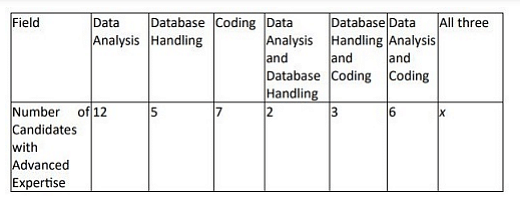
The number of applicants with advanced expertise in all three fields is given as x in the table, where x is a non-negative integer.
- XAT - 2024
- Data Interpretation