Question:medium
Two particles and of equal masses are suspended from two massless springs of spring constants and respectively. If the maximum velocities, during oscillations, are equal, the ratio of amplitudes of and is:
Two particles and of equal masses are suspended from two massless springs of spring constants and respectively. If the maximum velocities, during oscillations, are equal, the ratio of amplitudes of and is:
Updated On: Apr 19, 2026
- (A)
- (B)
- (C)
- (D)
Show Solution
The Correct Option is C
Solution and Explanation
To find the ratio of amplitudes of particles \(A\) and \(B\), given that their maximum velocities during oscillations are equal, let's start by analyzing the physics of the situation. Both masses have simple harmonic motion properties with spring constants \(k_1\) and \(k_2\).
- The formula for the maximum velocity \(V_{\text{max}}\) in simple harmonic motion is given by: \(V_{\text{max}} = A \cdot \omega\) where \(A\) is the amplitude and \(\omega\) is the angular frequency.
- Angular frequency \(\omega\) is given by: \(\omega = \sqrt{\frac{k}{m}}\), where \(k\) is the spring constant, and \(m\) is the mass.
- For particle \(A\): \(V_{A\text{, max}} = A_1 \cdot \sqrt{\frac{k_1}{m}}\)
- For particle \(B\): \(V_{B\text{, max}} = A_2 \cdot \sqrt{\frac{k_2}{m}}\)
- Since the maximum velocities are equal: \(A_1 \cdot \sqrt{\frac{k_1}{m}} = A_2 \cdot \sqrt{\frac{k_2}{m}}\)
- Simplifying this equality, we get: \(\frac{A_1}{A_2} = \sqrt{\frac{k_2}{k_1}}\)
This leads to the ratio of amplitudes of particles \(A\) and \(B\) being: \(\sqrt{\frac{k_2}{k_1}}\).
Thus, the correct answer is option (C).
Was this answer helpful?
0
Top Questions on Amperes circuital law
- A coil has a resistance of \( 30 \, \Omega \) and an inductive reactance of \( 20 \, \Omega \) at 50 Hz frequency. If an AC source of 200 V and 100 Hz is connected across the coil, then how much current will flow through the coil?
- MHT CET - 2024
- Physics
- Amperes circuital law
- In a series LCR circuit connected to an AC source, at resonance, the current is maximum because:
- MHT CET - 2024
- Physics
- Amperes circuital law
Consider the circuit shown :
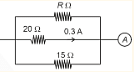 The ammeter reads 0.9 A. Value of R is
- JEE Main - 2024
- Physics
- Amperes circuital law
- A transistor is used in an amplifier circuit in common emitter mode. If the base current changes by 100μA, it brings a change of 10mA in collector current. If the load resistance is 2kΩ and input resistance is 1kΩ, the value of power gain is \(x×10^4\). The value of x is _______.
- JEE Main - 2022
- Physics
- Amperes circuital law
- Want to practice more? Try solving extra ecology questions todayView All Questions
