Question:medium
A coil has a resistance of \( 30 \, \Omega \) and an inductive reactance of \( 20 \, \Omega \) at 50 Hz frequency. If an AC source of 200 V and 100 Hz is connected across the coil, then how much current will flow through the coil?
A coil has a resistance of \( 30 \, \Omega \) and an inductive reactance of \( 20 \, \Omega \) at 50 Hz frequency. If an AC source of 200 V and 100 Hz is connected across the coil, then how much current will flow through the coil?
Show Hint
For AC circuits with resistance and reactance, use the formula \( Z = \sqrt{R^2 + X_L^2} \) to calculate impedance. Then apply Ohm's Law, \( I = \frac{V}{Z} \), to find the current.
Updated On: Jan 13, 2026
- \( 3 \, \mathrm{A} \)
- \( 4 \, \mathrm{A} \)
- \( 5 \, \mathrm{A} \)
- \( 6 \, \mathrm{A} \)
Show Solution
The Correct Option is A
Solution and Explanation
Given the problem statement, the inductive reactance at \( 50 \, \mathrm{Hz} \) is \( X_L = 20 \, \Omega \). The formula for inductive reactance is \( X_L = 2\pi f L \). Substituting the known values, \( 2\pi \times 50 \times L = 20 \). Solving for inductance \( L \), we get \( L = \frac{20}{2\pi \times 50} = \frac{1}{5\pi} \, \mathrm{H} \). When the frequency is increased to \( 100 \, \mathrm{Hz} \), the new inductive reactance is calculated using \( X_L = 2\pi f L \). Substituting \( f = 100 \, \mathrm{Hz} \) and \( L = \frac{1}{5\pi} \, \mathrm{H} \), we find \( X_L = 2\pi \times 100 \times \frac{1}{5\pi} = 40 \, \Omega \). The circuit impedance \( Z \) is determined by the formula \( Z = \sqrt{R^2 + X_L^2} \). With \( R = 30 \, \Omega \) and \( X_L = 40 \, \Omega \), the impedance is \( Z = \sqrt{30^2 + 40^2} = \sqrt{900 + 1600} = \sqrt{2500} = 50 \, \Omega \). Ohm's Law, \( I = \frac{V}{Z} \), is used to find the current. Substituting \( V = 200 \, \mathrm{V} \) and \( Z = 50 \, \Omega \), the current is \( I = \frac{200}{50} = 4 \, \mathrm{A} \). Therefore, the current flowing through the coil is \( I = 4 \, \mathrm{A} \).
Was this answer helpful?
0
Top Questions on Amperes circuital law
- In a series LCR circuit connected to an AC source, at resonance, the current is maximum because:
- MHT CET - 2024
- Physics
- Amperes circuital law
Consider the circuit shown :
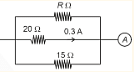 The ammeter reads 0.9 A. Value of R is
- JEE Main - 2024
- Physics
- Amperes circuital law
- A transistor is used in an amplifier circuit in common emitter mode. If the base current changes by 100μA, it brings a change of 10mA in collector current. If the load resistance is 2kΩ and input resistance is 1kΩ, the value of power gain is \(x×10^4\). The value of x is _______.
- JEE Main - 2022
- Physics
- Amperes circuital law
- A long straight wire with a circular cross-section having radius R, is carrying a steady current I. The current I is uniformly distributed across this cross-section. Then the variation of magnetic field due to current I with distance r (r < R) from its centre
- JEE Main - 2022
- Physics
- Amperes circuital law
- Want to practice more? Try solving extra ecology questions todayView All Questions