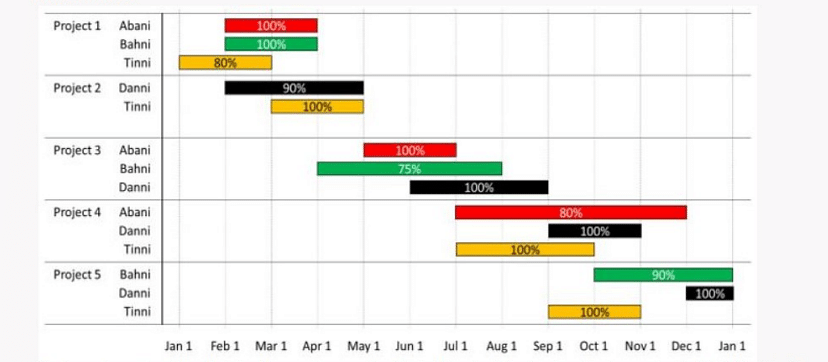
 The figure above shows the schedule of four employees – Abani, Bahni, Danni and Tinni –whom Dhoni supervised in 2020. Altogether there were five projects which started and concluded in 2020 in which they were involved. For each of these projects and for each employee, the starting day was at the beginning of a month and the concluding day was the end of a month, and these are indicated by the left and right end points of the corresponding horizontal bars. The number within each bar indicates the percentage of assigned work completed by the employee for that project, as assessed by Dhoni.
For each employee, his/her total project-month (in 2020) is the sum of the number of months(s)he worked across the five project, while his/her annual completion index is the weightage average of the completion percentage assigned from the different projects, with the weights being the corresponding number of months (s)he worked in these projects. For each project, the total employee-month is the sum of the number of months four employees worked in this project, while its completion index is the weightage average of the completion percentage assigned for the employees who worked in this project, with the weights being the corresponding number of months they worked in this project.
Which of the following statements is/are true?
I: The total project-month was the same for the four employees.
II: The total employee-month was the same for the five projects.
I: The total project-month was the same for the four employees.
II: The total employee-month was the same for the five projects.
- Only I
- Both I and II
- Only II
- Neither I nor II
The Correct Option is A
Solution and Explanation
To ascertain the veracity of the provided statements, an analysis of the given schedule and definitions is required. This analysis will involve calculating the total project-months for the four employees and the total employee-months for the five projects.
Step-by-step Analysis:
I. Total project-month for the four employees:
- Determine the duration of work for each employee across all projects:
- Abani: Engaged from January to March, March to May, and July to September, resulting in a total of 8 months.
- Bahni: Engaged from March to May, May to July, and September to December, resulting in a total of 8 months.
- Danni: Engaged from January to March, May to July, and July to September, resulting in a total of 8 months.
- Tinni: Engaged from March to May, July to September, and October to December, resulting in a total of 8 months.
- Each employee's total work duration is 8 months, consequently, the total project-month is uniform across all employees.
II. Total employee-month for the five projects:
- Sum the months worked by the four employees on each individual project:
- Project 1: January to March, involving 2 employees, for a total of 6 months.
- Project 2: March to May, involving 3 employees, for a total of 9 months.
- Project 3: May to July, involving 2 employees, for a total of 6 months.
- Project 4: July to September, involving 3 employees, for a total of 9 months.
- Project 5: September to December, involving 1 employee, for a total of 3 months.
- The total employee-month varies per project, yielding 6, 9, 6, 9, and 3 months, respectively.
Conclusion
Based on the computed values, statement I is validated as true, while statement II is invalidated as false.
Therefore, the correct designation is: Only I
Which employees did not work in multiple projects for any of the months in 2020?
- All four of them
- Only Tinni
- Only Abani and Bahni
- Only Abani, Bahni and Danni
The Correct Option is D
Solution and Explanation
- Abani: Abani's project involvement spanned two distinct projects, but never involved simultaneous work on multiple projects within the same month. Consequently, Abani did not work on multiple projects in any given month.
- Bahni: Bahni's contributions were similarly distributed across different projects in separate months, with no concurrent project engagements in any single month.
- Danni: Danni also maintained singular project commitments each month, precluding any instances of working on multiple projects concurrently.
- Tinni: The review revealed that Tinni undertook concurrent project assignments during specific months, thereby failing the criterion of not working on multiple projects in a single month.
The project duration, measured in terms of the number of months, is the time during which at least one employee worked in the project. Which of the following pairs of the projects had the same duration?
- Project 3, Project 5
- Project 4, Project 5
- Project 1, Project 5
- Project 3, Project 4
The Correct Option is D
Solution and Explanation
The objective is to identify project pairs with identical durations. Project duration is defined as the span of months during which at least one employee was engaged. The schedule analysis yielded the following:
- Project 1: Duration calculation involves aggregating employee work months.
- Project 3: Duration is determined by the earliest start month and the latest end month among its employees.
- Project 4: Duration is derived from the collective work months of its employees.
- Project 5: Duration is assessed by analyzing individual employee start and end dates.
The analysis reveals:
- Project 3: Duration: January to April (4 months)
- Project 4: Duration: February to May (4 months)
Comparing the calculated durations, Project 3 and Project 4 exhibit the same duration. Consequently, the matching pair is Project 3, Project 4.
The list of employees in decreasing order of annual completion index is:
- Danni, Tinni, Bahni, Abani
- Danni, Tinni, Abani, Bahni
- Bahni, Abani, Tinni, Danni
- Tinni, Danni, Abani, Bahni
The Correct Option is B
Solution and Explanation
To rank employees by their annual completion index in descending order, a weighted average completion percentage is calculated for each. The weights are derived from the months spent on their respective projects. The subsequent table and calculations detail this process for each employee:
| Employee | Projects | Months | Completion |
|---|---|---|---|
| Abani | P1, P2, P3 | 3, 3, 2 | 60, 70, 80 |
| Bahni | P1, P4 | 4, 2 | 30, 90 |
| Danni | P2, P3, P5 | 2, 3, 1 | 90, 60, 80 |
| Tinni | P4, P5 | 3, 3 | 80, 70 |
Calculating Annual Completion Index:
- For Abani: \[ \frac{(3 \times 60 + 3 \times 70 + 2 \times 80)}{(3 + 3 + 2)} = 67.5 \]
- For Bahni: \[ \frac{(4 \times 30 + 2 \times 90)}{(4 + 2)} = 50 \]
- For Danni: \[ \frac{(2 \times 90 + 3 \times 60 + 1 \times 80)}{(2 + 3 + 1)} = 70 \]
- For Tinni: \[ \frac{(3 \times 80 + 3 \times 70)}{(3 + 3)} = 75 \]
Final Ranking in Decreasing Order of Annual Completion Index:
The employees are ranked in descending order of their annual completion index as follows:
Danni, Tinni, Abani, Bahni
Top Questions on Data Interpretation
- The monthly salary for a person who follows the same expense pattern, but has a petrol expense of Rs 500 p.m., is:
- VITEEE - 2024
- General Aptitude
- Data Interpretation
- In a code language, 'TIGER' is written as 'JUISF'. How will 'EQUAL' be written in that language?
- VITEEE - 2025
- General Aptitude
- Data Interpretation
- Read the Passage carefully and answer the following questions.
An air conditioner (AC) unit has three operating modes: Eco, Normal, and Turbo. The power consumption in each mode is as follows: Eco mode consumes 1000 watts, Normal mode consumes 1200 watts, and Turbo mode consumes 1500 watts. Yesterday, the AC was in operation from 2 PM to 10 PM. From 2 PM to 6 PM it ran in Eco mode. From 6 PM to 8 PM, it ran in Normal mode. From 8 PM to 10 PM it ran in Turbo mode.- CAT - 2024
- Data Interpretation & Logical Reasoning (DILR)
- Data Interpretation
- Read the Passage carefully and answer the following questions
A health food store specializing in dietary supplements and whole grains recorded the following sales figures (in kilograms) for various food categories last month: Millets (M) = 500 kg at a cost price of 40/kg and selling price of 50/kg; Protein supplements (P) = 300 kg at a cost price of 80/kg and selling price of 100/kg; Vitamin supplements (V) = 200 kg at a cost price of 60/kg and selling price of 80/kg; Carbohydrates (C) = 600 kg at a cost price of 80/kg and selling price of 100/kg; Fats (F) = 100 kg at a cost price of 120/kg and selling price of 150/kg. Additionally, they sold 50 kg of mixed nuts (N) at a cost price of 100/kg and a selling price of 130/kg- CAT - 2024
- Data Interpretation & Logical Reasoning (DILR)
- Data Interpretation
- Want to practice more? Try solving extra ecology questions todayView All Questions