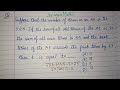
Suppose that the number of terms in an A.P. is \( 2k, k \in \mathbb{N} \). If the sum of all odd terms of the A.P. is 40, the sum of all even terms is 55, and the last term of the A.P. exceeds the first term by 27, then \( k \) is equal to:
Show Hint
- \( 8 \)
- \( 6 \)
\( 4 \)
\( 5 \)
The Correct Option is D
Solution and Explanation
Let the first term of the A.P. be \( a \) and the common difference be \( d \). The A.P. contains \( 2k \) terms. The final term of the A.P. is \( a + (2k-1)d \). Given that this final term exceeds the first term by 27, we establish the equation:
\( a + (2k-1)d = a + 27 \)
This equation simplifies to:
\( (2k-1)d = 27 \)
The sum of the odd-indexed terms (\( a, a+2d, a+4d, \ldots \)) comprises \( k \) terms. Using the A.P. sum formula, the sum of these odd terms, denoted as \( S_{\text{odd}} \), is given as 40:
\( S_{\text{odd}} = \frac{k}{2} \times [2a + (k-1)2d] = 40 \)
This can be expressed as:
\( k(a + (k-1)d) = 40 \)
Similarly, the sum of the even-indexed terms (\( a+d, a+3d, a+5d, \ldots \)) also has \( k \) terms. The sum of these even terms, \( S_{\text{even}} \), is given as 55:
\( S_{\text{even}} = \frac{k}{2} \times [2(a+d) + (k-1)2d] = 55 \)
This simplifies to:
\( k(a + kd) = 55 \)
We now have the following system of equations:
- \( (2k-1)d = 27 \)
- \( k(a + (k-1)d) = 40 \)
- \( k(a + kd) = 55 \)
From the first equation, we isolate \( d \):
\( d = \frac{27}{2k-1} \)
Substitute \( d \) into the second equation:
\( k(a + (k-1)\frac{27}{2k-1}) = 40 \)
Substitute \( d \) into the third equation:
\( k(a + k\frac{27}{2k-1}) = 55 \)
Subtract the second equation from the third equation:
\( k(k\frac{27}{2k-1} - (k-1)\frac{27}{2k-1}) = 15 \)
This simplifies to:
\( k(\frac{27}{2k-1}) = 15 \)
To solve for \( k \), we rearrange:
\( k = \frac{15(2k-1)}{27} \)
Simplifying further:
\( 15(2k-1) = 27k \)
This equation resolves to:
\( 30k - 15 = 27k \)
Rearranging yields:
\( 3k = 15 \)
Therefore:
\( k = 5 \)
The value of \( k \) that satisfies all given conditions is 5.
Learn with videos:
Top Questions on Arithmetic Progression
- The sum of the first 20 terms of the arithmetic progression 7, 10, 13, ... is:
- BITSAT - 2025
- Mathematics
- Arithmetic Progression
- If the sum of the first $ n $ terms of an arithmetic progression is given by $ S_n = 3n^2 + 5n $, find the first term $ a $ and common difference $ d $.
- BITSAT - 2025
- Mathematics
- Arithmetic Progression
- The 5th term of an AP is 20 and the 12th term is 41. Find the first term.
- BITSAT - 2025
- Mathematics
- Arithmetic Progression
- The sum of the first 30 terms of an arithmetic progression is 930. If the first term is 2, what is the common difference of the progression?
- BITSAT - 2025
- Mathematics
- Arithmetic Progression
- Want to practice more? Try solving extra ecology questions todayView All Questions
