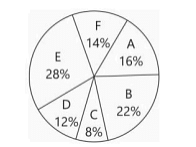
Study the pie chart and table and answer the questionsStore Respective ratio of number of linen kurtis to cotton kurtis sold A 7:5 B 5:6 C 3:2 D 5:3 E 4:3 F 7:3
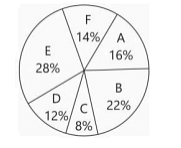
Number of kurtis (linen and cotton) sold by store D is what percent more than the number of linen kurtis sold by store B?
| Store | Respective ratio of number of linen kurtis to cotton kurtis sold |
| A | 7:5 |
| B | 5:6 |
| C | 3:2 |
| D | 5:3 |
| E | 4:3 |
| F | 7:3 |
Number of kurtis (linen and cotton) sold by store D is what percent more than the number of linen kurtis sold by store B?
- 16%
- 20%
- 24%
- 18%
The Correct Option is B
Solution and Explanation
The goal is to determine the percentage increase in kurtis sold by store D relative to linen kurtis sold by store B.
Step 1: Calculate kurtis sold by store D
Store D sold 12% of 84,000 total kurtis.
\( \text{Total kurtis sold by store D} = 84,000 \times \frac{12}{100} = 10,080 \)\
Step 2: Calculate linen kurtis sold by store B
Store B sold 22% of the total kurtis. The ratio of linen to cotton kurtis for store B is 5 : 6.
\( \text{Total kurtis sold by store B} = 84,000 \times \frac{22}{100} = 18,480 \)\
Calculate linen kurtis sold by store B:
\( \text{Linen kurtis sold by store B} = \frac{5}{11} \times 18,480 = 8,400 \)\
Step 3: Calculate percentage increase
The percentage increase formula is:
\( \text{Percentage increase} = \frac{\text{Difference}}{\text{Original value}} \times 100. \)\
The difference is:
\( \text{Difference} = 10,080 - 8,400 = 1,680. \)\
Calculate percentage increase:
\( \text{Percentage increase} = \frac{1,680}{8,400} \times 100 = 20\%. \)\
Therefore, kurtis sold by store D is 20% more than linen kurtis sold by store B.
Top Questions on Pie Charts
The pie-diagram below shows the percentage of expenditures of Paul and Balu per month.

- IBSAT
- Data Interpretation
- Pie Charts
- In a company, there are 1200 employees working in six different departments. The table below gives the ratio of men and woman in each department and the pie chart describes the percentage distribution of employees in each department.

- IBSAT
- Data Interpretation
- Pie Charts
- Refer the graphs given below and answer the following question. Total population is 724 million and total income is Rs.54300 crore

- IBSAT
- Data Interpretation
- Pie Charts
- Answer the questions based on following graph.

- IBSAT
- Data Interpretation
- Pie Charts
- Want to practice more? Try solving extra ecology questions todayView All Questions
Questions Asked in CMAT exam
| Store | Respective ratio of number of linen kurtis to cotton kurtis sold |
| A | 7:5 |
| B | 5:6 |
| C | 3:2 |
| D | 5:3 |
| E | 4:3 |
| F | 7:3 |
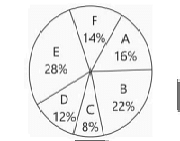
What is the difference between average number of linen kurtis sold by stores D and E together and average number of cotton kurtis sold by the same stores together?
- CMAT - 2024
- Pie Charts