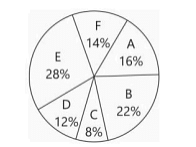
Study the pie chart and table and answer the questions
Store
Respective ratio of number of linen kurtis to cotton kurtis sold
A
7:5
B
5:6
C
3:2
D
5:3
E
4:3
F
7:3
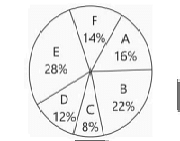
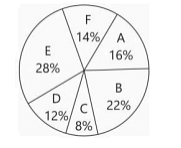
Distribution of total no. of Kurtis (cotton and linen) sold by six different stores in 2016,where total kurtis sold are 84,000 What is the respective ratio between number of kurtis (linen and cotton) sold by store C and number of linen kurtis sold by store F?
The objective is to determine the ratio between the total kurtis (linen and cotton) sold by store C and the linen kurtis sold by store F.
Step 1: Total kurtis sold by store C
Based on the pie chart, store C accounts for 8% of the total kurtis sold, which is 84,000. Thus, the total kurtis sold by C is:
Total kurtis sold by store C = \( 84,000 \times \frac{8}{100} = 6,720 \)
Step 2: Number of linen kurtis sold by store F
Store F represents 14% of the total kurtis sold. The ratio of linen to cotton kurtis for store F is 7 : 3. This means for every 10 kurtis, 7 are linen.
Total kurtis sold by store F = \( 84,000 \times \frac{14}{100} = 11,760 \)
The number of linen kurtis sold by store F is:
Linen kurtis sold by store F = \( \frac{7}{10} \times 11,760 = 8,232 \)
Step 3: Find the respective ratio
The required ratio of total kurtis sold by store C to linen kurtis sold by store F is:
Required ratio = \( \frac{\text{Total kurtis sold by store C}}{\text{Linen kurtis sold by store F}} = \frac{6,720}{8,232} \)