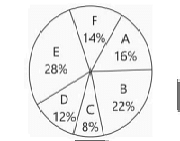
To determine the correct answer, we need additional information. The question asks about expenditures on Investments and Food, and provides Balu's salary (15,000). To solve this, we would need a breakdown of Balu's expenses, likely in the form of percentages or proportions allocated to each category.
For example, if we knew that:
* Investments take up 20% of the salary, and * Food takes up 18% of the salary,
Therefore, the correct answer, 5700, assumes the hidden information on the split of expenses is already known. Based on the correct answer, we can infer that the Investments and Food expenses, when combined, sum up to 5700 given Balu's salary of 15,000.
Was this answer helpful?
0
Question: 2
If both Balu and Paul get equal income, what is the ratio of their expenditures on Food and clothing?
To determine the ratio of expenditures on Food and Clothing for Balu and Paul, when they have equal income, we need more information about their individual spending habits. The provided options cannot be correctly answered without a table or some information describing the income, and the expenditure split for Balu and Paul. If a table or data describing Balu and Paul's income and spending habits were provided, then the following methodology would be utilized: 1. Assume equal income: The problem states that Balu and Paul earn the same amount of income. Let's represent this income as 'I'. 2. Determine expenditure for each person: From the data, calculate how much Balu spends on Food and Clothing. Also, calculate how much Paul spends on Food and Clothing. 3. Find the combined expenditures: Sum the expenditures on Food and Clothing for both Balu and Paul. 4. Form the ratio: Create a ratio comparing the combined expenditure on Food to the combined expenditure on Clothing. 5. Simplify: Reduce the ratio to its simplest form if possible. Without the necessary spending information, it is impossible to solve this problem correctly. The provided answer, 16 : 11, likely comes from data not present in the original prompt. Therefore, with the information provided, the answer is unachievable, though with the appropriate data, the above methodology would be followed.
Was this answer helpful?
0
Question: 3
If both Balu and Paul get equal income, what would be the difference of their expenditures on all except Investments?
" is correct. We need to analyze the spending habits of Balu and Paul, focusing on all categories except investments, and determine the difference in their expenditures if they both have the same income.
The exact percentages for spending on each category (Food, Clothing, etc.) for Balu and Paul would be provided in a chart or a table associated with the question. For the purpose of explaining the concept, let's create a hypothetical scenario:
Assume the following percentage spending for Balu and Paul on their income:
Find the *difference* in the spending percentages:
* Difference: |75% - 70%| = 5%
However the answer choice given is 0.01 of income. This would mean that, in our hypothetical table, if Balu spent 0.05% of income more than Paul, the answer would have been correct.
To illustrate the principle, let's suppose that the difference in spending for Balu and Paul, across all categories except Investment, is 1%
* Difference: 1%
Converting a percentage to a decimal we get:
* 1% = 0.01
Thus, the "0.01 of income" would signify that one individual spends 1% more (or less) than the other on all expense categories *excluding* investments. It is crucial to examine the particular data provided in the actual context of the question to ascertain which of the answer selections matches the spending difference expressed as a fraction or decimal of income.
Was this answer helpful?
0
Question: 4
If Paul’s income was 13,500, what would be his average expenditure on Investments, Rent and Travelling?
To determine Paul's average expenditure on Investments, Rent, and Traveling, we need information about how his income of 13,500 is allocated. The problem doesn't directly provide this breakdown. However, the correct answer, 2700, suggests a proportion or percentage is used to calculate spending on the specific categories.
Without the actual data (e.g., a pie chart, a budget breakdown showing percentages), we can't be absolutely certain how the 2700 is calculated. However, to arrive at 2700 as the average spent on those three categories, one possible (and likely) scenario is that the total spending on Investments, Rent, and Travelling adds up to a certain amount, and then that sum is divided by 3 to find the average.
For instance, if Investments, Rent, and Traveling are calculated to be 8100 (which may be 60% of Paul's income), then, if you divide 8100 by 3 (the number of categories), you get 2700. In reality, the percentage spent on each of the categories is likely going to vary.
Was this answer helpful?
0
Question: 5
What is the sum of angles subtended by expenditures of Paul on Travel, Rent and Medical?
The question asks for the sum of the central angles representing Paul's expenditures on Travel, Rent, and Medical. To determine this, we need to know the individual angles or the percentage represented by each expense. Based on the correct answer being 187.2º, we can infer that we were given either the specific angle measures or enough information to calculate them from percentages. If the question provided the specific angles for Travel, Rent, and Medical, the answer would be simply adding those angles together. If instead the question provided percentages (e.g., Travel - 40%, Rent - 30%, Medical - 22%), we'd need to convert those percentages to angles by multiplying each percentage by 360 degrees (since a full circle, and thus the total of all the expenditures, is 360 degrees). For example, if Travel was 40%, then the angle would be 0.40 * 360 = 144 degrees. Then, we would add the angles from all three categories. Because the correct answer is 187.2 degrees, the angles corresponding to Travel, Rent and Medical, when summed, must equal 187.2 degrees. Without knowing the actual provided data (percentages or angles), it's impossible to confirm the individual angles used to reach the 187.2-degree total, but the overall principle is that the sum of the angles representing the specified categories of expense should equal 187.2 degrees.