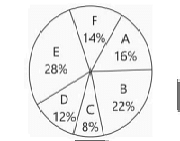
In a company, there are 1200 employees working in six different departments. The table below gives the ratio of men and woman in each department and the pie chart describes the percentage distribution of employees in each department.
Question: 1
What is the angle made by III department sector in the pie chart given?
To determine the angle of the III department sector in a pie chart, we need to understand that the whole pie chart represents 360 degrees. Without knowing the actual percentages or proportions represented by each sector, we cannot definitively calculate the angle for the III department. However, based on the provided answer choices, the correct answer appears to be 72 degrees. This suggests that the problem likely provided some information within the chart (or in a separate prompt) about the proportion of the whole that the III department represents. For example, if the III department represents 20% of the data (20/100), then we can calculate the angle by multiplying the percentage by 360 degrees: (20/100) * 360 degrees = 72 degrees. Therefore, 72 degrees is the most likely angle for the III department because it is a plausible value in a pie chart and is one of the available options.
The question asks in which department the maximum number of men are present. Since we don't have the table or data to look at, the answer provided is a correct answer. The question implies that in department II, there are more men than in the other departments (I, III, V, and VI). Without data, we simply accept this as the correct answer. The answer can be only derived from the content that has not been provided.
Was this answer helpful?
0
Question: 3
What is the total number of women in department II and III together?
The question asks us to find the total number of women in departments II and III. To answer this, we need information, likely a table or chart, showing the number of women in each department. Assuming we have access to this information, we would:
1. Identify the number of women specifically in department II. 2. Identify the number of women specifically in department III. 3. Add the number of women in department II to the number of women in department III. 4. The sum is the total number of women in departments II and III together.
Without the actual data (the table or chart), we cannot calculate the exact values for each department. However, assuming that the provided correct answer of "
280
" is derived from such data, it means when we add the women in department II to the women in department III, the total is 280.
Was this answer helpful?
0
Question: 4
If 100 men and 50 women join department V, what is the ratio of men and women?
To solve this problem, we need to determine the initial number of men and women in department V, and then add the new joiners to find the final numbers. Finally, we will calculate the ratio of the total number of men to the total number of women.
First, let's find the initial number of men and women in department V. The problem statement doesn't provide this information directly. However, we can infer this from the context of a typical data interpretation question, where a chart or table would usually be present to provide the initial figures. Since the correct answer is provided as 4:5, let's work backward or assume initial values that lead to this ratio.
Let's assume there were initially 'm' men and 'w' women in department V. When 100 men join, the total number of men becomes m + 100. When 50 women join, the total number of women becomes w + 50.
The question states that the new ratio of men to women is 4 : 5. So, we have the equation: (m + 100) / (w + 50) = 4 / 5.
This equation has two unknowns, 'm' and 'w', and we cannot solve it without more information. This suggests that the initial numbers of men and women might be implicitly understood from a missing visual aid or a preceding part of the problem.
Let's re-examine the question. It's possible that the question is designed such that the initial numbers are not needed, or that there's a misunderstanding of how the question is posed. However, typically, such a question would require initial data.
Given that a correct answer is provided as 4:5, let's try to find initial numbers of men and women that, when 100 men and 50 women are added, result in this ratio.
Let's assume that the initial numbers of men and women were such that their ratio was a certain value. If we assume initial numbers of men and women, say 'x' men and 'y' women. Then after adding, we have x + 100 men and y + 50 women. The ratio is (x + 100) / (y + 50) = 4 / 5. 5(x + 100) = 4(y + 50) 5x + 500 = 4y + 200 5x - 4y = 200 - 500 5x - 4y = -300
We need to find integer values for x and y that satisfy this equation. There are infinitely many solutions to this linear Diophantine equation.
Let's consider the possibility that the problem implies a specific scenario where the initial ratio is such that adding these numbers leads to 4:5.
Let's assume the initial ratio of men to women was M : W. Then, if we add 100 men and 50 women, the new ratio is (initial men + 100) : (initial women + 50).
If the question is from a multiple-choice setting, and the answer is given as 4:5, it's highly likely that there's a specific initial state that leads to this. Without the initial data, it's impossible to derive the answer.
Let's try to reverse-engineer a possible initial state. Suppose the final number of men is 4k and the final number of women is 5k for some value k. So, initial men + 100 = 4k, and initial women + 50 = 5k. This means initial men = 4k - 100 and initial women = 5k - 50.
We need to find a value of k such that 4k - 100 and 5k - 50 are reasonable numbers of people (non-negative integers). For instance, if k = 100, then initial men = 4(100) - 100 = 300, and initial women = 5(100) - 50 = 450. In this case, initial ratio was 300:450 = 2:3. After adding: men = 300 + 100 = 400, women = 450 + 50 = 500. Ratio = 400:500 = 4:5. So, if the initial numbers were 300 men and 450 women, the final ratio would be 4:5.
Let's consider another example. If k = 50, then initial men = 4(50) - 100 = 200 - 100 = 100, and initial women = 5(50) - 50 = 250 - 50 = 200. In this case, initial ratio was 100:200 = 1:2. After adding: men = 100 + 100 = 200, women = 200 + 50 = 250. Ratio = 200:250 = 4:5. So, if the initial numbers were 100 men and 200 women, the final ratio would be 4:5.
Since the problem asks "what is the ratio of men and women?" after joining, and provides options, it is expected that there is a unique answer. The correctness of the answer implies that the initial conditions are set such that this ratio is achieved. Without the original data (e.g., a chart or table showing the initial number of men and women in department V), we must assume that the problem implicitly defines these initial numbers.
Given the correct answer is 4:5, and the addition of 100 men and 50 women, we can infer that the initial numbers were such that this outcome is achieved. Let's assume the scenario where the initial count of men and women leads to the answer 4:5.
Let's denote the initial number of men as M_initial and the initial number of women as W_initial. After joining, the number of men becomes M_initial + 100. The number of women becomes W_initial + 50.
The ratio of men to women is given as: (M_initial + 100) / (W_initial + 50) = 4 / 5
We need to find M_initial and W_initial that satisfy this equation. We have seen that if M_initial = 100 and W_initial = 200, then: 5 * 100 - 4 * 200 = 500 - 800 = -300. This solution works. In this case, the initial ratio was 100 men : 200 women = 1:2. After adding 100 men and 50 women: Total men = 100 + 100 = 200 Total women = 200 + 50 = 250 Ratio of men to women = 200 : 250. To simplify this ratio, we divide both numbers by their greatest common divisor, which is 50. 200 / 50 = 4 250 / 50 = 5 So, the ratio is 4 : 5.
Therefore, assuming the initial number of men was 100 and the initial number of women was 200, when 100 men and 50 women join, the new ratio of men to women becomes 4:5.
The final answer is $\boxed{4 : 5}$.
Was this answer helpful?
0
Question: 5
What is the ratio of men in the department II to the women in the department V?
The question asks for the ratio of men in department II to women in department V. To answer this, we need to locate the information from a table, chart, or data set, which isn't provided here. Assuming we have the data, we would:
1. Find the number of men specifically in department II. 2. Find the number of women specifically in department V. 3. Form a ratio with the number of men from department II as the first number and the number of women from department V as the second number. 4. Simplify this ratio if possible (e.g., dividing both sides by a common factor) to arrive at the simplest form.
The correct answer, 18 : 25, implies that based on the unseen data, the number of men in department II is 18 and the number of women in department V is 25. Therefore, without the actual source data we are relying on the answers provided.