ABC Business School was a school with a difference. Regarded as one of the top business schools in western India, but relatively unknown beyond that, the school catered to smaller organizations seeking to hire students for sales and marketing positions, with occasional openings in HR roles. These students were open to secure job opportunities, even if they offered relatively lower salaries. The organizations, that recruited from ABC, did not really care for the talent, but appreciated the students' ability to follow orders without questioning them. The school’s strength laid in its alumni, who consistently returned to the institution for recruitment, thereby ensuring the school’s continued existence. Given the placement record, the school attracted a specific segment of business school aspirants, who wanted a solid job but were not excited about learning.
Recently, some alumni of ABC threatened that their children should be given preference in admissions, or they would withdraw as recruiters. The director was, however, hesitant about allowing alumni to interfere in running the school because the fairness of the admissions process had earned ABC high respect within the corporate world that recruited from the school.
Which of the following reasons, if true, will BEST help the director NOT to worry about pandering to those alumni?
Which of the following reasons, if true, will BEST help the director NOT to worry about pandering to those alumni?
- The alumni were the reason that ABC was able to attract corporates.
- Some of the alumni were regularly teaching as guest faculty in the school.
- The alumni depend upon ABC’s success to enhance their employability.
- No business school, in the region, has allowed alumni any say in managing the operations.
- ABC has not entertained any requests from the alumni till date.
The Correct Option is C
Solution and Explanation
Step 1: Scenario Analysis.
Alumni threats underscore their significance to institutional operations. Nevertheless, the director must prioritize institutional independence and credibility.
Step 2: Option Evaluation.
- Option 1: Acknowledges alumni's role but fails to directly validate disregarding their demands.
- Option 2: Lacks relevance to the alumni's request for preferential admissions.
- Option 3: Suggests that the alumni's reliance on ABC's success fosters shared interests, thereby diminishing the credibility of their threats.
- Option 4: Demonstrates a regional pattern but lacks direct applicability to ABC's specific circumstances.
- Option 5: Previous determinations hold less weight when confronted with present difficulties.
Final Answer: (3)
Across the country, business schools were ranked by popular magazines. A few business schools in the same region were applying for rankings, hoping that rankings will affect their visibility among corporate houses and recruiters. To achieve a good rank, ABC faculty members, who have primarily focused on teaching thus far, would need to actively engage in research and consulting activities. The director was aware that asking the faculty to switch to research and consulting would not be easy.
Which of the following facts will BEST help the director not to worry about applying for rankings?
Which of the following facts will BEST help the director not to worry about applying for rankings?
- The alumni do not follow research publications in general.
- The alumni do not care for the teachers, or classes, in general.
- The alumni are aware that ABC offers a retainable talent pool.
- ABC’s placements in the previous year were completed in 4 days.
- ABC could never break into the top 40 ranks in the country when it applied earlier.
The Correct Option is C
Solution and Explanation
Step 1: Analyze the scenario.
The director's primary concerns are recruiter visibility and faculty involvement in research and consulting. Counterbalancing these, a robust talent pool and satisfied recruiters may lessen the immediate need for ranking improvements.
Step 2: Evaluate the options.
- Option 1: Reflects alumni disinterest in research, failing to address recruiter visibility.
- Option 2: Suggests alumni apathy towards faculty initiatives, with no connection to rankings.
- Option 3: Emphasizes recruiter satisfaction with the talent pool, diminishing the importance of rankings.
- Option 4: Demonstrates placement effectiveness but does not directly influence ranking decisions.
- Option 5: Indicates past unsuccessful ranking attempts, without addressing recruiter satisfaction.
Final Answer: (3)
A few faculty members complained to the director regarding the lack of attendance and seriousness among many students during classes and exams. The director knew that this had been the case for decades but became more rampant in the last few years. He was also aware that the classes were mostly rituals, conducted to tell the world that ABC believed in education and had little bearing on placements. However, he believed that students must be told to attend classes and take exams with serious attitude.
Which of the following announcements by the director will BEST ensure that faculty stop complaining about student attendance?
Which of the following announcements by the director will BEST ensure that faculty stop complaining about student attendance?
- Students, who attend every class, should be given “thank you” notes from the director.
- Students should be asked to pay a monetary penalty for missing classes.
- Faculty members, who make classes very engaging, should be felicitated during the convocation.
- Only students, with at least 85 percent class attendance, will participate in placements.
- Students should be rewarded for contributing to in-class discussions and learning.
The Correct Option is D
Solution and Explanation
Step 1: Scenario Analysis.
The core issue identified is insufficient student attendance and a lack of academic seriousness. A robust intervention linked to a critical outcome, such as placement, is expected to resolve this.
Step 2: Option Evaluation.
- Option 1: A simple "thank you" note offers minimal motivational impact.
- Option 2: Financial penalties may foster ill will and lack direct correlation with academic commitment.
- Option 3: Recognizing faculty can boost teaching efficacy but does not target student conduct.
- Option 4: Tying attendance to placement opportunities presents a direct and significant incentive for students to engage seriously with classes.
- Option 5: Recognition for class participation is advantageous but does not directly address attendance concerns.
Final Answer: (4)
Top Questions on Caselets
- Read the following scenario and answer the questions that follow.
Mr. Singh lived in a sprawling housing society. He employed two part-time domestic helps, Vimla and Sharda. Vimla was responsible for cleaning and dusting, while Sharda took care of cooking.
Once Sharda fell ill and consequently took leave for three days. When Sharda returned to work, she learned that Mr. Singh’s gold ring, a gift from his mother, was missing. Suspecting theft, Mr. Singh had terminated Vimla. Mr. Singh asked Sharda to take additional responsibility of cleaning the house, along with an offer to double her salary. Sharda accepted the offer as her previous two jobs were lost due to frequent health-related absences. She was struggling to make ends meet; this offer would go a long way to help her.
Next day, while cleaning under the dressing table, Sharda found the gold ring. Overjoyed, Mr. Singh expressed his gratitude by presenting Sharda a reward of one thousand rupees! However, he made no mention of reinstating Vimla.- XAT - 2024
- Decision Making
- Caselets
- Read the following scenario and answer the questions that follow.
In Symbolis, an upcoming medium sized IT services organization, only 1% of the employees were awarded an annual performance bonus. This annual performance bonus was decided by a committee formed of different functional heads. When Ms. Nalini Kattakayam received the annual bonus for the first time in her five years at Symbolis, Ms. Shalini Sampath, a colleague with seven years of tenure at Symbolis, told Nalini that this annual bonus was less a reflection of Nalini’s performance and more a recognition of those who have fostered a strong rapport with the powers that be. Incidentally, Shalini had never received any performance bonus in her tenure at the company.- XAT - 2024
- Decision Making
- Caselets
- Read the following scenario and answer the questions that follow.
Raman had been working tirelessly as a Project Manager in the IT department of Flying Groceries, a renowned app-based supply chain company, for the past three years. Having graduated from a top-tier engineering college, he dived straight into the corporate world, managing projects with great zeal that inspired his seniors.
At the end of his first year with Flying Groceries, impressed with his hard work, Raman’s boss, Suraj, the founder-CEO of Flying Groceries, fast-tracked his promotion and made him Delivery Manager responsible for multiple projects of a vertical. Suraj also promised Raman the position of Chief Operation Officer in the fifth year of his tenure.
In search of a greater career trajectory, Raman pursued entrance exams for business schools. His efforts bore fruits as he secured a place in the country’s best business school, known for a strong alumni base, stellar placement records and demanding academic requirements.
Raman was delighted; he had three months to join the business school. Flying Groceries demanded that any employee who wished to leave the organization should give at least a month’s notice. Raman decided to continue working and enriching his work experience, which will be beneficial when applying to companies after graduating from the business school. Therefore, he decided not to share the news of the offer with anyone else for the time being.- XAT - 2024
- Decision Making
- Caselets
- Read the following scenario and answer the questions that follow.
Kasta, a small industrial town hosted a steel plant and its associated ancillary companies. Most of its residents were steel plant employees from different states of the country. While the town offered employment opportunities, it lacked an airport. For those wanting to fly, the nearest airport was in Michaelganj, 100 kms from Kasta. To reach the airport, people rented taxi services available at Kasta, and Prabhu was one such taxi-service provider.
Prabhu’s rates were reasonable - a trip to airport cost Rs. 2200, but for a round trip, the fare was Rs. 3000. Yet, it was not just the affordability that made him popular, his reputation for punctuality and reliability was unmatched. When it came to ensuring the safety of women travelling alone, he would always be the first choice. Such was his trustworthiness that even the steel plant would solicit his services when expecting solo female visitors. Moreover, whenever residents encountered issues with their personal cars, they would turn to Prabhu for help.
However, the world shifted when the COVID-19 pandemic struck. Travel restrictions and safety concerns limited Prabhu’s trips to Michaelganj for over a year and a half. Financial strain followed, with accumulating interest on his home loan. He was weighed down by debt, but things improved once COVID-19 travel restrictions were lifted. Having faced financial hardships during COVID-19, he sought to offset his losses by raising the fare. Yet, he was aware of the stiff competition in town, where many others offered services at a similar fare as his.- XAT - 2024
- Decision Making
- Caselets
- Want to practice more? Try solving extra ecology questions todayView All Questions
Questions Asked in XAT exam
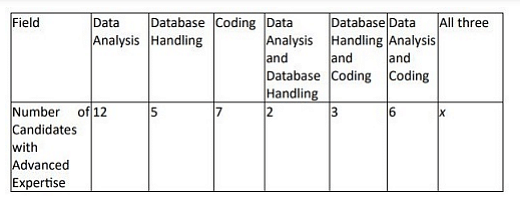
The number of applicants with advanced expertise in all three fields is given as x in the table, where x is a non-negative integer.
- XAT - 2024
- Data Interpretation